
Search AFCEA Site
Resource Library:
AFCEA's trusted Resource Library offers a wide range of white papers, e-books, case studies, executive videos and analytical content. These documents may be relevant to your work and of interest to you as a member of the global cyber, defense, security, intelligence and technology communities. The content updates often so please bookmark this page and come back frequently.
Registration is required to access the documents. This registration information is minimal and is only shared with the sponsor of the specific document you access.
For information regarding posting content in the Resource Library, please contact our advertising department by phone (703) 631-6181 or email or your SIGNAL account executive.
Filter the library by ...
 From AI Adoption to AI Readiness: A Strategic Framework for Workforce Transformation, Volume 1
Provided By: AFCEA

 Sep 2026
As artificial intelligence (AI) capabilities accelerate, organizations must evolve their workforce models, governance structures, leadership approaches and operating frameworks to fully realize the benefits of AI while preserving trust, accountability, resilience and mission effectiveness. This AFCEA Cyber Committee white paper provides an executive framework for designing, governing and continuously evolving AI-enabled workforce ecosystems. It synthesizes emerging research, leading practices and strategic recommendations into an integrated operating model that helps le ...
 The Cognitive Center of Gravity
Provided By: AFCEA
Sep 2026Modern conflict increasingly turns on the ability to influence how people perceive reality, assign trust and make decisions. This places the cognitive domain at the center of gravity for military and government operations. Building on early information warfare theory, including the work of Martin Libicki, this AFCEA Cyber Committee white paper explains how artificial intelligence (AI)-enabled influence operations do more than accelerate misinformation; they make manipulation of the interpretation layer scalable, personalized and adaptive. This paper leverages the Nation ...
 Quantum Computing and Post-Quantum Cryptography (PQC) Primer 2026
Provided By: AFCEA
Sep 2026Recognizing that tomorrow's "harvest now, decrypt later" threats demand active defensive planning today, the AFCEA International Cyber Committee Quantum Subcommittee is dedicated to enriching the conversation through sharing technical, yet simplified, information. The goal is to provide a clear, operational foundation in quantum computing and post-quantum cryptography (PQC) by translating abstract mathematical abstractions into understandable concepts.
.jpg) Discover the Essential Guide to Selecting Resilient Innerduct for Future Network Expansion
Discover the Essential Guide to Selecting Resilient Innerduct for Future Network ExpansionProvided By: MaxCell
Aug 2026In today's fast-paced digital landscape, defense professionals rely heavily on seamless, secure, and high-speed data connectivity to serve clients efficiently and maintain compliance. Whether you're supporting a single site or a multi-location operation, the underlying network infrastructure plays a critical role in your firm's productivity and data security. Our exclusive white paper, "How to Choose the Right Innerduct," provides professionals with an insightful overview of selecting the optimal innerduct solution for network construction projects. Backed by industry e ...
 A Career Development Road Map for the Next Generation of Cyber Leaders
Provided By: AFCEA
Jun 2026Developing a successful career in cyber can be challenging. Having the tools and strategies to navigate career challenges as they arise can go a long way in future-proofing a cyber career. This AFCEA Cyber Committee white paper presents a road map for early- and mid-career cyber professionals seeking to cultivate and strengthen their capabilities as industry leaders. It provides practical strategies for skill-building, professional growth and long-term career growth, including mentorship, networking and leadership development.
 Sustaining the Fight Forward: AI for Expeditionary Readiness
Provided By: Tagup Inc.
Jun 2026Expeditionary operations create one of the most challenging logistics environments in defense: rapid mobilization, cross-domain integration, and self-sustainment without fixed support. Discover how AI-powered decision intelligence purpose-built for constrained, uncertain, and fast-changing environments is keeping expeditionary forces mission-ready.
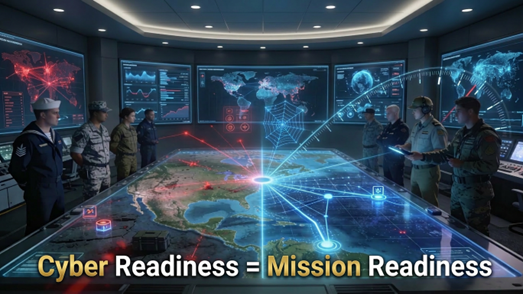 The Evolving State of Cyber Warfare: Capabilities, Challenges and Projections of a Hyperconnected Battlefield
Provided By: AFCEA
May 2026The emergence of the cyber domain brought many positives to our society: accessibility, communications and a level of on-demand convenience that is unlike anything our predecessors have ever experienced. However, the increased connectivity that technology facilitates also presents a new level of vulnerability and next-generation threats. Understanding where the cyber battlespace begins and ends is an increasingly elusive challenge. In this AFCEA Cyber Committee white paper, experts discuss cyber warfare definitions, impacts of expanding technological capabilities, curre ...
 From DoD Zero Trust Mandates to a Defensible Maturity Roadmap in 4 Weeks
Provided By: Zephon
May 2026Zero Trust isn't a future goal-it's a mandate with real consequences. Federal and DoD organizations are under increasing pressure to prove compliance, but most struggle not with tools, but with demonstrating measurable, audit-ready maturity. Zephon's AISE platform turns that challenge into a competitive advantage by rapidly assessing your current state, identifying critical gaps across all seven Zero Trust pillars, and delivering a clear, prioritized, and defensible roadmap in just four weeks-so you can move confidently from uncertainty to action.
 Building an Intelligent Network Fabric for Command, Control and Defense
Provided By: Nokia Federal
May 2026Future defense architectures will require networks that can both communicate and sense- simultaneously and intelligently- within the same spectrum resources. Integrated Sensing and Communications (ISAC) represents a pivotal step in this evolution.
.jpg) AV-over-IP and Unified Communications Are Transforming Federal Collaboration
AV-over-IP and Unified Communications Are Transforming Federal CollaborationProvided By: Crestron
May 2026In this episode of our SIGNAL Executive Video, we speak with Joe Schauder, senior director of federal government at Crestron, a manufacturer and distributor of audiovisual technology and unified communications providing meeting-room capabilities to help agencies collaborate effectively and efficiently. Schauder said secure collaboration is critical in the age of remote work, especially between federal agencies sharing classified information. Crestron's tools focus on how the meeting rooms function as a whole. Learn more at crestron.com
 Rethinking the Meeting Experience With Mission-Embedded, AI-Enabled Collaboration Infrastructure
Provided By: Crestron
May 2026As federal missions grow more complex and distributed, agencies across the defense, intelligence and civilian communities are rethinking how they collaborate. Meeting rooms, command centers and executive spaces are no longer just venues for briefings-they are mission infrastructure that must support secure, real-time information sharing.
 Accelerating ATO to Meet the Military’s Need for Capability at the Tactical Edge
Provided By: Spectro Cloud
Apr 2026Overcome the bottlenecks in the government's authorization model while securing cloud architectures at the tactical edge, key to keeping pace with today's modern, AI-driven battlespace.
 Beyond the Fence Line: Securing Civilian Infrastructure That Empowers National Security
Provided By: AFCEA
Apr 2026Civilian infrastructure is the unguarded flank of national defense. While military bases operate within hardened cyber perimeters, the local water, power and communications systems they rely on often remain exposed. These vulnerabilities represent an underrecognized but serious national security risk. This Cyber Committee white paper discusses interdependencies, current vulnerabilities, existing policies and actionable recommendations. Securing the infrastructure surrounding our military installations must be prioritized as a national security imperative.
 The AI Botnet Tempest: Defending the Internet at the Edge for the Department of Defense and the Defense Industrial Base
Provided By: Cloudflare
Apr 2026The perfect cyber storm requires key ingredients to come together. Today, the confluence of AI, cheap botnets, and geopolitics have evolved DDoS attacks into AI-powered, hyper-volumetric weapons capable of overwhelming national-scale infrastructure in seconds. With malign actors' increased force, governments and industry need to rethink how the internet itself is protected.
 Call For a National Space Systems Cybersecurity Governance Body
Provided By: AFCEA
Apr 2026This AFCEA white paper, written by members of the Cyber Committee, is a call to action for the policymaking entities tasked with implementing a space security strategy in Executive Order (EO) 14369: Ensuring American Space Superiority, and focuses on the cybersecurity governance of space systems, with governance being the core mechanism to realize a strategy effectively to strengthen national, economic and critical infrastructure security and increasingly leverage commercial innovation in a rapidly evolving threat landscape.
 Integration of Cyber Into a National Concept of Operations Supporting the Interests of the United States
Provided By: AFCEA
Apr 2026While existing research has examined cyber operations in support of military missions across the competition-crisis-conflict continuum, significant gaps remain in understanding how cyber capabilities can enable a truly integrated, whole of nation approach to protecting U.S. national and economic security. Sustaining critical infrastructure, supporting the national economy, meeting global commitments, enabling military mobilization and maintaining defense production all depend on reliable access to cyberspace. This white paper, written by members of AFCEA's Cyber Committ ...
 Cybersecurity for the Frontline: Foundations for a Cyber‑Ready Frontline Workforce in the AI Era -Vol. 1 of 4
Provided By: AFCEA
Mar 2026As cyber-physical systems, AI-driven operations and connected infrastructure transform every sector, frontline workers have become the true defenders of organizational resilience. Volume 1 of the Cybersecurity for the Frontline series, written by Cyber Committee and Homeland Security Committee members, establishes the strategic foundation for an AI‑ready, cyber‑literate workforce that can safeguard critical infrastructure in an era of rapid digital convergence. Volume 1 of 4
 Cybersecurity for the Frontline: Roles, Skills and Competency Frameworks for Frontline Cyber Readiness - Vol. 2 of 4
Provided By: AFCEA
Mar 2026As AI-enabled, cyber‑physical environments become the backbone of modern operations, organizations must redefine frontline roles and ensure every worker who touches digital systems carries measurable cybersecurity and AI competencies. Volume 2 of the Cybersecurity for the Frontline series, written by Cyber Committee and Homeland Security Committee members, provides this blueprint. Volume 2 of 4.
 Cybersecurity for the Frontline: Sector-Specific Priorities, Metrics and Assurance Frameworks - Vol. 4 of 4
Provided By: AFCEA
Mar 2026As cyber threats escalate and AI becomes embedded across every operational domain, organizations are confronting a new reality: frontline personnel--not IT or cybersecurity teams alone--now form the true cyber perimeter. Volume 4 of the Cybersecurity for the Frontline series, written by Cyber Committee and Homeland Security Committee members, translates this truth into a clear, sector‑specific roadmap for 2030, offering leaders a practical framework for measuring, validating and proving frontline cyber and AI readiness across all 16 U.S. critical infrastructure sectors. ...
 Cybersecurity for the Frontline: Operationalizing Cyber Resilience - Vol. 3 of 4
Provided By: AFCEA
Mar 2026Building cyber and AI literacy is only the beginning; operational resilience is achieved when frontline teams consistently apply those skills under real‑world conditions. Volume 3 of the Cybersecurity for the Frontline series, written by members of the Cyber Committee and Homeland Security Committee, shows exactly how to translate workforce capability into daily, repeatable operational behaviors. Volume 3 of 4.

