
Sponsored Products
Applied Companies
 |
The new GETT Family: The GETT (Generator, ECU, Tent Trailer) is an integral sub-system component to the
|
|
| The Standard USMC COC GETT – 10Ton ECU with 23kW Generator |
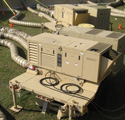
Applied Companies recently announced the new Family of GETTs, which are based upon the combat proven USMC COC GETT design. “We feel this is a natural direction to head.” said
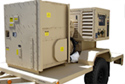 |
| The 5 Ton ECU with 23kW Generator equipped with Auxiliary Fuel Tank |
"Our aim is to provide customers Standard Products,” according to LTC (Ret) Skip Williams, Regional Business Director. “By using the standard M1102 Light Tactical Trailer as the GETTs platform base” Williams went on to say, “the customer has a proven TACOM trailer which can be integrated with a 5, 8 or 10 ton Environmental Control Unit (ECU). However, not only does the customer choose the ECU size, they also have the choice of either a 23 or 35kW generator set to support their C4IRS systems and application needs.”
“We bring to the GETT Family the proven design of the USMC GETT and the flexibility for customers to mix and match Power and HVAC requirements for their C4 needs. The good news is that all sub-systems components in this Family have been combat proven.”
Applied Companies is a Veteran Owned Small Business in Valencia, CA. Contact: 800-799-6194, www.AppliedCompanies.net or info@AppliedCompanies.net
Codan US Inc.
Fully integrated with the ALE (automatic link establishment) capabilities of the Codan 2110M radio, the RC-50 provides easier data connections with optimum channel selection and throughput. The RC-50 modem is in compliance with military standard (MIL-STD) 188-110B and will support future NATO interoperable waveforms.
The RC-50 modem interfaces with Microsoft Outlook e-mail software, which is integrated with the 2110M manpack radios, and also provides an HF wireless gateway to connect to Ethernet networks and enable future networking applications.
Codan radios are in use in more than 150 countries, and are renowned for providing fast, simple and reliable voice and data communications. In addition to Codan’s recent release of the 2110M manpack radio, more than 60,000 of Codan’s New Generation Transceiver (NGT) series of HF radios have sold since its release in 1997. With compliance to MIL-STD-188-141B ALE (JITC Certified), FED-STD-1045 ALE, interoperability with commercial and other military grade radios, frequency hopping, and voice encryption, these transceivers further strengthen Codan’s legendary reputation for quality and exceptional value.
 |
About Codan
Codan US, Inc. is a subsidiary of Codan Limited, based in
DHS Systems
 |
DRS Technologies
 |
DRS ARMOR™ FULLY-RUGGED
DRS Tactical Systems, Inc., a unit of DRS Technologies, Inc., offers two fully-rugged mobile computers – the ARMOR™ C12 Rugged Convertible Notebook and the ARMOR™ X10 Rugged Tablet PC (www.drsarmor.com). This line of rugged mobile computers offers data protection technology, “anywhere” connectivity and sunlight readable display options, making these computers the ideal solution for ensuring situational awareness, protecting valuable data and/or increasing worker efficiency.
Based on over 25 years of experience developing military computer and display systems that survive in the harshest environments, DRS has taken the lessons learned in outdoor conditions around the globe and applied them to ARMOR fully rugged mobile computers.
"DRS has extensive experience developing systems that meet and exceed military requirements and survive extremely harsh environments around the globe. In fact, DRS currently is the global leader in the ultra-rugged computing market," said Michael J. Sheehan, president of DRS Technologies’ Tactical Computing strategic business unit. "This experience has given us unique insights on how to make the computing systems survive and deliver optimal performance in extreme environments. Whether it's a soldier in need of mission-critical information in the desert or a utility worker in need of automation in the field, ARMOR rugged mobile computing devices survive the rough conditions they face on a daily basis."
ARMOR mobile computers combine advanced computing and communications technology with MIL-STD-810F durability and exceptional service, which includes a three-year comprehensive warranty and a direct line to customer support. These computers use Intel® processing technology and offer a full array of communications options, including integrated Wi-Fi, Ethernet and a PCMCIA slot. Weighing just 5.2 pounds, including batteries, ARMOR tablets and convertible notebooks go anywhere in support of any operation requiring mobility.
Additional features and other technical highlights include:
- ARMOR C12 Convertible Notebook Computers feature a rugged, die-cast magnesium alloy case. These units have been extensively tested for drop-shock, moisture, temperature extremes and resistance to dust and vibration, providing IP 54 level protection from damaging elements. The 12.1-inch outdoor-viewable touch-screen display quickly transforms from a tablet-style computer to a compact notebook with a full-size keyboard.
- The ARMOR X10 Tablet features a specially designed aluminum DuraCase™ chassis with ShutOut™ sealing technology that meets IP 66 level protection from dust, dirt, water and temperature extremes. In addition, the ARMOR™ X10.
- Tablet offers no-flap input connections and tool-free, hot-swappable battery access. Available in both touch screen and passive pen versions, the 10.4-inch LCD monitor uses backlight technology for enhanced indoor and outdoor viewability – even in direct sunlight.
DRS Tactical Systems, located in
DRS Technologies, headquartered in
For additional information please contact:
Vice President, Public Affairs
(973) 451-3584
goldberg@drs.com
or
Patricia M. Williamson
Vice President, Investor Relations
(973) 898-6025
p.williamson@drs.com
General Dynamics C4 Systems
General Dynamics C4 Systems
Telephone: 480-441-4079
E-mail address: JTRShms@gdc4s.com
Web Address: www.gdc4s.com/jtrshms
 | 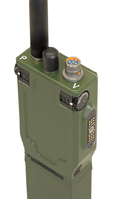 |
JTRS HMS Rifleman Radio: Part of the Joint Tactical Radio System (JTRS) Handheld, Manpack, Small Form Fit (HMS) program, the one-channel AN/PRC-154 (Rifleman Radio) enables secure voice and data communications, including GPS position location information, among team-members and squad leaders. The soldier-worn Rifleman Radio is intended for close-combat operations and uses the JTRS Soldier Radio Waveform (SRW) to connect any warfighter to the battlefield network. Lightweight and power-efficient, the Rifleman Radio meets JTRS requirements now, with the communication capabilities warfighters need today.
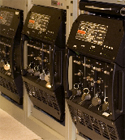 |
Digital Modular Radio: Software defined, Digital Modular Radios (DMR) currently operate aboard U.S. Navy surface and subsurface vessels, fixed-sites and other Department of Defense communication platforms at frequencies ranging from 2 MHz to 2 GHz. Certified by the NSA for secure voice and data over HF, VHF, UHF, and SATCOM channels, DMRs are built using open architecture standards and are designed to accommodate next-generation communication waveforms and information security requirements.
Harris Corporation
 |
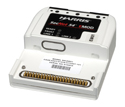 |  |
| SecNet 54 Radio Module | SecNet 54 Ethernet Module |
SecNet 54® is a family of Internet Protocol (IP) communications encryption products designed to keep data, voice and video communications secure. This innovative product suite is based on a modular architecture which allows the user to accommodate a wide variety of scenarios. The SecNet 54 is comprised of two components: an NSA-certified KIV-54 Cryptographic Module (CMOD) that provides all security-critical functions, and an External Module (XMOD) that handles the transport of encrypted data over specific protocols. Its modular design enables the attachment of a variety of XMODs, allowing secure, yet quick and easy utilization of standard communication technologies such as wired 802.3 Ethernet (EM01), wireless 802.11 (RM01) and other protocols. With its versatility, small size, and up to TOP SECRET/SCI wireless and wired communications capabilities, SecNet 54 offers users a cost-effective alternative to traditional, bulky in-line network encryption devices.
Designated as the KIV-54RM01, the SecNet 54 with Radio Module provides a wireless 802.11a/b/g interface and can be configured as an access point, wireless bridge or as an infrastructure or ad-hoc station. The initial release of SecNet 54 was configured as a secure wireless local area network (SWLAN) device, supporting 802.11a/b/g links up to 54 Mbps and including both CMOD and Radio Module (RMOD) components. In this configuration, SecNet 54 serves as a Type-1, layer 3 SWLAN encryptor that can be utilized for both tactical and garrison/enterprise applications. Additionally, layer 2 encryption is supported on the 802.11a/b/g RMOD, including WPA2 PSK and WPA2 Enterprise (client).
Designated as the KIV-54EM01, the SecNet 54 with Ethernet Module is small enough to function as a mobile, single-client INE, yet powerful enough to host numerous classified clients—limited only by bandwidth requirements. Flexibility for classified network connectivity is provided by dual Red-side and Black-side Ethernet interfaces. Weighing less than one pound, the KIV-54EM01 is significantly smaller than current “micro” INE solutions and supports links up to 100 Mbps. Its low power consumption enables it to be powered via multiple sources, including small AC power supplies, batteries, and Power-over-Ethernet (PoE). A priority-based, smart power supply automatically senses power failures and switches to the next logical power source.
Based on a modular architecture, the SecNet 54 family is evolving to support added features and capabilities that previously required the use of additional, separate equipment. The latest capabilities include VPN with NAT-T, permitting unfettered operation in COTS environments. This new release also includes VLAN tag pass-through without the use of Generic Routing Encapsulation (GRE) tunnels. The end result is that SecNet 54 provides even greater value with no increase in physical size or power.
SecNet 54 is designed for use by all branches of the U.S. Department of Defense, federal and homeland security agencies, and the intelligence community. SecNet 54 products are Controlled Cryptographic Items (CCI) that can only be procured by organizations with COMSEC or DOD DAC accounts.
Jensen AV
Jensen AV is a full service Audiovisual System Design firm whose award winning service and reputation for quality builds lasting relationships. We have both Schedule 58 and Schedule 70 GSA Contracts. On contract are all products by AMX.
 |  |  |
AMX Communication and Distributed Audio EXPerience Kits are the newest and bestselling product from AMX. AMX control systems interface to your audio/video, lighting, HVAC, and security systems. Control systems are what make technology simple to operate. Creating a control and automation system for government and military applications that yields tangible, reliable and secure results requires the efficiency, power and simplicity of AMX technology. With an AMX EXPerience Kit operating behind the scenes all facets of government have the means to streamline processes, eliminate inefficiencies, and take action.
EXPerience Kits take the guess-work out of your communications solution. They include all the components necessary to install and program your AMX touch panel control system. At Jensen Audio Visual we have AMX ACE certified programmers who can design and program your system for you. The most popular AMX EXPerience Kit is the EXP-5231I
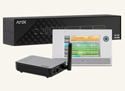 |
The KIT INCLUDES
- MVP-5200i: 5.2" Modero® ViewPoint® Touch Panel with Intercom
- NI-3100: NetLinx® Integrated Controller
- NXA-WAP250G: 802.11g Wireless Access Point
- Power Supply, Cabling and Accessories
AMX EXPerience Kit solutions simplify the way people interact with technology. With the increasing number of technologies and operating platforms, an AMX EXPerience Kit solves the complexity of managing this technology with reliable, consistent and scalable systems.
Oberon
Locking suspended ceiling enclosures for 802.11n wireless access points
 | 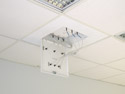 |
Oberon introduces the new model 1053 suspended ceiling enclosure for IEEE 802.11n wireless access points, which require up to 6 antennas. This new “plenum rated” ceiling enclosure is large enough to accommodate any manufacturers’ access point. These ceiling enclosures provide a convenient, secure, and aesthetic means to mount the access point. The 1053 door has convenient mounting locations for up to 6 external antennas. This ceiling enclosure has a locking door and is UL listed. Oberon also manufacturers wireless LAN access point enclosures for wall mounting and ceiling mounts in “hard-lid” areas. Please visit our website at www.oberonwireless.com.
Scalable Network
 |
Scalable Network Technologies Introduces EXata, Breakthrough Emulation Technology for Mobile Wireless Networks
 |
The technology advancement that enables EXata to deliver this realism is true or real-time emulation - an exact digital replication of a physical wireless network. Any hardware, software, or human user connected to an EXata SVN is not able to discern a difference between real networks and components and their virtual (emulated) replacements.
Network testing is complex and costly because scientifically rigorous studies require repeated trials. Being able to start and stop trials - as well as pause and modify parameters on the fly - is necessary to efficiently conduct such experiments. EXata SVN’s displace the traditional model of physical testbed evaluation by leveraging the flexibility and low cost of simulation to produce the highly accurate, highly detailed results of a testbed. Furthermore, the EXata SVN can stay in service throughout the lifecycle of the system to provide increasing levels of detail and realism as the project demands.
The EXata product family consists of EXata and a collection of add-on libraries that model various communication protocols. The power of additional processors can be added with a license upgrade. A feature-rich visual development environment allows users to set up models quickly and then run models that present real-time statistics and helpful packet-level debugging insight.
EXata provides out-of-the-box support for quad-core processor systems. It is possible to achieve real-time emulation with the base EXata product. For additional speed-up and scalability through parallel execution, users can upgrade EXata to run on multiples of four processors.
More information including a downloadable demo version of EXata, technical specifications on the product and whitepapers is available on the company website, www.EXata.com.
Smartronix
Radio Data Adapter
Smartronix has developed the Radio Data Adapter (RDA™) cable, a solution that eliminates multiple single function serial cables and replaces them with a single multi-purpose Universal Serial Bus (USB) cable. The capabilities of the RDA cable address current shortfalls in the ability of the operating forces to transfer data throughout the battle space.
Tactical radio users require real-time access to critical command and control (C2) information at all echelons across the battle space. Current C2 systems and software require radio operators to physically reconfigure radio hardware when transitioning from one system to the next. In an environment where lost seconds can mean life or death, stopping to change radio hardware is not effective.
The RDA multi-function cable reduces equipment weight, complexity, and bulk at a fraction of the cost. The RDA is a 4-in-1 USB cable that provides the host computer operating system a method of connecting to a variety of military radios. The RDA is powered from the computer's USB port and presents itself as a multi-port serial adapter. This simultaneously enables three data ports and up to four operational modes: asynchronous data, synchronous data, asynchronous remote, and High Performance Waveform/Point-to-Point Protocol (HPW/PPP).
The ability to run simultaneous software applications requiring both synchronous and asynchronous data transfer modes through the RDA cable has increased the speed and availability of data to all levels of the battle space, thus reducing the kill chain and aiding time-sensitive targeting. By consuming only a small fraction of the power required by PCMCIA card-based system, the RDA cable offers a savings that is truly significant when dependent on batteries. The RDA cable solves the problem of physically having to change cables, decreases equipment weight, saves power, and has been combat proven to work in even the harshest operating environments.
In addition to the lower power, weight, and slimmer profile of the Smartronix RDA cable, this single cable provides a more cost effective alternative to using multiple serial cables each designed to perform only a single function. One multi-function RDA cable replaces four separate cables for approximately one third of the cost.
 |
The Smartronix RDA cable is battle tested and supports a variety of tactical radios to include the: AN/PRC-117F, AN/PRC-148, AN/ARC-210, AN/PRC-150, AN/ARC-231, AN/PSC-5 and AN/PRC-119E (RT-1523). Additionally Smartronix is currently accepting RDA cable orders to support the newly fielded AN/PRC-152 and AN/PRC-117G.
For additional information contact Smartronix, Inc,
SWE-DISH
 |
Product Announcement: SATCOM ON THE MOVE (SOTM)
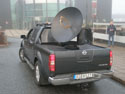
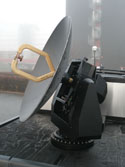
SWE-DISH and world leading stabilized platform developer Saab have joined forces in developing a high performance SATCOM ON THE MOVE terminal (4 axis antenna system) that enables broadband satellite communications with land vehicles and marine vessels while moving at top speed.
The SOTM terminal is designed to provide an affordable, unsurpassed broadband on the move satellite communications capability, close to worldwide coverage and access to almost any commercial Ku-band satellite in service today. The SWE-DISH / Saab SOTM terminal is well suited for both land and marine applications. Identified target platforms ranges from light off-road vehicles through smaller boats, to medium size littoral ships, all which operate at high speeds and with major components of pitch, roll and sway.
Key features:
• Smallest available Ku-band SOTM solution meeting FCC requirements
• 4-axis solution addressing the Zenith Paradox
• Designed for use on both land and marine platforms
• Fast automatic satellite acquisition
• Instant automatic satellite re-acquisition after passing e.g. a building blocking the LOS
• Extremely small losses in RF chain resulting in excellent EIRP values and performance
• Inertial Navigation System and high performance stabilization system ensuring optimum pointing accuracy
• Low weight due to use of light-weight components such as carbon-fiber antennas
• Very high data rate – up to 8 Mbps depending on link budget – our demonstrator has reached in excess of 10 Mbps!
 |  |  |
Syntonics LLC
Syntonics LLC, based in
The FORAX-HA was successfully tested in a single radio prototype last year at the Yuma Proving Grounds. The FORAX product line, deployed since 2004 by
Syntonics recently added HF and GPS capability to its already-fielded SINCGARS, VHF/UHF, and UHF TACSAT modules. Under this contract they will add an EPLRS module. To date, Syntonics has fielded over 200 FORAX links here and abroad. Syntonics expects the FORAX-HA to be useful in both
For additional information contact Ray Madonna 410 490 2680 or Ray.Madonna@SyntonicsCorp.com.
Teligy
 |
This increase in engineering capability was made possible by an investment in infrastructure and equipment, but mostly an investment in personnel. “Finding the right engineers with the proper skill set and the ability to make our customers goals their own was the key factor that makes this new capability so important,” states Jason Yates, vice president of development.
The new RF design capabilities compliment Teligy’s existing digital design and layout engineering services allowing the company to better meet the growing demand in the wireless sector. Teligy has already designed turnkey wireless solutions for both the defense and medical sectors. The advanced RF design capabilities now offered by Teligy, coupled with their expertise in commercial off-the-shelf (COTS) system design and system level software development, allow them to provide their customers with a complete set of engineering services focused on the single goal of helping the customer meet the goals of their projects and bring solutions to the field.
About Teligy: Teligy, Inc., operates as an advanced provider of custom software and hardware design, development, and testing services. Founded in 2002, Teligy has built a reputation as an outsourcing partner specializing in the communications and networking industries. Located in
 |  |
New IP Dod Network-Centric Network Access Platform Announced by Ultra Electronics-DNE Technologies--Solves Quality of Service Issues in Tactical Networks
Ultra-DNE’s new PacketAssure Service Delivery Managers represent the next generation of bandwidth allocation in tactical IP networks. PacketAssure Service Delivery Managers are a compact and affordable complement to - or alternative for - an IP Convergence Router and all its required hardware and training. It offers a simpler set-up and operation, yet improves network throughput over congested links. DNE’s PacketAssure line provides superior Quality of Service (QoS) and eases congestion by selectively identifying low-priority traffic for retransmission, allowing the PacketAssure to reliably run time-critical Internet Protocol (IP) traffic over limited bandwidth in support of high-speed IP radios and modems.
In addition, Ultra-DNE's PacketAssure Service Delivery Manager uniquely formats IP data to be used with existing deployed encryption devices to provide Type 1 TRANSEC. Together, these features combine into the most versatile and powerful Service Delivery Manager in the tactical network transformation market.
PacketAssure has demonstrated its ability to enhance or replace IP Convergence Routers, bringing 100% call completion rates with toll-quality voice over both standard and secure applications. Contact Ultra-DNE at 1-800-370-4485 for copy of this free white paper that quantifies bandwidth savings and call completion ratios in tactical networks. Find out more about PacketAssure and other Ultra-DNE network products at www.ultra-dne.com.



Comments