Malware threats for mobile and messaging environments are increasing quickly, evolving in sophistication and functionality at a pace that eclipses PC-based malware, according to a report by McAfee Labs. Malicious programs for Android have become especially prevalent; historically, only two other operating systems have more malware.
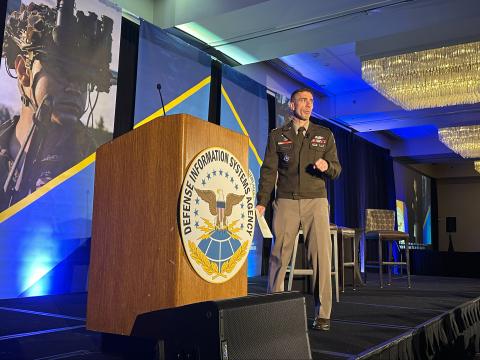
Integrating the network and defending it against cyberattacks are among the top priorities in the new Defense Information Systems Agency (DISA) 2011-2012 Campaign Plan. The plan, released this morning, focuses on requirements and opportunities facing the information agency.
Digital-data investigators have a new tool in their arsenals as they try to capture bad guys' information before they can harm others. The device enables immediate, on-scene triage of devices, eliminating the need to send equipment back to a laboratory while saving precious time and resources.
The Office of Naval Research is turning to a community of more than 1,000 cyber wargame players in a three-week effort to “crowdsource” new ideas on how to combat Somali pirates.
The National Geospatial-Intelligence Agency is asking companies not only to create better keyboard-tethered 3-D imaging platforms but also to bring analysts into the 3-D world through kinesthetic interaction with imagery taken from above areas of interest.
Homefront Help is SIGNALConnections’ effort to support U.S. service members, veterans and their families. The column highlights programs that offer resources and assistance to the military community ranging from care packages to benefits and everything in between. In that same spirit, Homefront Help presents opportunities for readers to donate time, offer resources and send words of thanks to those who sacrifice for freedom. Programs that provide services are listed in red. Opportunities for the public to reach out to service members are listed in blue. Each program description includes a link to the organization's website, when available. Homefront Help also has a Facebook page where visitors can gather and share information.
This special travel organization offers service members and other U.S. Defense Department personnel a chance to enjoy vacations for discount prices at more than 3,500 time share properties in approximately 80 countries. Through the deals, travelers can stay at locations without buying into a time share or even attending a presentation for one, if they so choose. Several different types of deals are available including: space available, a seven-night vacation option typically during the off season and/or on very short notice for $369; high-demand weekly rentals in popular locations during peak season but at discounted commercial rates; nightly getaways; and special offers from lodging locations that may include car rentals or other discounts.
The Modular Tactical System integrates a command, control, communications, computers, intelligence, surveillance and reconnaissance capability with the rest of the equipment worn by the dismounted soldier. The commercial system is produced by Black Diamond Advanced Technologies, Tempe, Arizona, and was tested by special operations units during operation Enduring Freedom in Afghanistan. It offers a vest-based configuration with a tactical mission controller, cables routed through an interchangeable cummerbund with body armor, a night vision goggle-compatible visual display and a tactical hub for interfacing with mission-specific components, such as range finders. The system can be powered by a wide array of existing military batteries. It is designed to be interoperable with existing systems already on the battlefield. It is adaptable for specialized missions requiring application-specific equipment, including targeting, combat medics, explosive ordnance disposal, combat weather and military intelligence.
The U.S. Army is introducing its first fully immersive virtual simulation program for dismounted soldiers and small tactical units. The Dismounted Soldier Training System will provide virtual environments for soldiers to increase combat preparedness and reduce traditional training expenses. And the system’s advanced graphics and tools utilize video game elements and skills already familiar to young soldiers.
At a time when almost all of government is being squeezed by efforts to lower spending, a new report from a congressional watchdog agency strongly suggests that the Defense Department needs to do a better job of managing its intelligence, surveillance and reconnaissance (ISR) systems. "Intelligence, Surveillance and Reconnaissance: Actions Are Needed to Increase Integration and Efficiencies of DOD's ISR Enterprise," (GAO 11-465) warns that the department must improve its control over disparate ISR efforts if it is to provide effective ISR support to the force.
By Capt. Joseph A. Grace Jr., USN (Ret.), SIGNAL Magazine
A week ago, I spent three nights in the hospital with my 17-year-old son, who was suffering from severe headaches and uncontrolled nausea. One test after another revealed nothing, and we ended up with a diagnosis of, “Get him some rest, keep something down and hydrate him with IVs [intravenous fluids], and we’ll see.” Needless to say, his dad—a trained submarine nuclear officer and former chief information officer of Navy Medicine—was ready to stand the watch in the hospital. “Get him some rest and fluids…”—a simple assignment—or so it seemed.