
The Coming Swarm: Drone Technology Continues To Evolve
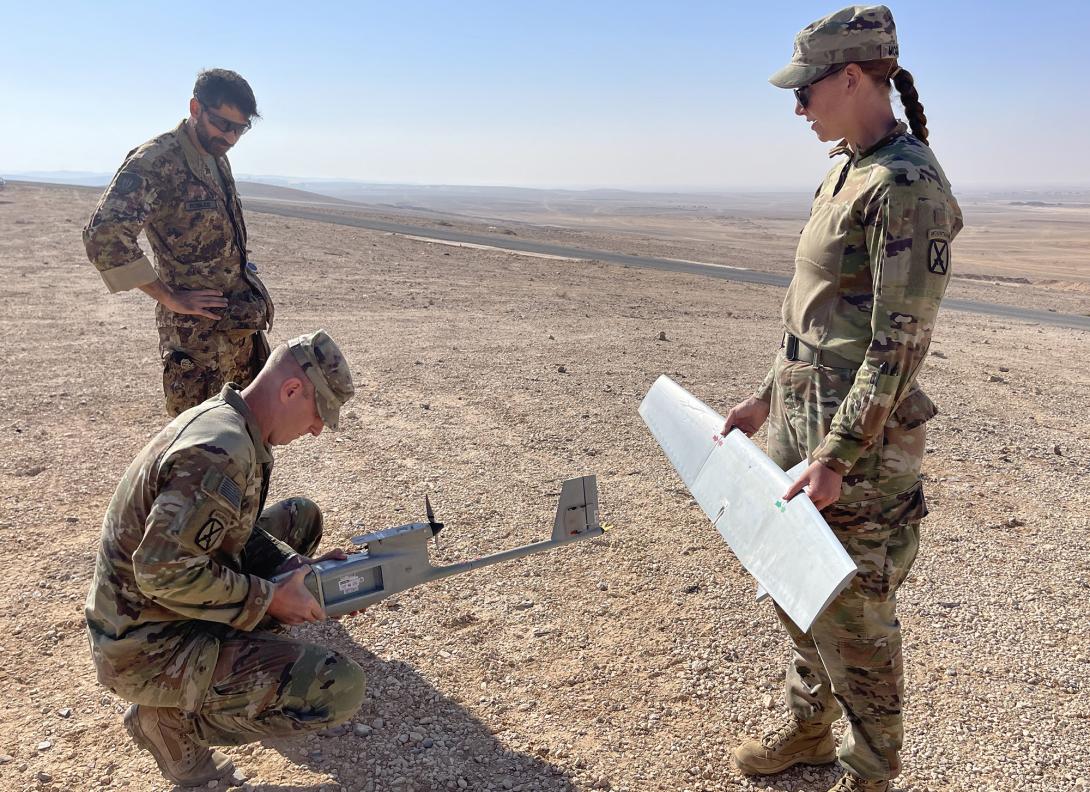
Unmanned aerial vehicles (UAVs), or drones, are a considerable threat that the United States and NATO need to address. The ability of small UAVs, especially, to carry deadly payloads of munitions and sophisticated sensors creates great risk, experts say, and they expect the next technological leap in small UAVs to be armed swarms.
More has to be done, especially stateside, for base security, to protect U.S. military sites and operations.
Detecting and mitigating the operations of small UAVs is difficult, however, requiring layered sensors to get an accurate picture of where a drone is in the airspace, explained Col. Bill Edwards, USA (Ret.), director of Counter-Unmanned Aerial Systems (C-UAS) Operations and Training, ENSCO.
“These drones, they fly fast, they are small, they are agile, they carry payloads, and some of these payloads are, of course, ordinance or bombs or some type of explosive,” Edwards said.
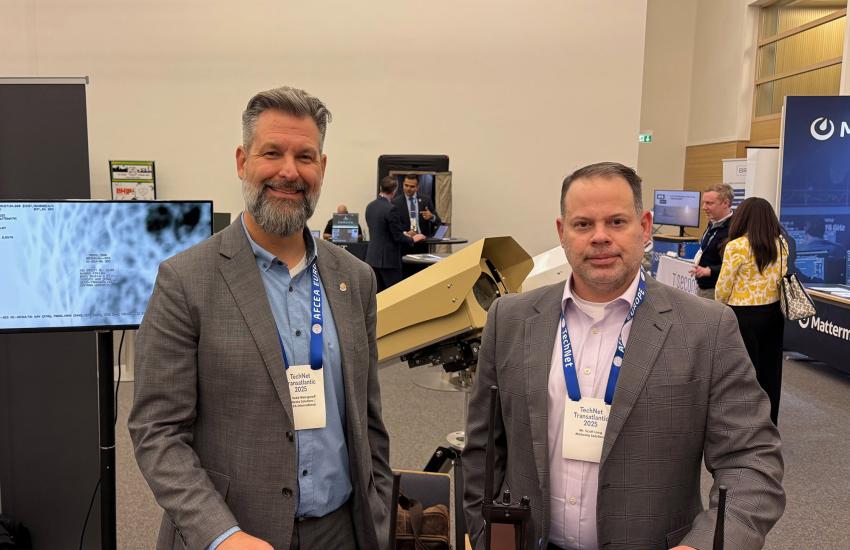
Generally, there are several ways to detect small drones—radio frequency (RF), radar, optics and acoustics, Edwards noted. “This ecosystem is very complex, and it may be even chaotic, but really, when you simplify it down to the ways to detect a drone, those are typically the four ways that you detect a drone,” he stated, speaking at AFCEA’s TechNet Transatlantic in Frankfurt in December.
Today’s state-of-the-art counter-drone detection systems for small UAVs rely on a multi-layer approach, using multiple detection capabilities.
Edwards spoke along with Johnathan Grim, pre-sales engineer, Motorola Solutions; David Sonntag, senior director of Business Development, Walaris GmbH; and Glenn Larish, senior program manager, NexTech Solutions.
The experts said that in the last 12 months especially, strides have been made in counter-drone technologies, enabling detection at greater distances for small UAVs, with more powerful cameras and sensors, and some systems that leverage artificial intelligence (AI).
And while drone swarms have yet to be seen on the battlefield, countermeasures are needed. Edwards noted that, “at least in my experience, we have not seen a swarm in Ukraine. We have seen mass distribution, and mass distribution means there are a lot of drones in the air at one time, but not centrally commanded and controlled.”
For any counter-swarm capability, a continuation of the multilayered sensor approach is needed, along with AI to play a role in the visualization and object detection of the threat, and motion prediction algorithms, Sonntag explained.
“If it is a swarm that we would be seeing, we are tracking that within the field of view of the camera,” he said. “Our edge AI, it is processed on the edge next to the sensor, and it is able to process, to track and to classify up to 40 objects at once, which means that every object gets a unique identifier. For every object, we have 3D information derived from all sensors that we are using. This makes it possible to track each object without losing it and without swapping the ID of the object.”
The AI algorithms would classify according to the shape of the flying object and then verify that it is not a false positive but a real potential threat, based on confidence intervals.
“The operator gets a cropped picture in order to see what the AI sees,” he continued. “They verify that the classification done by the AI is correct, and they definitely know why the AI made this decision. Of course, we have confident bands. [A soldier can] explain to the operator, within a certainty of 90%, that it is a UAV, so he has some explanations what is happening and why it’s happening.”
Additionally, anti-swarm solutions would also require motion prediction within that multilayered approach to see an object, where it is moving and predict where it will be going in the following seconds.
“So, if they occlude, if they go behind each other, we can still keep the correct track,” Sonntag said.
In addition, any future counter-small UAV capability would need to be able to identify payloads, the experts said. This may be difficult as drones in the swarms could have differing payloads. Some have intelligence surveillance and reconnaissance (ISR) payloads, and also strike capability payloads, making this a “complex problem,” Edwards said.
Operators would have to determine which part of the swarm posed the biggest threat, sorting out the attack drones, the ISR drones and the so-called “dumb drones.”
“There are probably multiple different kinds of drones within one swarm,” Sonntag said. “It is not easy to determine or do a threat assessment, so we need to develop new technologies like payload detection, for example, or analytics. Some drones sound different because they are heavier, because it has a bomb as a payload. There are ways to do this, but it is definitely something that is not there yet. I don’t know any company who has great solutions for payload detection right now.”
Autonomous swarms would have preplanned missions and could avoid emitting any RF signals.
“How do we detect these kinds of objects with what kind of sensors?” Sonntag asked. “And if the swarm then splits up, which part of the swarm is the one that we should follow with which sensors? We probably need not one sensor mix, but multiple distributed sensor systems, and we have to orchestrate or coordinate which kind of sensor follows which kind of object.”
And while direct energy capabilities, or lasers, are expected to be one of the counter-UAS technologies in the future for kinetic interdiction, in swarms or otherwise, the experts identified several considerations.
Optics would need to be advanced, the weather good, and tracking has to be more accurate over longer distances, as a laser will require time to burn through a drone to disable it, Larish noted.
“Especially for a camera solution, the better optics we can get on the camera, the further out you can start engaging a target,” he said. “The downsides are the drones are going to get harder, so you are going to have a harder time burning through it. You are also going to run into atmospheric conditions where the drone can fly, but the laser is not going to be as effective because of atmospheric scatter with mist, light, moisture or dust.”
“And from a software perspective, if you want to do automated target tracking for very fast flying objects, and we need some seconds until the laser destroys the target,” Sonntag suggested. “We have to be very precisely on track, on the target ... because otherwise we will not be able to stay with the speed of the object.”
Counter systems for small drones must also have well-integrated data layers and processing, Sonntag said. “You will be getting all these data layers coming together,” he clarified. “You may have an RF sensor layer. You may have a radar layer, and it may have some AI input. You have optical, you have acoustic, and you are consolidating that information into a place where that operator who is trained on that system can actually then advise leadership on what’s happening.”
The experts, however, all agreed that the largest impediment to advancing much-needed counter-drone technologies for small drones is the military itself and the bureaucracy.
Unless the military can truly address delivery speed and make quick adaptations in the field, it will be difficult to counter small UAVs, Larish warned. Drone technology is advancing fast.
“What we found consistently was that the program offices move too slow for the threat,” he said. “The ability for us to move quickly and be able to get things out quickly, get it integrated, tested and out the door, is what allows us to be relevant, and allows us to provide capability to warfighters that will actually help them solve their problem.”
Sonntag agreed, adding that bureaucracy sometimes even stands in the way of performing updates to capabilities.
“It is one thing to provide an update,” he shared. “It is another thing if it gets an operational approval to be deployed. And we see this. It is very frustrating that we have updates, crucial updates that the customers won’t deploy because they have to test and certify an update, and that takes time they don’t want to spend. They are happy that they have a system that is running and working, that they do not want to open it up at all.”


Comments