
DOW CIO Office Promises Enterprise-Wide Cyber Talent Management System
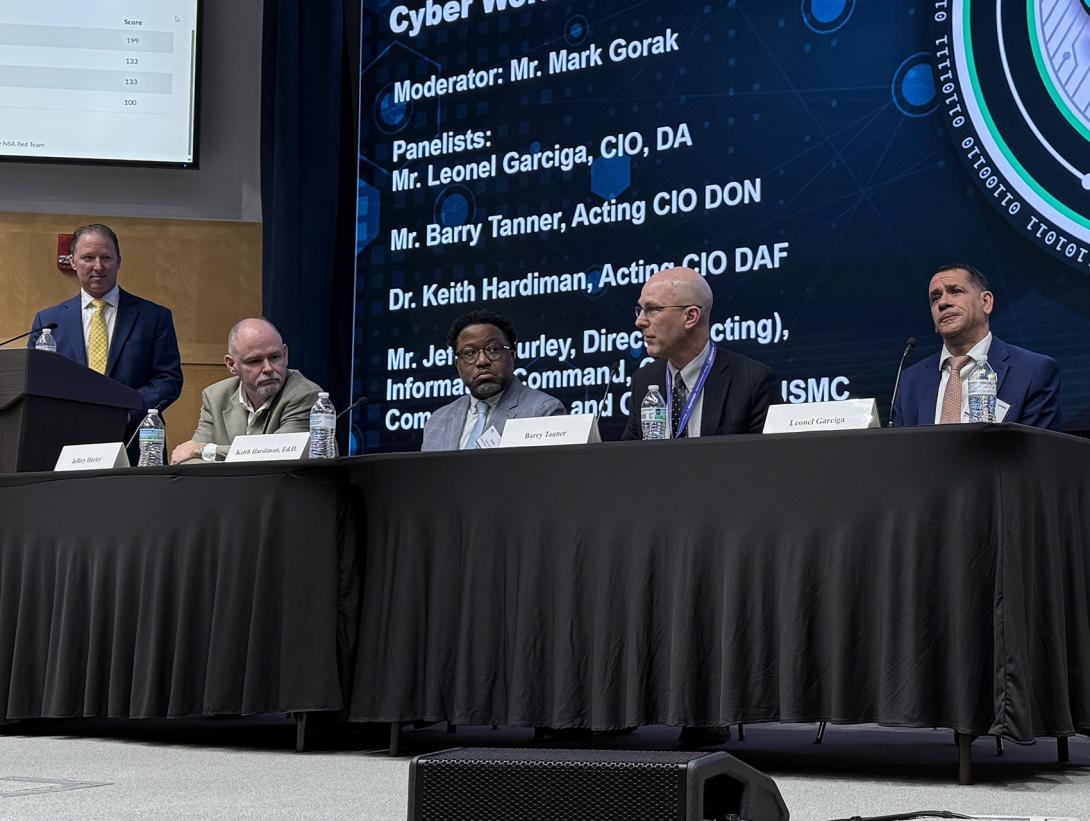
As each military branch works with its own talent management solution, department chief information officers seek an enterprise-wide, integrated system to meet their talent needs. At this year’s Cyber Workforce Summit 2.0, the CIOs may have gotten an answer to their prayers.
Sharing the stage were panelists Leonel Garciga, U.S. Army CIO; Keith Hardiman, acting deputy CIO, Department of the Air Force; Jeffery Hurley, acting director, information command, controls, communications and computers, Office of the Deputy Commandant for Information, U.S. Marine Corps; and Barry Tanner, acting CIO, Department of the Navy.
Moderating the panel was Mark Gorak, director of the cyber academic engagement office and principal director for resource and analysis at the office of the Department of War (DOW) CIO.
“All the departments are asking the DOW to dictate to them an enterprise-wide … cyber talent management system,” Gorak said, summarizing the candid discussion that took place on the second day of the event in Washington D.C. The system would be integrated across the entire department, he explained.
“I will commit to do that,” he announced, drawing loud applause from the crowd, “... pending my boss’s priorities,” he quipped, referencing DOW CIO Kirsten Davies, who spoke earlier in the day.
“I’ll need your help though, so we get the requirements correct up front so we don’t have disappointment on the back end,” he told the panelists, who all nodded to his request.
This is a time for fundamental transformation, Gorak said, noting skills-based hiring initiatives and missions to “radically eliminate the old system and do something brand new.”
Speakers also discussed the way forward.
The Marine Corps is actively working with its training and education command, commonly referred to as TECOM, to provide the fleet an appropriate level of training at the right time. The idea is to teach theory, rather than the box, Hurley highlighted.
Additionally, a continued evaluation of the DOD 8140 cyber workforce qualification program has helped them understand the civilian workforce, he said.
“Understanding over the next 12 months, we need to figure out how to fund training, how to put those folks through the right skills testing to make sure that we do have the right people in the right places from a civilian perspective, that our [cybersecurity service providers] are appropriately manned,” Hurley continued. “Overall, we are just trying to revamp and make sure that our teams are ready to go when we need them to go for the fight that’s coming.”
Garciga also added his thoughts.
“The Army’s in an interesting moment in time right now,” the Army CIO said. “We are in the midst of probably one of the most significant transformations in two to three decades.”
The echelon around defensive cyber will change, Garciga predicted. “Some of those are going to be recategorized. I think they won’t be cyber roles anymore,” he said, noting that changes within the next two years will be critical.
Additionally, a mindset shift from compliance to readiness is currently happening across all teams, Tanner pointed out.
“We are now looking at ourselves from the lens of delivery and outcomes as opposed to a checklist that somebody gave me,” he said. “When you talk about your priorities and we start breaking down, ‘What is the blocker between where I am and where I need to be from a readiness perspective,’ we’re laser focused on some of those policy gaps that are standing in our way.”
One gap the acting Navy CIO mentioned was contractor qualifications to ensure fast delivery to the warfighter.
Tanner also spoke on data infrastructure and its operational need.
“Even if we build some brand enterprise system at the top level, it needs authoritative sources of data to feed it,” he said. “Those things are going to come from the services that man, train and equip the force, and therefore, we have to make sure that our data is good.”
A consistent and dynamic training approach is also vital, Tanner stressed. “A classroom is interesting, an operational scenario is much, much, much more valuable,” he said.
Regarding the cyber talent management system within the Air Force, Hardiman said he's looking to turn it into an enterprise-wide, automated approach. “That’s one of the things I have as an objective this year,” he said.
Another one of Hardiman’s objectives is focused on incentivization to join the force.
“We have to find ways to better incentivize and compensate our folks, so I really want to find a way to provide other options, other opportunities to provide flexibilities for compensation on how we can really get this talent, make sure that they [know their value],” he said.
Hardiman also pushed for further development of uniformed and nonuniformed personnel.
The Cyber Workforce Summit 2.0 is hosted by AFCEA International in cooperation with the DOW CIO and the National Defense University. SIGNAL Media is the official media of AFCEA International.


Comments