
New Leader at the Defense Intelligence Agency
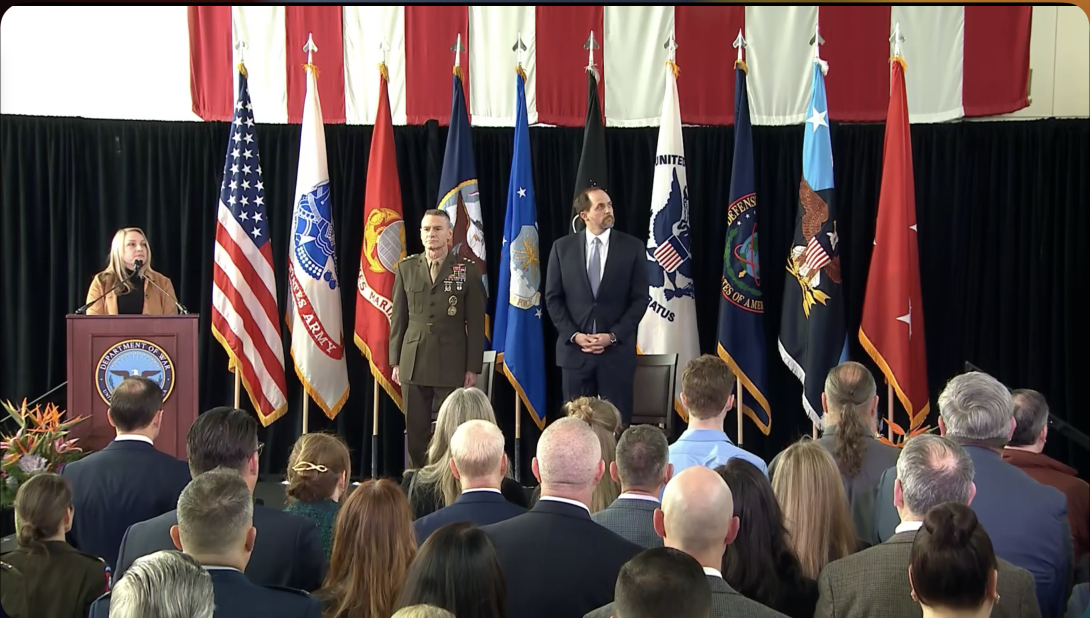
On February 20, Lt. Gen. James Adams, USMC, took over as the 25th director of the Defense Intelligence Agency (DIA), during a ceremony at DIA headquarters at Bolling Air Force Base, Washington, D.C.
The DIA provides intelligence on foreign militaries to the Department of War.
Undersecretary for Intelligence and Security Bradley Hansell introduced Adams and laid out priorities that Secretary Pete Hegseth wants the DIA to pursue under Adams’ leadership, including a call for an “all-source-fused data architecture.”
But first, the department expects Adams to reexamine how the agency operates to improve its processes and output.
“I do believe we stand at a generational inflection point in the history of the Department of War,” Hansell said. “The operational environment and threat environment we face will no longer allow us to achieve success the ways we have done since the turn of the century. At the highest levels of the department, we are reexamining every aspect of how we operate to ensure we are maximizing effects and then return on those investments. I've asked General Adams to do the same here at DIA.”
Then, the department wants to see realignment across the defense intelligence enterprise.
This includes “rapid” alignment with the administration and the department's priorities, and reallocating resources and capabilities that will have the biggest impact.
“We need to do that in an enduring way,” Hansell emphasized. “But second and equally important, I believe, is we must enable the department to operate in a new risk paradigm. Decision-makers will continually be forced to make more difficult choices regarding the allocation of forces and the commitment of resources. The ability to effectively navigate that trade space begins with the ability to accurately assess and articulate the risk with much of that work being done here at DIA, from the scientific and intelligence efforts done here to our efforts to accurately inform the full-life acquisition life cycle, to risk calculations about the decisions of war.”
Next, Hansell emphasized evolving to a new risk paradigm.
“Decision-makers will continually be forced to make more difficult choices regarding the allocation of forces and the commitment of resources,” Hansell said. “The ability to effectively navigate that trade space begins with the ability to accurately assess and articulate the risks, with much of that work being done here at DIA.”
Hansell asked that the DIA provide leaders “an accurate picture,” by providing intelligence to warfighters at the speed of relevance. “And have the courage to provide ruthlessly accurate assessments to our policymakers,” he noted.
After realignment, the department wants the DIA to modernize across three key areas, starting with artificial intelligence.
“We will leverage artificial intelligence across the enterprise to not only automate processes from where they are today, but generate unique insights at the speed of relevance,” Hansell said. “This is an absolute no-fail mission.”
Then, the department wants the DIA to modernize its workforce to match the new technological environment.
“To meet that imperative and take care of our people will require aggressive planning and really hard decisions,” Hansell continued. “And I challenge all the leaders here today to lean into this effort.”
In addition, the department wants the DIA to broaden its abilities against our hardest enemies.
“Additionally, I've asked General Adams to find novel, unique ways to scale our ability to collect against our toughest adversaries,” Hansell said.
This would include scaling of bespoke collection capabilities as well as modern defense human intelligence.
Regarding the idea of the all-source fused data architecture, the department wants to use insights brought forth by AI to a global common operating picture.
“The third area that I want to cover is how we are going to maximize enterprise effects with the investments already made from across the combat support agencies,” Hansell stated. “That will require a true enterprise lens. First of all, it is past time to create an all-source fused data architecture capable of providing AI-enabled insights that can inform a global common operating picture and can support joint targeting in theater. “
Adams is a Marine Corps aviator with 3,300 flight hours, including 300 combat hours in Iraq and Afghanistan, having flown the AH-1W Super Cobra helicopter.
“I have no doubt he understands firsthand the value of solid intelligence gathering for the warfighter and the cost of not doing so as we face new challenges and continue the necessary evolution at DIA,” Hansell stated.
“We cannot remain static, and as Honorable Hansell said, we need to transform and become better,” Adams noted. “DIA must continue to evolve at the speed, scale and complexity of modern warfare.”

Comments