
NASA Pushes to the Lunar Surface Amid Geopolitical Competition and Greater Military Ties

The National Aeronautics and Space Administration, or NASA, is evolving with greater U.S. military ties, as the space domain faces increased threats from adversaries, said Jared Isaacman, NASA administrator, who spoke with Ret. Gen. Kevin Chilton, USAF, explorer chair, Mitchell Institute for Aerospace Studies’ Spacepower Advantage Center of Excellence, at the Air & Space Forces Association’s annual conference in September.
This time around, the People’s Republic of China (PRC) poses the greatest threat, the space administrator cautioned.
“We are in the midst of a very real second space race,” Isaacman said. “China will accomplish what the Soviets never could. They have an achievable two-launch architecture to put their taikonauts on the moon. They have demonstrated reusability with their rockets. They have the expertise, and history has shown they could even be early, and we could easily be late. They too seek to build a moon base alongside the Russians and put a nuclear reactor right in one of the limited parking spots on the lunar south pole. And success in this endeavor will be measured in months, not years.”
Chilton surmised that China’s actions on Earth could easily be echoed in space, making things very dangerous for the United States.
“It occurs to me that when you look at their behavior on planet Earth in the South China Sea, making illegal claims for that, the Taiwan Straits, their illegal fishing, crossing into exclusion zones of other countries, they seem to not want to play by the rules of the road that are laid here on Earth,” Chilton stated. “Is there any reason we should not suspect they would do the same on the lunar surface?”
Isaacman warned that the PRC’s plan to dominate moon operations was one they have been “dialed in on for some time and frankly in a lot of ways it’s a more achievable plan,” he said.
NASA’s best case is four launches to the moon to do what China is planning with two, and China has reusability built into their moon strategy, while NASA does not, with its SLS rocket.
However, Isaacman couched the threat of China blocking U.S. lunar surface activity as one that has helped NASA refocus.
“I’m thankful for the reality that the Chinese have a plan to potentially, you know, to likely deny that critical area on the lunar south pole because it has given us the latitude to fix what is broken,” he explained. “To stop all the external impositions, the self-inflicted wounds that we had in our strategy and bring extreme focus to the mission.”
Another issue is that China’s space efforts are run by their People’s Liberation Army.
“The Chinese don’t draw a distinction between their civil and military aspirations in space,” he said. “Originally their moon base had some scientific community connections. That is very much back within their military umbrella.”
NASA, notably, is still a civilian organization, which is an important distinction.
At the start of the first space race, the U.S. Air Force contributed greatly to the Apollo program and the Mercury and Gemini efforts, but it supported the civilian agency as opposed to being in charge of the operations.
The U.S. Space Force continues to manage the Eastern and Western launch ranges at Cape Canaveral and Vandenberg, and more recently, Space Force Guardians and joint warfighters provided support to NASA’s space flights.
“Our partners across the national security enterprise have always aided in these great American endeavors,” Isaacman said. “The Space Force was there for Artemis 2. Guardians contributed to the safe ascent, tracked Orion through the cislunar corridor and provided continuous spaceflight safety support. The United States Navy and really contributions from all the services, alongside the 45th Weather Squadron, supported launch and recovery operations.”
Today’s threats, however, are calling for NASA to “cooperate” more closely with the U.S. military.
“NASA, for sure, has the peaceful obligation, but we also can be very efficient in our limited budgets and collaborate where appropriate with the Department of War,” Isaacman said.
This cooperation “only becomes more important” as activity moves farther away from Earth, he continued. Of mutual interest is cislunar situational awareness and traffic between low-Earth orbit and lunar orbit.
“We should absolutely be collaborating, especially as we think about the cislunar environment on areas that benefit our civil ambitions, our scientific breakthroughs that we are pursuing but also enhance our national security footprint farther out into space,” he said.
In addition, the increased ties with NASA and the U.S. military include the creation of the U.S. Space Academy—akin to West Point or the Air Force Academy—to develop and train U.S. Space Force Guardians and civilians for space exploration. Under the president’s executive order to create the new academy, Isaacman would serve as the chair of a commission to build the academy, with initial enrollment planned quickly for 2028.
Most strikingly, however, is the need for offensive space operations, given adversarial abilities to threaten our space infrastructure as well as fire from space on our terrestrial or sea-based assets.
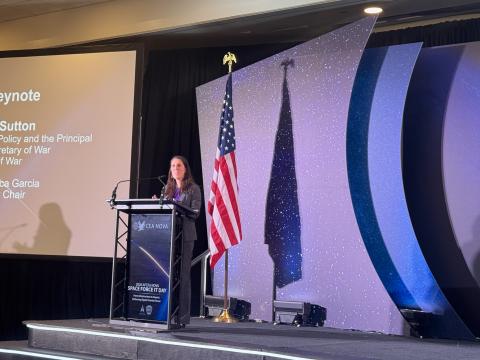
This means arming the U.S. Space Force, said Gen. Douglas Schiess, the new chief of space operations (CSO), U.S. Space Force, speaking to reporters at the AFA conference on September 15.
“We are going to arm and grow the Space Force, the Guardian force, and make sure that we have the capabilities that we need—acquisition, transformation—those things, to be able to do the mission that the nation calls us to do.”
As a means of deterrence, the Space Force is now speaking out about its need to add more weapons (including on-orbit capabilities), as it goes about adding both defensive and offensive protections.
“The threat is out there from potential adversaries, specifically China and Russia, and their capability—we have talked about them being able to grapple a satellite and move it to a different orbit,” Schiess noted. “At this point, we are trying to say that we also need capabilities to not only defend the joint force from space but be able to attack and defend our assets. I think it was time within the Department of War that we talked about it, and it’s time to talk about that we have the capabilities to make sure that we can do it in space.”
For years, the Space Force has been adding service components to the U.S. combatant commands. That effort continues, and remains a priority, as they have learned from the war in Iran, the importance of having Guardians in U.S. Central Command, the CSO confirmed.
As always, the lack of a military budget from Congress and a stopgap continuing resolution (CR) is impacting the Space Force’s efforts in regard to modernizing its global space operations and adding the needed arms, space controls and space security capabilities.

Schiess noted that in the almost seven years of the Space Force, more than half of that time it has faced a CR that hampers its abilities.
“We are thankful that we have a CR for going into 1 October, but I would really be more thankful if we had a budget,” Schiess exclaimed. “About 90% of the programs we have are programs from last year, so we can still get after this. But those 10% of programs that we can’t do are things that’s going to slow us down, and the threat is not slowing down.”
Part of what is needed is maneuver warfare, and they are examining how to add that capability to satellites to be able to move space assets, he said.
“We are looking at every new system that we bring on,” the CSO shared. “There are multiple ways to do that. Is there more fuel on a satellite? Are there more satellites as we go proliferate more orbits? We have to be able to maneuver.”
Schiess also noted that he has a “great” relationship with NASA and Isaacman, which he will continue to strengthen.
“As a matter of fact, before this job, I was the S3 for the Space Force,” Schiess shared. “My deputy was Nick Hague, who was an astronaut, and so we have some great relationships there.”
Isaacman cautioned that the move to cooperate more with the Space Force was not a militarization of NASA. “As the Apollo 11 plaque says, at NASA, we do come in peace for all mankind,” he said.
NASA similarly is facing budget impacts from the CR. Isaacman was hopeful, however, and reported that the space agency was seeing bipartisan support from Congress for its efforts. He stressed that NASA would not be spreading its resources too thin, trying to please all stakeholders, but would take a heightened approach.
They are focusing on returning to the lunar surface, creating the first human outpost on the moon and launching more science and discovery missions, among other measures to ensure American superiority in space.
“America is back in the business of sending astronauts to the lunar environment,” Isaacman shared. “And we are not slowing down. Artemis 3 is being assembled in the vehicle assembly building at Kennedy Space Center as we speak. The crew is in training. In 2027, you will witness the three most powerful rockets in the world.”
The plan is for U.S. astronauts to reach the surface of the Moon in 2028, while NASA builds the foundation of the U.S. Moon base in early 2027, with the help of robotic landers on the lunar south pole.
“Throughout phase one, we will be testing surface power, crude and autonomous mobility, position navigation and timing, early tests to support future habitation modules,” the space administrator said. “All the science and technology demonstrations the NASA budget affords.”
One main fact is clear, Isaacman said: the United States cannot fail in its space endeavors.
“There are real consequences for coming up short here,” he said. “If we fail in this regard and the Chinese are able to get there ... and they have a more achievable architecture to the lunar surface than we do. It causes all our allies to question whose security guarantees do you trust. Whose technology should I follow? Whose standards should I adhere to? These are real implications.”


Comments