
The JIOP Is Jumping for Innovative Technology
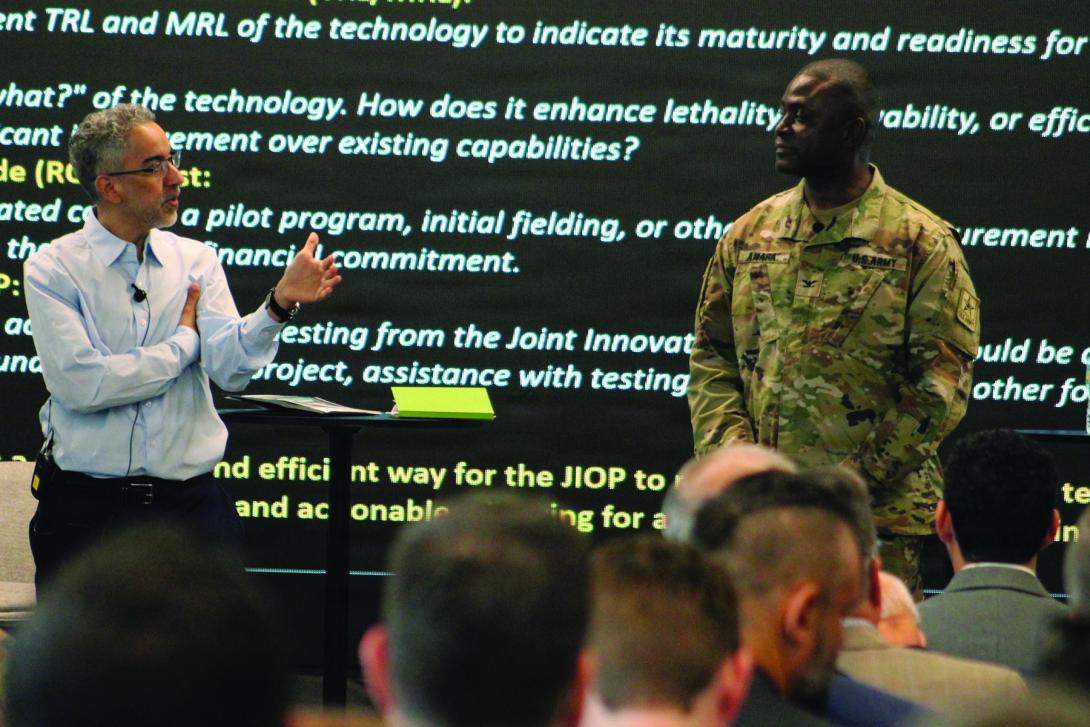
The Defense Innovation Unit and the former Army Futures Command, now the U.S. Army Futures and Concepts Command, provide capability development for warfighters by targeting strategic needs.
The Army, however, is seeing gaps in technologies needed more quickly at the operational level for its response forces that deploy rapidly around the globe.
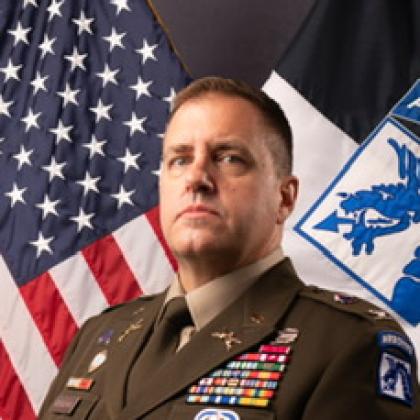
For this, the service is now turning to the Joint Innovation Outpost, known as the JIOP, which is led by Col. Thomas Monaghan, USA.
“Every piece of technology we develop at the JIOP has one ultimate purpose: to enhance the lethality and survivability of our soldiers on the battlefield,” stated Monaghan, in a written interview. “This is about ensuring our warfighters can dominate any adversary, anywhere in the world.”
To do this, the JIOP relies on the XVIII Airborne Corps—headquartered at Fort Bragg, North Carolina, and led by Lt. Gen. Gregory Anderson, USA—and leverages the corps’ contingency forces: the 82nd Airborne Division, 101st Airborne Division (Air Assault), 10th Mountain Division, 3rd Infantry Division and other specialized brigades.
Since the core mission of XVIII Airborne Corps is “to deploy a scalable, rapidly deployable headquarters and enabling forces to conduct sustained and combined arms operations anywhere in the world, on order,” the soldiers need technologies and capabilities for complex forward-operating environments—in weeks or months, instead of years, explained the chief technology officer for the XVIII Airborne Corps, Robert Braun.
Braun is a former signalier and chief warrant officer and was instrumental, along with Army senior leaders, in the JIOP’s establishment. He clarified how the JIOP was different than other military technology organizations.
“The Army was moving in the right direction when they established Army Futures Command,” Braun told SIGNAL in an interview. “They wanted to get after the same thing that we are doing in the JIOP, but the difference was that the Army Futures Command, at that time, was looking at the Army of 2040 and how to get after modernizing the Army as a formation, in both structure and technology, but looking at a much longer time horizon. DIU is looking at longer time horizon projects to change things for the department, so there was a natural gap that existed.”
The organization supports the secretary of war’s and the secretary of the Army’s directives to accelerate acquisition alongside soldier innovation by directly engaging tactical-level elements (the Corps forces) to evaluate capabilities for tailored testing and evaluations.
“We are very cognizant within the Corps of making sure that we are not doing things that are divergent from where the Army wants to go in the long-term approach,” Braun shared. “At the same time, we are able to inform that long-term approach.”
In just a short time, the JIOP leaders have built up a dynamic ecosystem of soldiers, industry and academia, identifying new tactical needs and evaluating and testing technologies. The organization reached initial operating capability last fall and was fully operational on January 26, Braun said.
“We have requirements that come in from a couple of different avenues,” he stated. This includes from the so-called DIRT Labs in each of the XVIII Airborne Corps’ divisions supported by the U.S. Army Combat Capabilities Development Command (DEVCOM).
“They all have DEVCOM-backed Catalyst Pathfinder-funded Defense Innovation Research and Technology, or DIRT, Labs,” Braun noted. “At those labs, the soldiers down in our divisions can print, they can do software development, they can do some textile manufacturing. There are some things that they can do to solve problems that they have, but they don’t have transition pathways.”
The JIOP’s role is to provide that transition pathway, to expedite the movement of ideas and innovative technologies from soldiers, the DIRT labs, training initiatives—such as Scarlet Dragon—and technology challenges, including the Dragon’s Lair competition series—into programs of record, procurement processes or partnerships with industry.
Essentially, the JIOP rapidly brings together technologies that can be mass-produced to fill a capability gap quickly across the service and joint force at a larger scale.
“One example would be the 82nd Airborne Division’s short-range reconnaissance drones,” Braun explained. “The drone was fielded in a very large Pelican case, something that was not so transportable. The soldiers would take the drone system out, bubble wrap it, try to protect it as much as they could, stuff it into their rucksack, so they could hit the drop zone, get it out of the rucksack, unwrap it, put it together and deploy it to do short-range reconnaissance.”
As a solution, soldiers from the 82nd came up with a soft-sided compartment sewn into their rucksack as the jump pack for the unmanned aerial systems (UAS).
“After refining the solution, Capt. Ben Daniels, a platoon leader in the 82nd, took the capability into one of the service’s Dragon’s Lair competitions, where we look at what is the most mature technology that comes out of these labs, and is the most prepared to transition into a program somewhere,” Braun shared. “Then, the JIOP has acquisition professionals that understand what transition really means, and we got that capability to a North Carolina company to mass-produce and put on contract back to the Army. Now that drone case will be a program of record capability that gets fielded.”
For that capability, the JIOP process includes language written into the requirements for future reconnaissance drones or other small UAS to comply with the certain dimensions of the new soldier-developed cases. “So that we are not redesigning a new case every time,” Braun said.
In addition, Braun said, Scarlet Dragon has been a successful venue from which the JIOP is harnessing technology. Scarlet Dragon is meant to enhance readiness, interoperability and lethality in support of the Joint Force, interagency partners and international allies, facilitating the sharing of live data and the integration of AI to optimize joint, interagency and partnered operations, according to the corps.
The training initiative is a three-times-a-year series that focuses on Combined Joint All-Domain Command and Control, Mission Command Information System and artificial intelligence (AI).
Another early success of the JIOP is from a different perspective—an industry idea coming directly to the military.
“We had an industry partner show up, and they said, ‘Hey, I’ve got a counter-drone round that I think you all should take a look at,” Braun remembered. “Okay, we have counter-UAS as one of our projects, let’s take a look, even though we’re not necessarily looking at sensors and effectors.”

We are very cognizant within the Corps of making sure that we are not doing things that are divergent from where the Army wants to go in the long-term approach.
The JIOP used an off-base range to test the company’s counter-drone capability using a ballistic dummy. “It was immensely successful as a round. ... I think they shot down around 1,000 drones and only had one malfunction ... and being able to link it into the ecosystem that we have established here [is great],” Braun said.
The leaders invited the project manager for ammunition to observe testing at the JIOP, and afterward, he indicated that the capability was something very much needed by the Army, even though they did not have a written requirement for it.
“It went through ATEC [Army Test and Evaluation Command] testing, and it is going to wind up being a capability that hits the Army as a counter-drone round, and it was just because a vendor showed up and they had an idea or a product of something that they believed we needed,” the CTO emphasized.
Additionally, the JIOP has specific acquisition authority that enables funding speed and flexibility. JIOP Director Monaghan received an acquisition delegation memorandum from Assistant Secretary of the Army (Acquisition, Logistics and Technology) Brent Ingraham. This allows Monaghan to execute funding like a project manager, Braun explained.
Monaghan has the authority to execute $50 million per project per year within the JIOP. And he also requested and received a $25 million-per-year budget for research, development, test and evaluation (RDT&E) funds. “That was a huge win for the JIOP,” Braun shared.
Through the Army Contracting Command–Rock Island, the JIOP can harness its other transaction authority to execute some of the solutions. Even more powerful, however, is the role of the 419th Contracting Command with the JIOP.
“The 419th Contracting Command jumped on board with us right away, and they put warranted contracting officers in the JIOP, so we have access to just about any contract vehicle that exists within the Army,” Braun stressed.
Because of this, the JIOP is transforming acquisition timelines. “We don’t need to develop an RFI [request for information] to go out to industry where it is just this long one-to-three-year process to develop,” he noted. “It is like, ‘I’ve got it now. I want to show you.’ And yes, that’s exactly what we need. Let’s get that into a program, and let’s get that out to the Army.”
The problem is that acquisition personnel are not used to this level of spending agility, Braun stated.
“What we are having a really difficult time with, in the implementation of that authority, is a core is not used to having access to that resource and getting people to understand the differences between RDT&E funds, sustainment money, procurement money,” he said. “They say, ‘You are asking for something that already exists in the Army,’ and they think that we can’t legally buy that through the JIOP, so there is some learning and growing pains that we are going through.”
“What makes the JIOP different is the problems that we are focused on are the 50-meter targets that we have to satisfy to be able to be prepared to go anywhere in the world and fight tonight,” Braun noted.
Every piece of technology we develop at the JIOP has one ultimate purpose: to enhance the lethality and survivability of our soldiers on the battlefield.

Comments