
USARPAC, Allies Deploy Long-Awaited PACOM Mission Network
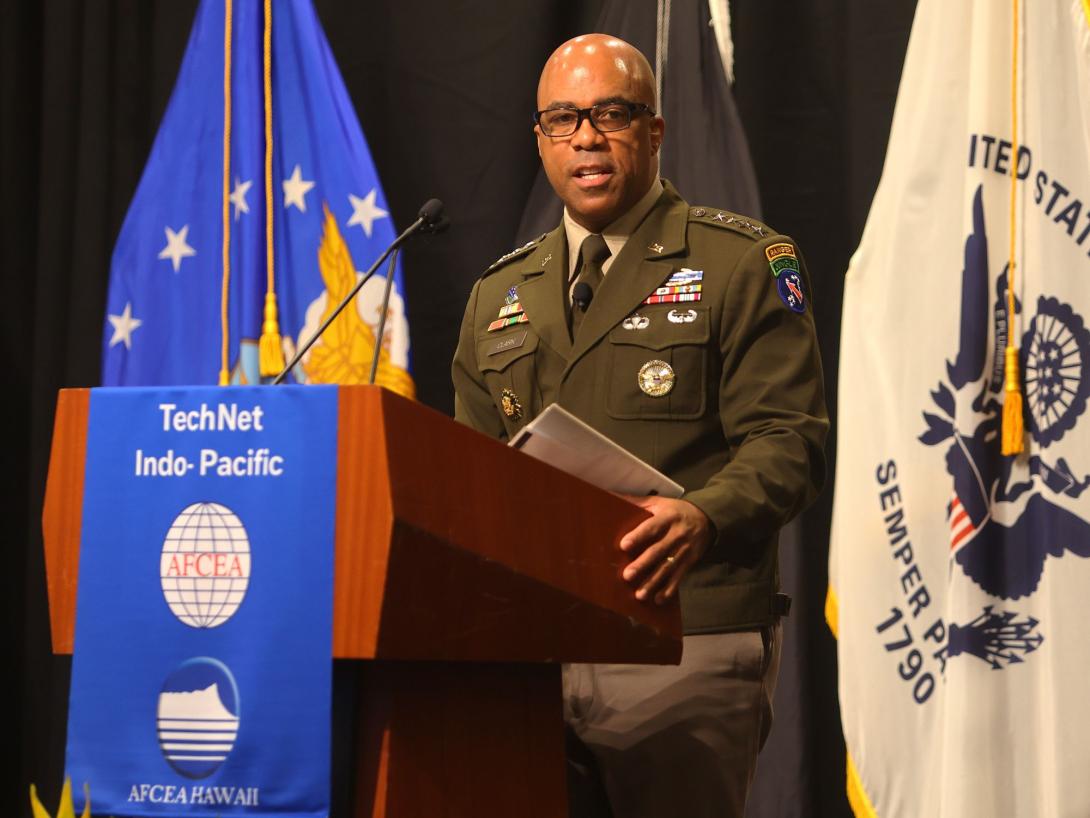
U.S. Army officials, with the help of their partners in the Japanese and Australian militaries, have unlocked a groundbreaking communication capability in the Indo-Pacific region. The multinational forces deployed the PACOM Mission Network (PMN) at Yama Sakura 91, Gen. Ronald Clark, commanding general of U.S. Army Pacific (USARPAC), announced during TechNet Indo-Pacific 2026 in Honolulu.
The toolset is a layered, resilient mesh network that can seamlessly transfer target quality data across all three allies. Via the PMN, personnel achieved real-time trilateral fires integration, optimized a digital kill chain and leveraged Maven smart systems to scale on the fifth day of the nine-day exercise. Furthermore, on the sixth day of Yama Sakura 91, officials produced 200 digital fire emissions. As depicted through this exercise, the ability to work together and enhance collaboration across continents can ultimately protect soldiers on the battlefield.
“This proves that when we provide our formations shared redundant zero-trust architecture, we can collapse kill chains from hours to seconds and ensure that even in a highly degraded contested environment, the joint and combined force can still communicate, coordinate and execute,” Clark explained during his keynote address. “That capability can reduce the time required to move from identifying a threat to making an informed decision from hours to seconds, which will literally save lives in combat.”
“When we share data and synchronize our systems and innovate alongside our allies and partners, we transform the theater from a collection of isolated capabilities into an unbreakable deterrent force,” he added.
This announcement was the culmination of a journey that was in its early stages two years ago and faced early hardship. At that time—which is when Clark took command of USARPAC—and at Yama Sakura 89, warfighters representing the same three countries were struggling to operate, as Clark called it, “a swivel chair for voice communications,” as they were “passing a hand mic literally from one to another to ensure that we had voice communications because our efforts to connect digitally were completely incompatible.”
The PMN addresses this issue.
Clark announced the news as he was emphasizing the importance of his Service Component Command developing and fostering partnerships, which he labeled the second of three focal pillars at USARPAC to achieve tactical, operational and strategic victory.
USARPAC leaders are enhancing interoperability and their relationships with partners in several other ways, such as campaigning efforts and Operation Pathway. The latter is a series of over 50 exercises, operations and investments taking place annually in the Indo-Pacific region.
“These are not mere exercises; they are rehearsals on key terrain that build all-important human, procedural and technical interoperability,” Clark assured.
Expounding on the partnerships pillar, Clark stressed that “this deep network of allies and partners is our true asymmetric advantage. [It’s] something that no adversary can duplicate or replicate, because you cannot surge trust in a crisis. It must be forged over time through shared realistic training and persistent presence on the ground with our allies and partners.”
Command and control networks must be resilient, secure and survivable to attain effective deterrence on the modern-day battlefield. To maintain their advantage, “our partners must be integrated into this secure data ecosystem,” Clark explained further. “We cannot innovate alone. We must modernize together.”
In addition to partnerships, USARPAC focuses on two other pillars: its people and the responsibility to prevail in competition, crisis and conflict.
When we share data and synchronize our systems and innovate alongside our allies and partners, we transform the theater from a collection of isolated capabilities into an unbreakable deterrent force.
To support its people, the Army is pursuing a strategy focused on modernization as leaders are focused on quickly procuring critical systems that reinforce how they fight; however, gaining access to these types of capabilities is only one piece of the puzzle. The ability to gain the edge is also up to the warfighters themselves. Soldiers must be fit, forward and able to fight, according to Clark. During his keynote speech, Clark exhibited pictures of soldiers experimenting with new capabilities.
“Make no mistake about it: the soldiers you see in these photos are curious,” Clark pointed out. “They’re technologically adept. They’re constantly looking for better ways to accomplish their missions. They want to get their hands on the newest gear, take it to the field, test it and push it to the limits.”
Commanders have a role to play in this process as well, he added. “Our responsibility as leaders is to continue to foster a culture that encourages innovation, experimentation and adaptation.”
Soldiers in USARPAC and the 25th Infantry Division are putting this practice into action. USARPAC personnel are integrating machine learning into their staff processes to speed up their analytic decision-making, and 25th Infantry Division units are leveraging additive manufacturing to design, develop and deploy tactical unmanned aerial systems. They produce 45 drones per week, according to Clark.
The commanding general of USARPAC added that they are using autonomous, unmanned aerial resupply systems, like their Joint Tactical Autonomous Aerial Resupply System, to maneuver around vulnerable port infrastructure and keep joint forces fueled and armed.
To achieve the third and final pillar—their responsibility to prevail in competition, crisis and conflict—Clark is voicing the need for survivable, resilient sustainment infrastructure that operates when traditional infrastructure is disrupted or unavailable. They can only meet this need with the assistance of industry.
“Our Army and the Joint Force cannot solve these problems on our own,” Clark told a room full of individuals in the public and private sector. “We need the technical acumen, industrial capability and entrepreneurial drive in this room to help us.”
TechNet Indo-Pacific is co-sponsored by AFCEA International and AFCEA Hawaii. SIGNAL Media is the official media of AFCEA International.
Comments