
Advancing Geo Simulation Technology for Precision Missions

In national security, speed, efficiency and accuracy are essential. Booz Allen’s advanced space mission performance simulation technology is transforming how missions prepare, adapt and succeed in complex environments. A NASA Search and Rescue study demonstrated how this innovation can improve real-time operations and help save lives.
Providing Precision: NASA Search and Rescue
In a recent NASA Search and Rescue exercise, Booz Allen tested new high-performance space-based geolocation capabilities by towing an emergency rescue beacon in the Pacific Ocean and demonstrating more accurate performance than existing approaches. We quantified the performance of a new space-based geolocation algorithm by evaluating both synthetic and real mission data within our dynamics simulation framework to inform algorithm optimization and accelerating decision-making.
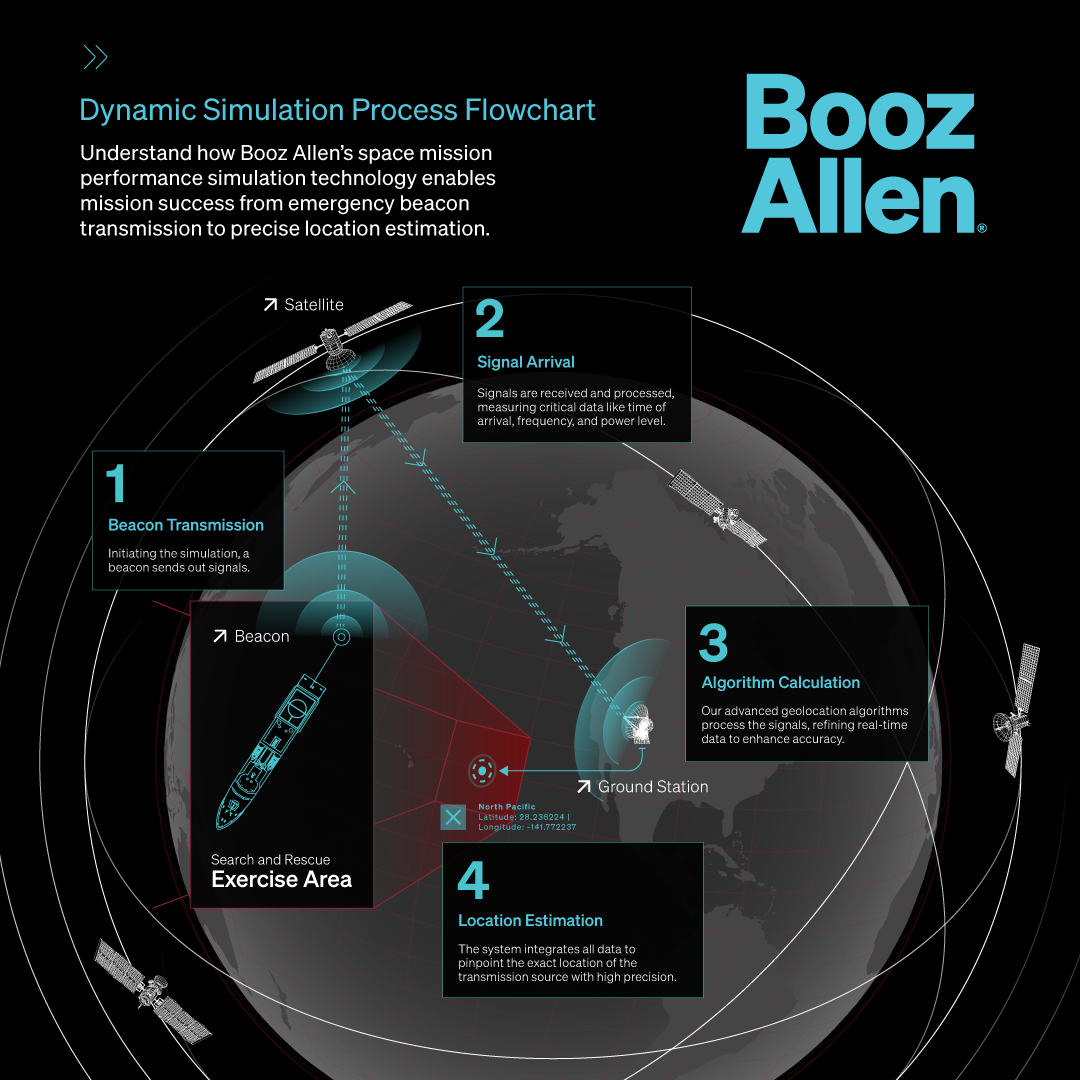
Our dynamics framework characterized performance of competing geolocation algorithm implementations, including time difference of arrival, frequency difference of arrival and other techniques to evaluate beacon geolocation performance in a variety of environments and space geometries. Algorithms are further tested with hardware-in-the-loop (HIL) using our wideband real-time signal processing capabilities.
By processing data from NASA’s database, our solution showed potential for real-time beacon geolocation when fully integrated with a base station. We refined our geolocation algorithms to achieve an accuracy within 3-5 km for 95% circular error probable (CEP), surpassing the SARSAT system requirements of 7 km for 95% CEP. This innovation enhances search and rescue mission effectiveness, ultimately helping to save lives.
Dynamic Simulations for Accurate Predictions
Our geolocation simulation framework, dynamic sim within the R.AI.DIO® software development kit, simulates complex scenarios like orbital dynamics of satellites or movement dynamics of various objects such as airplanes, cars and individuals. It optimizes geolocation algorithms and analyzes radio frequency communications links by considering factors such as time of arrival, frequency and power level. Through these simulations, we optimize algorithms and system locations, enhancing the capability to locate transmission sources and predict sensor coverage.
Enhanced Geolocation With Integrated HIL Simulation
Booz Allen’s wideband heterogeneous signal processing edge receiver integrates with R.AI.DIO® kit dynamic sim to provide additional HIL algorithm performance verification. This capability digitizes multiple GHz of radio frequency spectrum per channel, providing:
- HIL signal processing algorithm verification for diverse wideband sensing applications
- Sensor Open Systems Architecture rack-mounted form factor
- Remote reprogramming capability
By integrating this hardware component, we ensure our simulations are verified under realistic conditions, leading to adaptable and reliable signal analysis solutions that meet evolving mission demands.
Broad Applications: From Space to Ground
Our space mission performance simulation technology supports various national security missions by enhancing geolocation algorithm development, direction finding and resource management. Applications include:
- Optimizing satellite tracking
- Assessing coverage maps
- Processing radio frequency transmissions across diverse environments
These robust and modular solutions empower national security teams to act with speed, precision and confidence.
Discover how we’re advancing signals analysis and capabilities to deliver mission advantage. Learn more here.




Comments