
The Army Positions Its Networks, IT and Schoolhouse for a Complicated Future
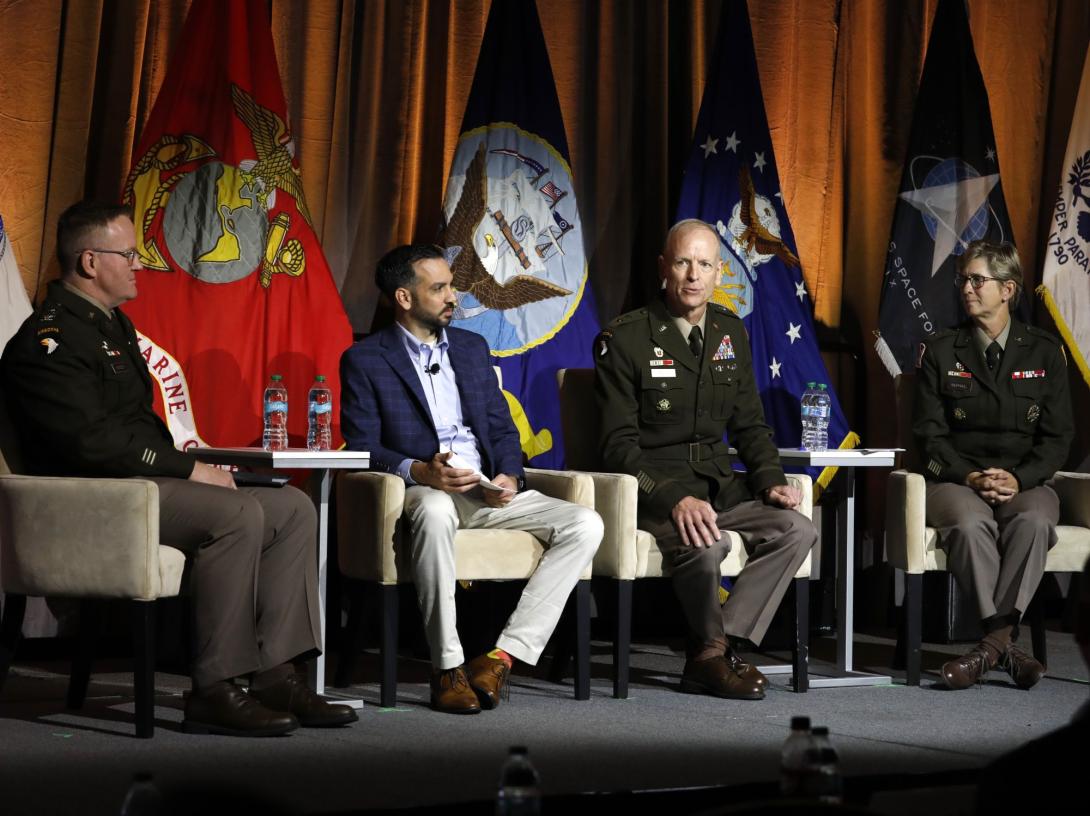
The confluence of sensors and systems providing data, advancing artificial intelligence (AI), and the need for the cybersecurity of that data means the U.S. Army must pivot to meet the needs of soldiers on the modern battlefield, according to Army leaders.
“If we accept the premise that the modern battlefield of data is a weapon system, where AI is the firing mechanism, data is the ammunition, we need the soldier to actually fire it by pushing that weapon system to the tactical edge,” explained Col. John J. Hosey, USA, 6th chief of cyber and commandant of the U.S. Army Cyber School.
The Army must balance data bottlenecks and “institutional collisions” while technology is quickly being fielded, Hosey noted, speaking at AFCEA International’s TechNet Augusta conference on August 20.
To succeed, the cyber protection team expert said, the service must leverage its people while protecting its networks.
“We are trying to field technology at speed, relying on a human capital pipeline to actually operate the technology, and then [we] have to defend the massive machine speed data flows, [in] live, contested environments,” Hosey said.
For Army Acting Chief Information Officer Gabriele Chiulli, it is not business as usual.
“It is a really interesting time we have right now,” Chiulli said. “The momentum going on with AI, the friction points that we are seeing, the positive friction of trying to get capability out as fast as possible, the influx of new technology, and the innovation going on. It is one of those things where we are trying to relook at everything we're doing in the Army.”
Chiulli said he understands the Army’s policies surrounding information technology do not necessarily support this innovation, especially at the scale the Army needs.
Take AI, for instance, and the use of AI tokens, or the units of data processing to run an AI query. Leaders were joking with the CIO that the demand for AI tokens was quickly outpacing resources.
“They were joking about the fact that people had to come to me for tokens, when we are trying to scale out AI across the Army,” Chiulli said. “It is not infinitesimal to think about how big the Army is. We are talking about over a million people.”
As such, one of the CIO’s main priorities—four months on the job—is to make information and data more “consumable.”
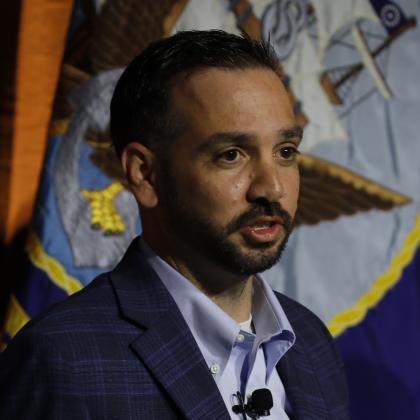
“Policies in the Army don’t make sense for a lot of what we are trying to do from an agentic perspective and all the new technologies,” he explained. “One of my priorities is to figure out how to make more consumable information from a policy perspective. So, that it is not as ‘Army-fied’ as I sometimes call it. Really trying to figure out how to make that user manual for both industry and for the warfighter, so when you search, ‘How do I use AI?’ you get the real answer.”
This includes understanding how the Army is going to plan and budget for an advanced workforce and providing the associated governance for data and AI innovation.
“We are starting to get that governance perspective together, to see what we want to apply AI to and what are those important problem sets,” he offered.
The successful opening of the Army Data Operations Center (ADOC) at Aberdeen Proving Ground, Maryland, in April is already having a positive impact, Chiulli shared.
The ADOC is meant to transform how the Army manages and utilizes its vast data feeds, systems and resources by connecting commanders at all levels to the Army’s enterprise data, according to an April 9 Army public affairs report.
The CIO’s role—and another one of Chiulli’s priorities—is to assist the ADOC with data governance and interconnectivity.
“One of the other priority areas that we have been working through is how do you make an organization successful in getting data pushed between our different systems,” he stated. “There’s hundreds, maybe even thousands of systems in the Army. When you start getting to the point where you are at a data kind of level, you aren’t thinking about the number of systems. You start thinking about what are my authoritative data resources, and how should I tag that data, and how do I get after that data?”
This means making sure systems are interconnected down to the application programming interface, or API, level.
Meanwhile, the Army Network Enterprise Technology Command (NETCOM) faces 1.2 million cyber attacks a day to its systems, said Maj. Gen. Jacqueline D. McPhail, USA, commanding general, NETCOM.
NETCOM operates and defends the service’s computer networks, including defending the so-called DOWIN-A network, the Army’s piece of the military’s information network previously called the DODIN, McPhail said. NETCOM also delivers theater-focused, unified information technology and cyber effects nationwide and tactically around the globe.
NETCOM is examining how AI, if possible, can help in the cyber defense of the network.
“When we talk about data, we provide that highway that the data traverses,” the commanding general said. “We secure, operate and defend that highway, and it is very interesting as we look at AI and how we can leverage AI to do that at the speed of need and at the speed of our adversaries that are trying to attack both the data and the network.”
One of my priorities is to figure out how to make more consumable information from a policy perspective.
The creation of specific cyber organizations over the last few years has helped NETCOM, McPhail continued. They are able to secure from “the desktop to the foxhole.”
“I think it was under Gen. [Stephen] Fogarty’s purview that we started establishing the the RCCs, the regional cyber centers,” McPhail stated. “And then Gen. [Maria] Barrett and Gen. Christopher Eubank, they stood up the Global Cyber Center. And why is that important? Because the Global Cyber Center is the focal point for the security, the operation and the defense of the DOWIN-A. And behind the scenes is the engineering and designing.”
As far as what she’d like from industry, the commanding general said she needs a digital twin of the DOWIN-A.
For Maj. Gen. Mark Miles, USA, deputy commanding general, U.S. Army Cyber Center of Excellence and Fort Gordon, ensuring force modernization, doctrine and building the training for the next generation of soldiers and leaders includes an understanding of how the Army will engage with its networks and data.
“It starts with how do we fight,” Miles offered. “How in 2026 do we fight networks? How in 2026 do we, as an Army, fight the electromagnetic spectrum? I’ll tell you that’s an evolving question. That is a question that’s impacted by innovation. That’s a question that enables artificial intelligence. And the answer to that question in 2032 absolutely isn’t the same answer as it was for our Army in 2026. That is the question that eats a lot of the time inside the gates of Fort Gordon.”
The general emphasized that the schoolhouse at Fort Gordon is preparing soldiers to fight anywhere, and that requires a comprehensive agility.
“Our job as an Army is to be prepared for the most advanced adversaries, in the most challenging environments,” Miles stressed. "We are not building eight different armies to fight specific threats in specific areas.”
To succeed on the modern battlefield, therefore, the Army must master how it trains data-driven soldiers and how it distributes and locates data. And it doesn’t stop there, Miles said.
“Then you go into organization, and where is the talent inside of a formation, inside of a corps, inside a division, inside of a brigade, that enables that movement of data and secures that data on the battlefield,” he said..
With the experience of Ukraine and wars in the Middle East, the Army is gaining “lessons learned,” and they all point back to decision superiority.
“The constant feedback that we get is, ‘Hey, we’ve got to be able to make decisions,” Miles confirmed. “We’ve got to have decision superiority in even the most denied environments, even in the most challenging. Well, that infers some kind of local data storage. That infers a compute and store that maybe from the organizational perspective is agile, relating to decisions that commanders can make on how they position material across the battlefield.”
TechNet Augusta is organized by AFCEA International with help from the U.S. Army Cyber Center of Excellence. SIGNAL Media is the official media of AFCEA International.

Comments