
Building Data Resilience To Adapt to Rapid Technology Evolvement
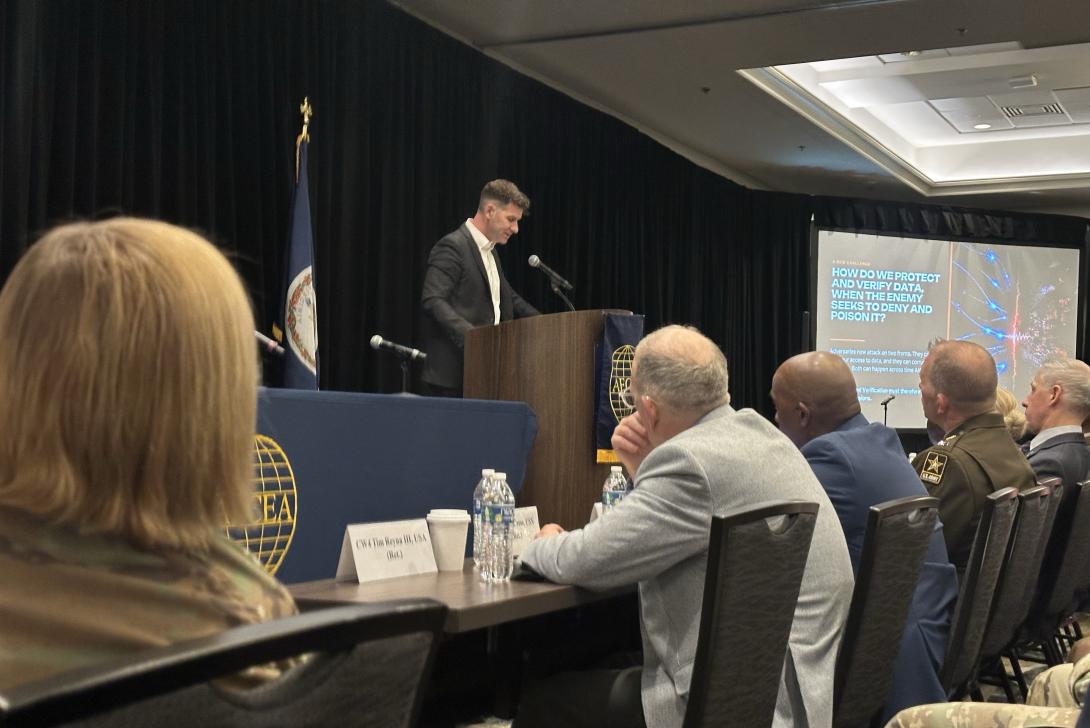
The 2026 Annual Data Forum, hosted by AFCEA International, welcomed industry partners, military personnel and academics on a bright November morning. Peter Singer began this year’s forum with a full audience and a presentation titled Tomorrow’s Fight: What Can We Predict of the Future Warfighting Ecosystem? The presentation examined the future progress of defense communication and technology utilization and training, in theory and practice.
As technological capabilities emerge as rapidly as they advance, threats and vulnerabilities advance alongside. Resilience is a tactical edge.
“It feels overwhelming, but we’re really only at the start of it right now. Every single organization, whether it’s the army to a university [or] to a national government. They’re all trying to figure out, ‘how do I deploy this technology?’ But right as we’re deploying it, the frontier is moving forward,” explained Singer.
Singer is a strategist and senior fellow for New America, a nonprofit think tank based in Washington, D.C. He is also a professor of practice at Arizona State University. Overall, he argues that shaping forces must be identified to define the world’s emerging technologies in predicting their effects. According to his assessment, human judgment matters in prioritizing protection and verification.
“We need to understand that AI [artificial intelligence] is a dual vector. It is a weapon. It is also a target,” Singer said. One of his concerns is the advancement of the state’s adversaries’ capabilities. Key players like Russia and Iran are deploying technology collaboratively, rather than in isolation. Others like China, which expects to be a fully intelligized force by 2035, put pressure on U.S. armed forces to evolve data infrastructure and system training. As the data capabilities expand from scaling to weaponry, the attack surfaces of threats will grow. Singer proposes building resilience through deception.
When looking at the various training manuals across the forces and in our allies, such as France and Australia, Singer found in his studies that deception was an undemanding skill. In practice, this can look like cyber and machine decoys, AI synthetic media. Singer describes the skill as a muscle that has atrophied through decades of Western dominance.
“The other aspect we found is that the industry is not ready for the need for deception because it’s not getting the demand signal for it,” explained Singer. “Robotic deception is something that the Ukrainians and Russians have been doing a lot of. We don’t have a large industry creating deceptive elements,” said Singer.
Singer’s proposal aligns with his beliefs in training the next generation of soldiers, who are the most digitally native group. Mental agility is the ability to find clarity within complexity.
“It’s about not just brawn, but also brains. It’s people with mental agility under pressure. Resilience to information and cognitive warfare. It’s bringing that together, and what I’m getting at is if we want not warfighters, but war winners, it’s people with critical thinking skills,” said Singer.
The Annual Data Forum is hosted by AFCEA International with assistance from the U.S. Army G-6. SIGNAL Media is the official media of AFCEA International.



Comments