
Comparing the Present to the Past: 25 Years of Evolution in Aerial ISR Capabilities
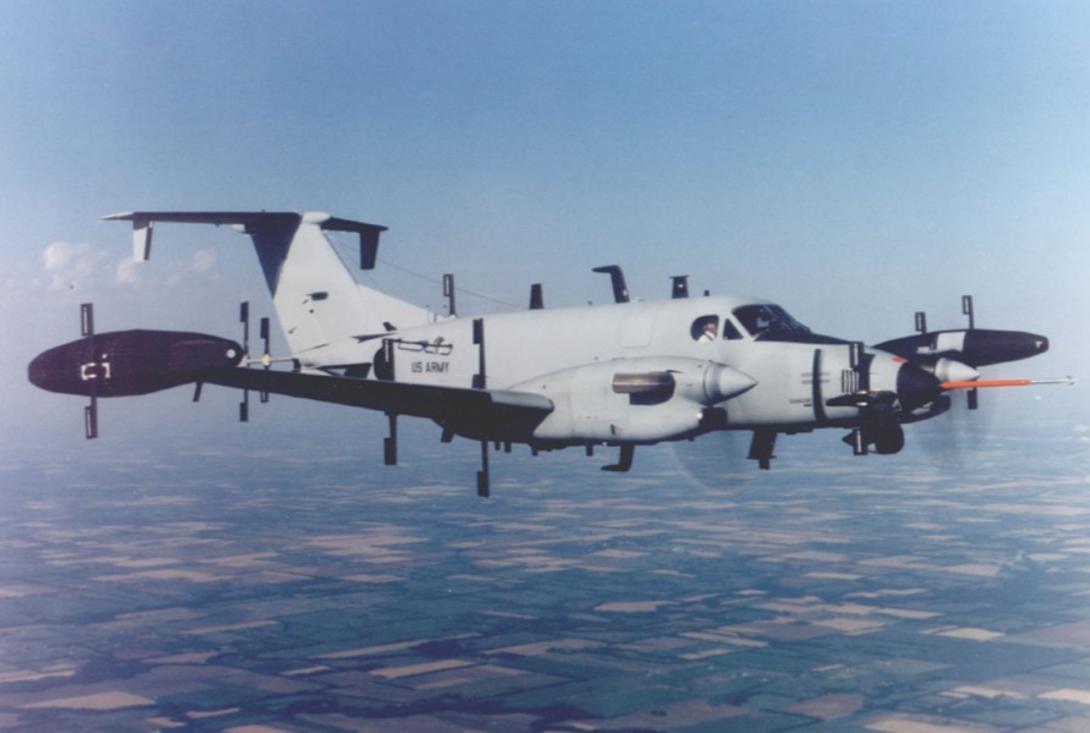
Defense leaders are embarking on a new era in intelligence, surveillance and reconnaissance (ISR) technologies, and U.S. Army officials are representing this monumental and lengthy transition by the production and prototyping of one specific tool: the High Accuracy Detection and Exploitation System (HADES). Furthermore, not only does this aerial ISR capability mark a new chapter in the field, but it also fills in gaps that existed during 9/11 and comprises and packs several advancements that crews have made in space over the last 25 years or so, including radar- and camera-related improvements, sensor upgrades and a more efficient data retrieval process.
HADES is an aircraft designed to provide Army personnel with the ability to gather intelligence from the air and at high altitudes. They will deliver the first HADES prototype by the end of the calendar year. Defense officials will then test the prototype, and as that occurs, crews will be constructing the second HADES prototype, per Col. Joe Minor, program manager for the fixed-wing fleet in the Army. Despite its novelty, Minor and Julie Isaac, project director for sensors-aerial intelligence under the Capability Program Executive Intelligence and Spectrum Warfare, said that they are already striving to improve HADES’ sensors to enable additional and deeper sensing at greater distances.
Happening concurrently with the testing exercise, leaders will also gather feedback on the aircraft. Their goal is to use this feedback, other lessons learned and upgrades in technology to produce one new and improved prototype of HADES per year, according to Minor.
The capability showcases a groundbreaking radar capability called the active electronically scanned array. Technologies that were available around the time of 9/11 and served similar roles to HADES featured a mechanical steering type of radar, according to Isaac. Due to the ever-evolving threats and technologies posed by enemies, possessing the ability to conduct ISR missions while staying as far from the adversary as possible is a critical need on the modern-day battlefield for military officials.
By leveraging the active electronically scanned array, HADES can operate from greater distances, function more rapidly and travel at a quicker speed. More specifically, the system can fly at altitudes of 40,000-plus feet, and it can reach anyone in the world within 24 hours, per Isaac and Minor. These successes are steps in the right direction in the journey toward achieving advanced and far-reaching ISR tools.
“Right after 9/11, we could be in battle spaces where we were right over top of our adversary and taking pictures in an electro-optic/infrared environment and taking pictures of things right over top of them,” Isaac described during an interview with SIGNAL Media. “Now that we have to be a little bit farther away, it’s really [about] getting after that clear resolution, high-resolution radar imagery as quickly as possible at a longer range.”
Isaac added that HADES consists of cutting-edge sensors that are connected and can share data with each other rather than operating individually. “All of the sensors can work together, and they can be fused together to get after analysis so that one sensor might be able to detect something and then send that data over to another sensor to then take an accurate picture of it so that there’s more of that instead of these silos that are being analyzed offboard, which is a huge jump into the future of making sure that we’re getting the most out of time for our warfighter,” Isaac said.
Not only can these sensors communicate with one another, but they can also adjust to a new target mid-flight. Now, if the mission changes after HADES takes off, operators can reconfigure the sensors accompanying the aircraft to attack a different target than what was set before it left the ground.
Lastly, HADES can execute on-board computing, and operators can access this analysis remotely or after the mission concludes, giving crews a timelier way of gathering the data.
In addition to the technological upgrades that have taken place over the last 25 years, HADES also embodies a shift in approach that has occurred over the last several decades, even predating 9/11. Minor dissected this transition in three parts: pre-9/11, the nearly two decades following 9/11 and the recent past and present.
Before 9/11, engineers designed the majority of systems in the fixed-wing fleet to address near-peer competition, particularly for the Cold War. Once 9/11 happened and as these “Cold War-built” platforms started to age, leaders in the Army and the entire U.S. military redirected their focus from that near-peer competition ideology to counterinsurgency (COIN) operations, the objective of which is to use a combination of military and civilian-based measures and operations that members of a single government initiate to control and neutralize the root cause of an insurgency, according to an Army University Press article written by Sgt. Maj. Wilton Gleaton of the Alaska National Guard.
This change in mindset meant that for 15 to 20 years after 9/11, Army officials prioritized systems and aircraft, which were mostly categorized as electro-optic/infrared- and signal intelligence-based technologies, that helped bolster their COIN operations in Afghanistan and Iraq. As for the third part, starting around 2019 and 2020, Army personnel began the journey that they are on right now: steering their attention toward jet-based aircraft and performance, for instance, the HADES capability.
Now, despite their attention shifting from one area to another, Army officials continued to research and build upon the systems and platforms of the previous era, Minor added. The transitional periods created a “clean sheet design,” which provided crews with the opportunity to reimagine what these older tools could look like and accomplish if they applied and attached the innovative technology that is available today—leading to significant technological breakthroughs.
“It’s unique in that [the leaps in technology were] not incremental,” Minor said during the same interview as Isaac. “Most of the time, you get a little bit better, a little bit better, a little bit better, but in this case, because we sort of shifted our focus to COIN operations for 20 years, we were able to really make a generational leap ahead in not only sensor technologies based on processing power improvements and other things, but also in the platform and the way that we bring them together and then are able to quickly process and export that information and get it into the user’s hands.”
Minor explained this process further by comparing it to the evolution of the cellphone. People used the car brick phone for years until researchers began to ask the question, “What can we do with the phone if we apply modern technology to it?”
“And it’s been really a generational leap rather than an incremental change just based on the fact that we shifted our focus for almost 20 years to COIN,” Minor added. “So, I think what makes HADES, as well as our other jet-based aircraft, so exciting was the opportunity to incorporate a clean-sheet design with modern technology after having stepped away from that problem set for 20 years for other focuses that were more urgent to our nation.”

Jet-based and ISR-focused aircraft, such as HADES, play an essential role within the U.S. Army. These capabilities allow Army leaders to gain vital insight into the motives, movements, maneuvers and maturation of their adversaries—insight that can determine whether they win or lose the fight. In fact, Minor stressed that every aspect of a military and political operation starts with information and intelligence.
“Lethality starts with intelligence; operations start with intelligence,” Minor said. “You need to be able to understand your adversary and understand what’s going on in the world and the world situation to be able to make good decisions. We talk a lot about lethality and targeting, whether it be long-range hypersonics or other kinds of munitions or ways to defeat adversaries, but unless you know what that adversary is doing and what those capabilities are, you don’t know what you need to defeat [them], and you don’t know where you need to shoot.”
Additionally, HADES’ ability to conduct these critical surveillance missions from far away is invaluable toward winning the future fight, as the modern battlefield is evolving and moving toward a long-range conflict. Minor warned that soldiers will not be able to pop their heads out of a trench and see the enemies as they did during World War I, or they will not be able to look across the battlefield to see their opponent as they did at Gettysburg or Valley Forge. Given the plethora of advancements that crews have made in technology, like HADES, these processes will take place from long distances, and leaders must adjust to earn the edge in the ISR space, which Minor argued is just as consequential as developing the best weapons.
“Intelligence is maybe not as sexy, or it doesn’t make as big of a bang, so to speak, as an artillery piece or a missile or something like that,” Minor said. “It is kind of a quiet, super important piece [that you need] before you can do anything impressive with those other investments, so they need to go hand in hand. You can’t know where the target is and not have something that can strike it, but also you can’t have something to strike that target and not know where the target is. Both are equally ineffective without the two working together.”


Comments