
Air Combat Command’s A6 Embraces Complex Role
The U.S. Air Force’s Air Combat Command (ACC) is readying for the future fight, tackling priorities laid out by Gen. Adrian Spain, the ACC commander, which include readiness across all domains; warfighting excellence; adapting to the strategic environment; bringing the future forward; and empowering leadership.
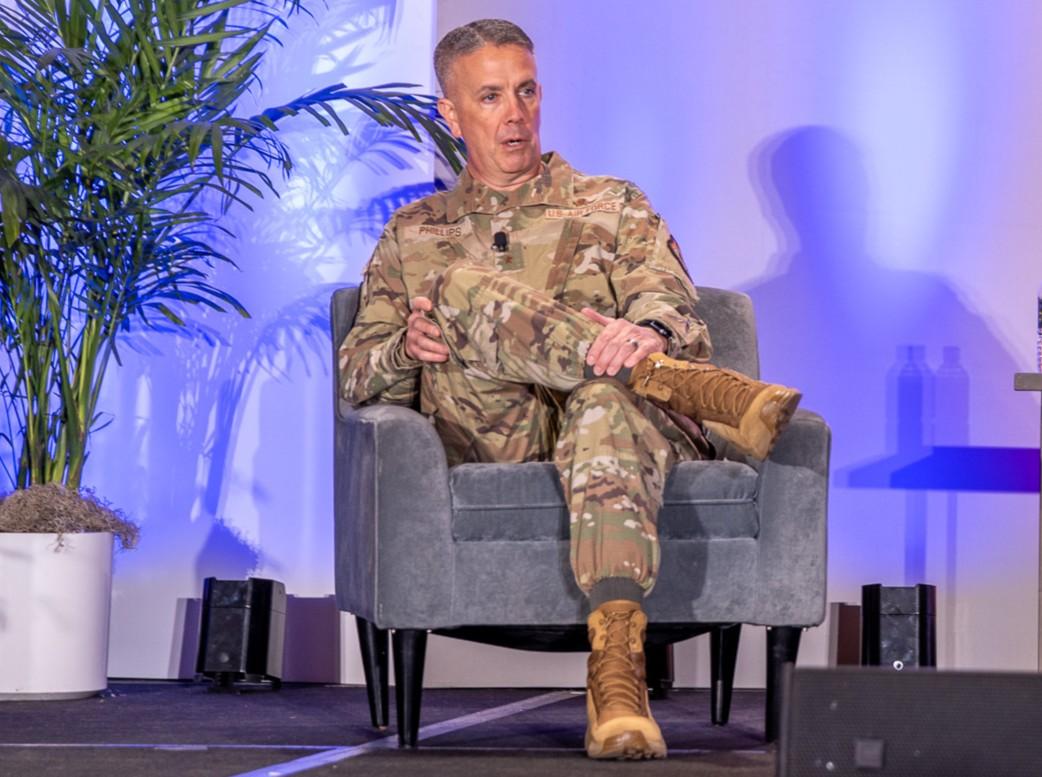
“For warfighting excellence, Gen. Spain has charged us to come into work every day and just get a little bit better so we are a little bit more ready the next day we come into work, so that if and when we ever do have to fight a near-peer adversary, we are as ready as we can possibly be,” explained Brig. Gen. Jeffrey Phillips, director of Cyberspace Operations and Warfighting Communications and chief information officer, aka the ACC A6.
Phillips spoke with Brig. Gen. (select) Lauren Courchaine, USAF, director, Communications and Cyber Systems Operations, AF/A6, Headquarters USAF, during the Rocky Mountain Cyberspace Symposium, in Colorado Springs, on February 5.
Supporting those priorities means moves of his own to bring modern cyberspace operations, command and control, enterprise-level information technology and advanced warfighting communications to airmen.
ACC, located at Joint Base Langley-Eustis, Virginia, is the Air Force's largest major command (MAJCOM) and means a global reach for those capabilities and technologies.
“For enterprise information technology, for example, we are the lead command for that,” Phillips said. “We go out to the other MAJCOMs. We ask them what their requirements are. We try to support them through the enterprise information technology councils, boards and panels.”
Notably, the ACC A6 role has shifted over the last several years, including from an October 2024 name change by the Department of the Air Force (DAF), from Cyberspace and Information Dominance to the Directorate of Cyberspace Operations and Warfighting Communications, given the evolving mission and responsibilities of the organization. The move also highlighted the ACC A6’s role in providing enhanced cyber capabilities and support to airmen, Guardians and joint forces.
Here, Phillips is relying on his gunslinger experience, as a former commander of the 67th Cyberspace Wing, Joint Base San Antonio-Lackland, Texas, the organization responsible for cyber operations.
To make sure ACC has integrated cyber effects into the tactical edge of its combat portfolio, he is working with an ACC division to deliver its cyber weapon systems.
“We have a division in A5 that is focused purely on the requirements and acquisition of our cyber weapon systems,” he said. “Then we have the Cyberspace Capability Center in ACC. They work closely with the 688th [Cyberspace Wing], with the acquisition community.”
Phillips also provides the strategic vision, policy, guidance and advocacy to drive the engineering and integration to build, extend, operate, secure and defend the Air Force portion of the Department of Defense Information Network, or DODIN.
Since ACC’s elevation to lead command of the service’s MAJCOMs, that makes the ACC A6 role all that more complex.
“ACC is the lead command for a lot of things,” Phillips said. “Since 2018, we have been the lead command for cyber and comms. We still have that role today. And so, we do a lot of things on behalf of the other MAJCOMs. One big thing we do is lead deployable communications. We define the requirements. We work with the acquisition community to buy and deploy those capabilities.”
Courchaine asked Phillips how it feels to be “the A6” for the MAJCOMs, noting that since he is coming from the ACC, having to lead the lead command functions, he will have his hands in everything that they do.
“Yes, the majority of the MAJCOMs have reached out to me since the announcement came out last week, and they have all told me that they will be my new favorite MAJCOM,” Phillips laughed. “They have a lot of work to do. And I think that that relationship with the MAJCOM A6s is really important.”
And above the ACC A6 is a revamped DAF A6 role.
Last July, the DAF created the Air Force A6 position, known as the deputy chief of staff for Warfighter Communications and Cyber Systems, led by Maj. Gen. Michele Edmondson, USAF. The creation of the Air Force A6 office separated the responsibilities for communications and cyber systems from the prior DAF A2/6 framework.
Phillips and Courchaine applauded that this role is led by a "17," the Air Force career code for cyberspace operations officers (including warfighter communicators and cyberspace effects operators). It reflects the increased importance for cyber and communications at the DAF level.
“I wanted to highlight something that I think is really important from this summer,” Courchaine shared. “Many of you have seen the announcement, but for the first time since Gen. Basla held the position of Air Force A6 (in 2012), we now have a 17 that's going to be the Air Force A6. I'm really excited that we have finally put a 17 back into the newly formed A6.”
Phillips already sees support from Edmondson, who took on the role in July.
“She jumped right in, and she championed us from the very beginning,” he shared. “I was in industry engagements with her virtually earlier this week, since we could not do them in person, and I was listening to her talk, and she has really owned the themes, the messages that we need to provide to our industry partners to find the requirements that we need to be successful to be able to win in the future.”
And as for Gen. Spain’s fourth priority—bringing the future forward—Phillips reports that they had some great initial success in their CIO duties of tackling “tech debt” and being able to replace aging digital infrastructure.
That tech debt that we had at those bases is gone, and we did it roughly six months per base.
The goal, Phillips said, is to deliver capabilities at a scale and speed that they have not been able to do in the past, under budget, which is not a small feat.
“He has charged us to deliver today's technology with today's dollars, to stop getting stuck in that five-year acquisition cycle,” Phillips explained.
Essentially, they have had to be creative.
“A lot of you are familiar with the Base Infrastructure Modernization program,” Phillips relayed. “We started that when [now retired] Brig. Gen. Chad Raduege was actually in the seat, in the 2018-19 timeframe, and we are just now starting to deliver those capabilities. That’s way too long. And so, at ACC, we took a different approach.”
They had to go outside of the normal acquisition channels, developing a commercial solutions offering contract vehicle to modernize the rest of ACC’s military bases.
“I was getting emails from wing commanders at Shaw, at Seymour Johnson and other bases, saying, ‘Hey, sir, our network is down again, and we have been down for three days,’” Phillips explained. “[They] can't support the missions of the bases when the networks are down. So, we tried to find a novel way to go outside normal channels and deliver the help that the wings needed.”
So far, they have been able to modernized six of the 12 ACC installations with brand-new digital infrastructure.
“That tech debt that we had at those bases is gone, and we did it roughly six months per base,” he continued.
The work has been so successful that Gen. Spain asked the ACC A6 to continue using that model to refresh two-to-three ACC bases on a five-year recurring cycle.
“The mission aspect, we have to get right,” Phillips said. “We have to win. We are focused on winning at ACC. We're focused on winning at the HAF [Headquarters Air Force]. I think all the other MAJCOMs are jumping on board with that as well. Winning is the most important thing right now, so we have to focus on what we can do every day to be more ready to win tomorrow.”
“And combat power is inherently digital, which is what makes the A6 so important,” Courchaine emphasized.
The Rocky Mountain Cyber Symposium is co-hosted by the AFCEA Rocky Mountain Chapter and AFCEA International. SIGNAL Media is the official media of AFCEA International.


Comments