
Cyber Defense Agencies Release Advisory on Russian State-Sponsored Targeting

Editor's Note: This article was updated with new information on July 15.
The Cybersecurity and Infrastructure Security Agency (CISA) announced Tuesday it has collaborated with the National Security Agency, FBI, Defense Cyber Crime Center and several international partners to release a joint cybersecurity advisory titled “Improve Router Hygiene to Protect Against Russian State-Sponsored Targeting.”
The advisory builds on the FBI’s service announcement in August 2025, attributing malicious cyber activity to the Russian Federal Security Service Center 16.
"Russian state-sponsored cyber actors have spent years quietly extracting configuration data from poorly configured routers across critical infrastructure," said Assistant Director Brett Leatherman of the FBI's Cyber Division. "This advisory gives network defenders the visibility to spot this activity and the mitigations to counter it. The FBI will work with our partners to continue to expose this tradecraft and hold these actors accountable."
According to the CISA press release, the advisory warns that Russian cyber actors are targeting vulnerable networks within critical infrastructure sectors, specifically communications, defense industrial base, energy, financial services, government services and facilities, and health care and public health.
Threat actors are primarily taking advantage of poorly configured routers and other common vulnerabilities to gain unauthorized access, exfiltrate sensitive configurations and act maliciously, the release said.
The most notable cyber threat group names listed in the advisory are Berserk Bear, Energetic Bear, Crouching Yeti, Dragonfly, Ghost Blizzard and Static Tundra.
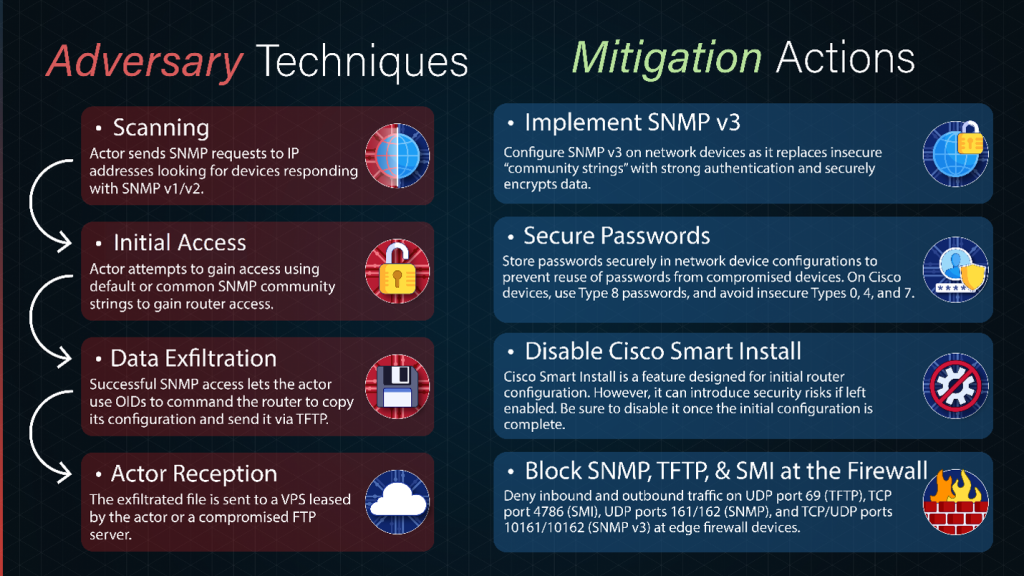
According to the advisory, actors use active simple network management protocol (SNMP) agents to scan for internet IP ranges that accept common or default community strings for authentication. Community strings are passwords that have been shared online in plain text that can be easily intercepted by malicious cyber actors.
The advisory recommends restricting access to management interfaces and firewall devices; strengthening authentication and data encryption protocols; securing weak internet-facing systems; and looking for suspicious activity. Specifically, the agencies advise disabling Cisco Smart Install, SNMPv1 and SNMPv2, and replacing it with SNMPv3, which adds stronger authentication and data encryption.
In the Office of the Director of National Intelligence’s 2025 Annual Threat Assessment of the U.S. Intelligence Community, Russia was identified as an advanced cyber threat.
“Moscow’s unique strength is the practical experience it has gained integrating cyber attacks and operations with wartime military action, almost certainly amplifying its potential to focus combined impact on U.S. targets in time of conflict,” the threat assessment read.
To strengthen defenses against Russian cyber actors, CISA collaborates with partners, including internet service providers, original equipment manufacturers and global cyber agencies, and participates in the Joint Ransomware Task Force.
“CISA continues to work with domestic and global partners to highlight the ongoing threat of nation-state actors targeting vulnerable network devices,” said Acting Executive Assistant Director for Cybersecurity Chris Butera. “The advisory provides a timely and urgent reminder of actions for critical infrastructure owners and operators to counter Russian state-sponsored activity. CISA urges network defenders to implement mitigation and remediation measures to reduce your attack surface and risk of exploitation.”
To help software manufacturers and online service providers identify vulnerabilities in their products, CISA and international partners published a guidance titled "Establishing a Coordinated Vulnerability Disclosure Program to Work With Security Researchers." The guidance aims to help software manufacturers and online service providers collaborate with security researchers who can identify weaknesses in networks, software and hardware, according to Wednesday's press release.
CISA and its partners encourage companies to implement well-defined coordinated vulnerability disclosure programs so they can effectively assess their risk and take the best actions to improve their product security.
"Coordinated vulnerability disclosure is foundational to building a secure software ecosystem. The practices in this guide help protect customers, strengthen products and support CISA’s Secure by Design initiative, which encourages companies to be transparent and responsible in how they build and maintain their technology,” Butera said. “CISA encourages suppliers to establish a coordinated vulnerability disclosure program and build constructive, collaborative relationships with security researchers to enhance product security.”



Comments