
DISA Europe Marches Forward With Modernization Efforts
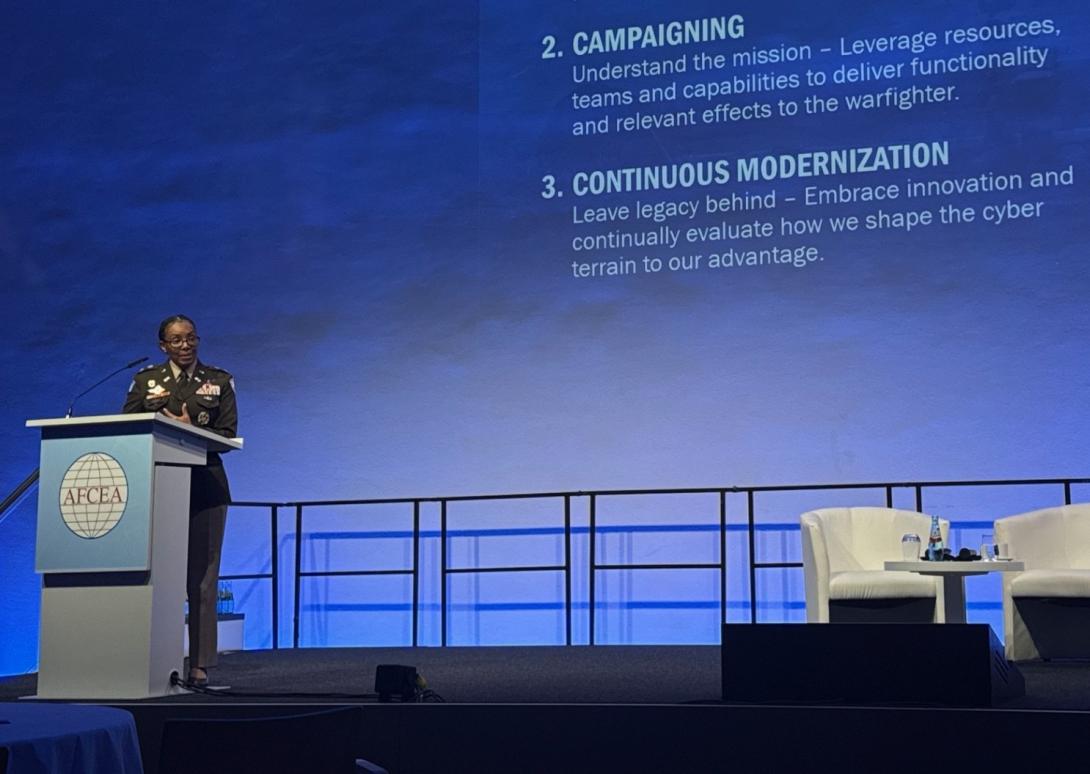
As commander of the Defense Information Systems Agency Europe (DISA Europe), U.S. Army Col. Tilisha Lockley’s mission is to provide information systems and services to warfighters in Europe, Africa and the Middle East.
As part of its role, DISA Europe is advancing the four priorities set out by the director of DISA, Lt. Gen. Paul Stanton, USA: readiness, campaigning, continuous modernization and establishing lethality, Lockley said on December 4 at AFCEA International’s TechNet Transatlantic conference in Frankfurt, Germany.
Stanton is also building on the DISA Next effort—created by the former DISA director, Lt. Gen. Robert Skinner, USAF (Ret.), that included, for example, network advancements, enterprise-level data center work and zero-trust provisions under Thunderdome.
The agency, including DISA Europe, is now working to operationalize the DISA Next strategy, Lockley explained.
For the continuous modernization priority, DISA Europe is modernizing its networks, including the Defense Information Systems Network (DISN) and Department of Defense Information Network (DODIN). This includes continued bandwidth and network infrastructure updates.
“We are migrating all of our users and our systems over to MPLS [multiprotocol label switching] so that we have better bandwidth and better throughput,” the commander highlighted. “We are still maintaining the current legacy infrastructure, and we are also upgrading to new network capabilities.”
For Stanton’s priority of campaigning, the DISA Europe commander explained that her agency's role is “to ensure that systems of systems function and that teams of teams integrate.”
An example of campaigning is the recent work done by DISA Europe’s cyber security service provider (CSSP) team.
That team, which supports 37 organizations across the European theater, recently received the Pentagon’s Chief Information Officer award for its cybersecurity support, Lockley noted.
“This team works hard every day to ensure they are providing top-notch capability and continuing to look at ways they can integrate and make their day-to-day services better,” she shared. “However, they didn't just stop there. They wanted to level up ... and continue to refine some processes, to continue to make our networks more secure.”
The CSSP team is working with the 16th Air Force, U.S. European Command J-3 and J-6 offices, and various defensive cyber operation (DCO) missions to strengthen the agency’s infrastructure.
“[They are working with them] to build out and integrate all of our functions in and through cyberspace, working and integrating together so that we solidify all those gaps and seams that we know are out there in our own individual operations,” the commander explained. “[They are working together in a campaign to make sure that we are integrated and sharing data and information prior to conducting DCO hunts across the networks.”
This effort helps to ensure that they are working as a collective team to share information and data as needed at echelon, Lockley stated.
The group is also examining old logs, using artificial intelligence and building out algorithms and application programming interfaces to see where anomalies had been in the network previously, as they build out and harden the network.
DISA Europe established a data integration cell to provide clear insights into its networks through new systems and dashboards, the commander said.
“For that, we took [funding] out of hide and built a data integration cell within our organization, and that integration cell ensures that we have a better picture of ourselves as we are modernizing,” Lockley stated. “With lots of changes and updates and lots of capabilities being added, we wanted to make sure that the customer no longer was the gauge for our network, that we could see ourselves and correct ourselves in a timely manner.”
This team works hard every day to ensure they are providing top-notch capability and continuing to look at ways they can integrate and make their day-to-day services better.
The dashboards even leverage information from legacy systems.
“We have taken the data out of those systems and ingested them into new tools like Maven to ensure that we can build out dashboards for our uses to see what our cyber landscape looks like within the theater,” she offered.
Already, those steps have “vastly improved” network visibility, allowing outage response times to improve with more immediate repair. “When you needed to know if a network was out or if a certain circuit was out, we have automated those systems so now we can see it as it happens in real time,” the commander stated.
“And my tech director [Rodolfo Fuentes] will fuss at me if I say we have completed this process,” she added. “We are still in the process of working through all of our circuits. There's many circuits that we need to integrate, but these are capabilities that we are working day to day to improve our data. And now we have a full-time team that is working on ensuring that we improve the services that we provide to the warfighting theater.”
To hold vendors more accountable, Lockley noted that DISA Europe has made improvements to its authorized service interruptions (ASIs), which in turn, has brought in a return from noncompliant vendors.
“Another key update that we made is with our scheduled ASIs, where we have recouped quite a few dollars back from our vendors, our primes and our subs for not meeting their 5-9 standards,” Lockley said. “When it comes to our circuits being down, we have automated that system. When a circuit no longer meets the threshold of the 5-9s, then we automate a form that automatically recuperates our resources back from the vendor, so that we can make sure that we are holding them accountable.”
As one can imagine, that has motivated their vendors and “vastly improved” their support and opened up the lines of communication.
“Because no vendor wants to give back money to the U.S. government,” she laughed. “So, we are making sure that we are holding them accountable. And instead of having a person that needs to look through those logs, that system has been automated.”
Given that success, DISA Europe has been asked to scale the solution across DISA.
TechNet Transatlantic is organized by AFCEA International in conjunction with the AFCEA Europe office. SIGNAL Media is the official media of AFCEA International.



Comments