
Pentagon Unveils New Talent Management Strategy
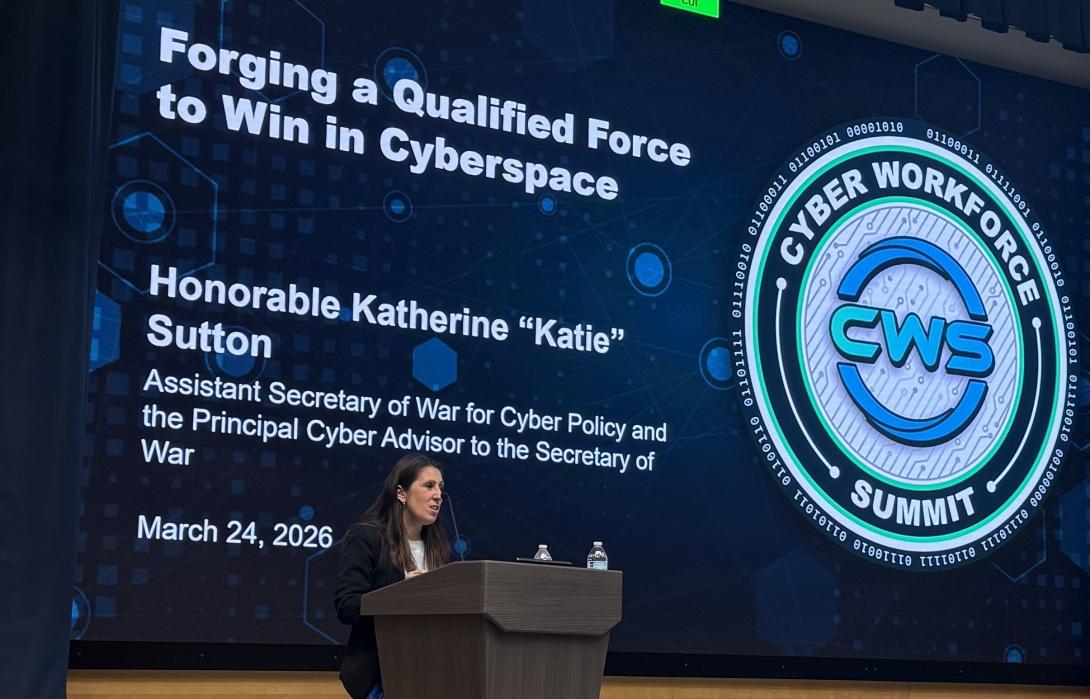
Department of War (DOW) officials announced the creation and implementation of Cyber Command 2.0—a new initiative designed to fundamentally reimagine how defense leaders identify, pursue and foster cyber-related talent, according to Katherine Sutton, assistant secretary of war for cyber policy and principal cyber adviser to the secretary of war.
This new approach will ideally result in the government acquiring and keeping highly skilled and qualified individuals, eliminating the problem of losing these people to better opportunities and benefits in the private sector. Establishing Cyber Command 2.0 signifies a move toward a framework that prioritizes the cultivation of comprehensive and extensive knowledge within the cyberspace and a move away from the traditional compliance-based approach, Sutton said.
Cyber Command 2.0 focuses on three pillars.
Firstly, Cyber Command 2.0 officials will evaluate domain mastery and the methods for which they develop complex cyber skills. They are producing new career tracks that give cyber operators the opportunity to enhance, improve and ideally master their crafts.
The second pillar is that team members will assess the process of skill specialization.
“The cyber domain is incredibly diverse, so a one-size-fits-all training path is not adequate to get after the diverse set of missions that we’re seeing,” Sutton said during a keynote address at the Cyber Workforce Summit 2.0 held in Washington, D.C. “We need operators who are rock stars in cloud architectures, wizards with industrial control systems and pioneers in artificial intelligence (AI). This new approach will create pathways for our people to become those deep experts, matching unique talents with critical skills that are mission specific.”
Lastly, Cyber Command 2.0 contributors will aim to incorporate additional agility and flexibility into the force. They need to have the ability to swiftly adapt and adjust to the ever-evolving threats and quickly field technologies, according to Sutton.
“We must develop options to deter or degrade cyber threats to the U.S. homeland,” Sutton said. “Our cyber workforce is the first line of defense in executing that mission and safeguarding the critical infrastructure and services that are foundational to our society and the nation’s ability to project combat power. We must build a resilient cyber terrain to defend against these adversaries, and we are working in lockstep with our government and private sector partners to harden our most critical infrastructure. This will require a workforce that has deep, specialized skills and people who understand not just networks but industrial control systems, financial networks and the complex web of technologies that can underpin our way of life. To win on this battlefield, we cannot rely on the legacy models for building talent.”
The legacy models have been insufficient in building the rooted skills that cyber operators need to be effective in the space. Additionally, they are fragmented and take too long, and their lack of flexibility and compatibility has limited their ability to integrate AI fully into workflows and adapt at speed and scale to counter threats, Sutton said.
This comes as cyber is becoming a critical component of the modern-day battlefield. Sutton stressed that mastering the space leads to winning the overarching fight of today, rather than just a single domain.
“For decades, we’ve viewed warfare through the familiar lens of land, sea, air and space,” Sutton said. “Going forward, we must operate on a fully integrated battlefield where the cyber domain is not a separate fifth domain of warfare but the connective tissue for all domain warfare. Victory on the ground, in the air, in space or out at sea now fundamentally depends on our ability to secure and dominate the cyber domain and to ensure that we have continued resilience of our systems and networks.”
“To deter conflict and defend the nation, we must be prepared to win in the cyberspace every single day,” Sutton added. “The adversary only has to be right once. We must be right every single day.”
The Cyber Workforce Summit 2.0 is hosted by AFCEA International in cooperation with the DOW CIO and the National Defense University. SIGNAL Media is the official media of AFCEA International.

Comments