
Ukraine’s Tech Advantage Faces a Learning Adversary
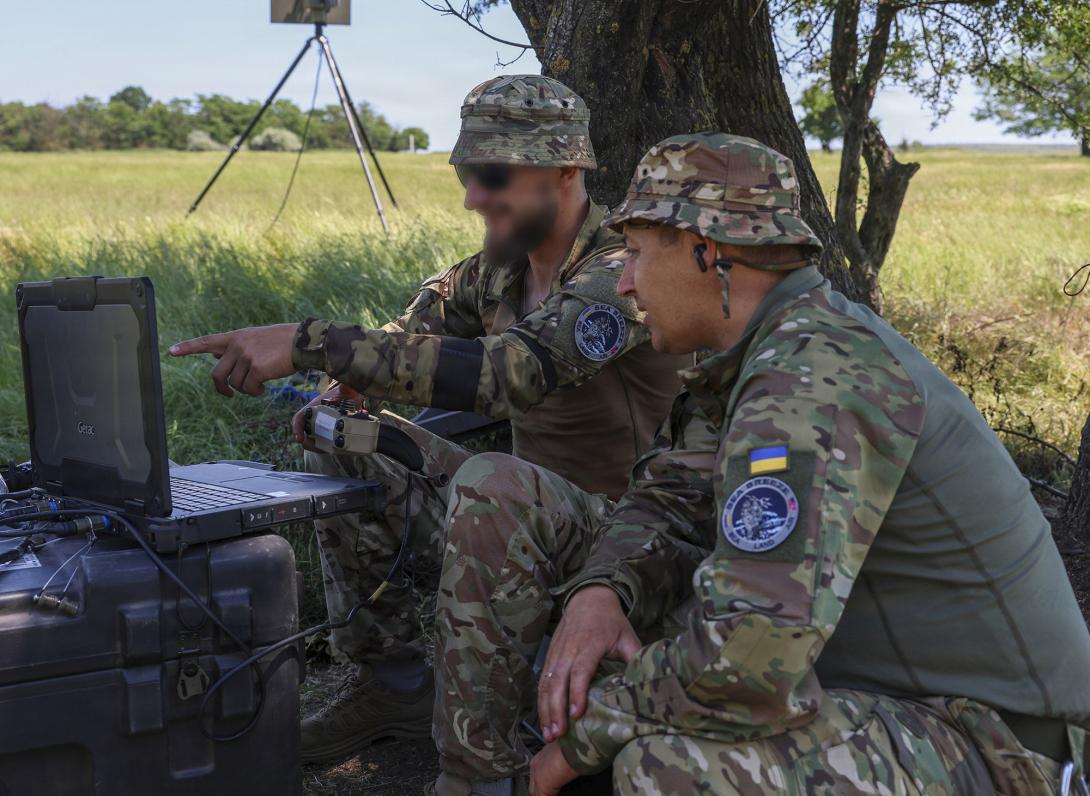
Ukraine’s data-centric approach to the modern battlefield has created a military advantage in its war against Russia. Through software acquisition and artificial intelligence (AI)-enabled capabilities, Ukraine’s resilience carries on as the nation defends its sovereignty. Still, Russia’s adaptability and power is not to be underestimated.
At the beginning of 2022, Russia launched its full-scale invasion of Ukraine, beginning what today is known as the most destructive war in Europe since World War II. While a significantly smaller nation, Ukrainian resistance stands through innovation, harnessing emerging technology for warfighters.
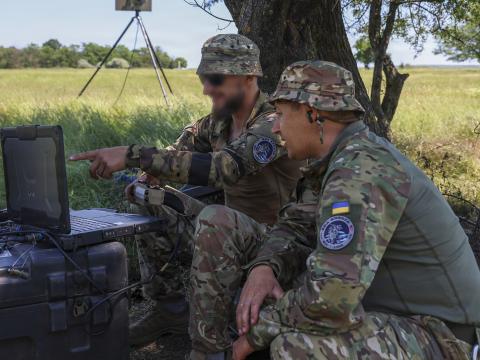
The Delta system, a cloud-based situational awareness and battlespace management software tool, is one of more than a dozen Ukrainian-built capabilities accelerated through AI.
“AI plays a role of software, which accelerates data analysis and data fusion,” Kate Bondar told SIGNAL Media in an interview.
Bondar is a Ukrainian national who previously worked with the country’s private sector as well as the Ministry of Defense. Three years ago, she moved to the United States and today serves as a senior fellow with the Wadhwani AI Center at the Center for Strategic and International Studies, or CSIS.
“There are thousands of drones flying in the air at the same time, so there’s no human capacity and human who can analyze all that, and Avengers system and other models developed by other companies, they just help to filter that out at least,” she explained.
The Avengers Lab system is a Ukrainian AI platform with copious amounts of battlefield data from the Delta command-and-control ecosystem. The platform is used to train AI models for target recognition and further combat operations.
Of note, in August, Ukraine reached a partnership with the United Kingdom, giving the UK access to its Avengers AI Labs platform.
“The platform provides real world data and insights to train AI models, collected by thousands of daylight cameras and infrared sensors across the battlefield in Ukraine,” a UK government press release states.
“This is AI sovereignty in practice: building our own capabilities and turning frontline experience into systems that protect our armed forces overseas and our critical infrastructure at home,” UK minister for AI, Kanishka Narayan stated for the press release.
At times, AI can help identify and detect objects unseen to the human eye, Bondar explained. Additionally, large language models, or LLMs, are useful for text analysis. “Text comes from intercepted communications from Russians, group chats of Ukrainian intelligence units and reconnaissance units, and these are ... thousands of messages per day,” she said.
Analysis of acoustic signals is also vital, as the models can depict different types of threats, such as Shahed or Gerbera drone systems. The analysis can contribute to creating a layered air defense system.
“It’s a data-centric approach,” added Samuel Bendett, researcher and advisor at the Center for Naval Analyses, commonly referred to as CNA, a nonprofit research and analysis organization.
“Ukraine is taking all the battlefield data, and it’s trying to analyze it quickly and put it in the hands of the warfighters,” he said. “Ukrainian commentators are saying that the victory goes not just to the forces that can scale cheap and easy solutions, but also forces that can network them, where data analysis is a key part of how information is gathered and shared with the warfighters.”
Although Ukrainians have brought in an age of modern warfighting, Russia has not been far behind.
“I’m a proponent of not underestimating Russia, because I hear a lot of opinions that Russia is old school, Soviet, rigid system,” Bondar shared. “Partially, it is, but it’s becoming less and less, and they’re also learning in this war, so we shouldn’t underestimate their capacity and capability to learn as well and adapt.”
Although the entire Russian military is not undergoing a full transformation, Bondar says pockets of innovation are spreading across the nation and “Russians are really good at identifying what’s working and then scaling it fast.”
For example, the Russian military established its Rubicon Center for Advanced Unmanned Technologies in 2024, which, according to Bondar, is now an elite unit.
“What’s interesting about Russia is that they learned a lot and now they start scaling,” she continued. Russian military then established the Unmanned Systems Forces in November 2025 and “announced 175,000 drone operators will be hired, and they will be trained according to the best practices tested on that experimental unit, they will be equipped with systems which prove to be the best and working with the best.”
While Ukraine is challenged with competition between its brigades and independent entities, which can sometimes lead to inefficiency, Russia’s centralized approach gives it an advantage in decision-making and scaling, Bondar highlighted.
“The same applies to technology,” Bondar said. “The minute [Russia identifies] a Shahed as their flagship system to attack Ukraine, they build facilities for production, they involve the best talent and bring people there, they establish a university to get the best young talent with their creative ideas. They constantly iterate.”
For that reason, Bondar highly discourages the public from assuming that Russia’s military power is old and ineffective. If anything, she claimed, Russia’s adaptation has been similar to Ukraine’s throughout the war.
Bendett also claimed that although Russia’s approach has been reactive, their ability to scale is a strength.
“I think the best example is the Molniya drone,” he said, noting the drone name, which translates to ‘lightning.’
The drone is inexpensive, easy to assemble and cheap. “It’s like a throwaway weapon,” Bendett noted. “That’s a lesson learned for the Russian military. They understood that they needed a drone that can fly the distance, that can carry a lot of cargo ... and be a fraction of the cost of the more expensive military systems that Russia uses,” he said.
One significant development by the Russian military has been SVOD, a digital integration and C2 tool Russia claimed to field in September. The word Svod, Bendett said, is a Slavic term for the heavens. And the tool is the answer to Ukraine’s Delta system.
The system “reflects the growing effort of digital integration within the land tactical level units,” according to a NATO Command and Control Centre of Excellence report. “SVOD is not an overarching C2 system, but a tool for the tactical level to exploit the kill chain possibilities and AI supported decision-making,” it states.
Still, according to Bendett, Ukraine remains one of the leading countries in combining software, IT and cyber with unmanned systems and AI. The transformation is due, in large part, to the Ukrainian government being open to new ideas that combined emerging technology with legacy systems.
“In Ukraine, there was an understanding that change has to happen relatively quickly, and so Ukrainians essentially allowed that to happen, not without problems and certainly not without issues and not without internal conflict,” he said.
Notably, Ukraine’s Minister of Defense Mykhailo Fedorov was dismissed by President Volodymyr Zelenskyy in July. The move drew some controversy from the Ukrainian public.
In Russia, however, leadership approaches problem-solving from an engineer’s point of view, Bondar explained. “Usually it starts [with] building systems; it starts with building a foundation, in this case it’s data and then building on top whatever they want.”
“Soon, I think we will see what Russia will build on top of this foundational layer that they have been collecting since mid-2024, beginning 2025, so they have already ... one and a half years of data,” she stated. “It is obvious that they started to think about this seriously and approaching this [in a] large-scale systematic way.”


Comments