
Army Converting Data Into Combat Readiness Through Enhanced Predictive Logistics
U.S. Army leaders are chasing an ultramodern autonomous predictive logistics ecosystem to ensure that servicemen and servicewomen are optimally prepared and equipped for the fight. The first and arguably most arduous step that can enable the rest of this monumental journey is the establishment of a single common data layer, which crews are attempting to create, per Lt. Col. Ruben Rangel, deputy chief of staff for the command and control (C2) support element in the 4th Infantry Division. They aim to tackle this major undertaking by consolidating and ingesting information into a unified, centralized location.
Furthermore, the Army is integrating state-of-the-art artificial intelligence (AI)-based sensors that can work complementarily with the common data layer. Ideally, the common data layer would monitor and track resources that are listed in the Army inventory, which includes weapon-related capabilities such as munitions, guns, artillery, vehicles, planes and helicopters and supply-related capabilities such as gas and energy. The common data layer—without the assistance of a human—would then keep an ‘eye’ on the availability of these tools and technologies, and when the supply of a device is low, the common data layer would then immediately trigger the sensors to alert commanders of the need to restock an asset. This advancement can provide officials with a substantial upgrade over the existing tactics, techniques and procedures, as Rangel painted a picture of what that operation looks like by highlighting an example regarding vehicles and fuel.
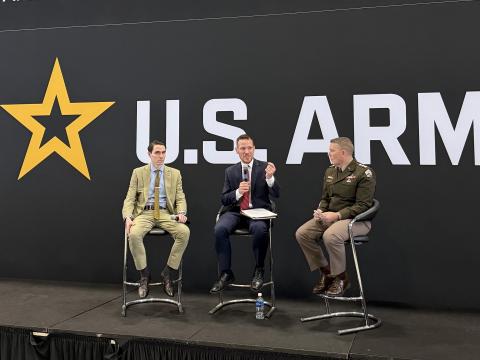
“If it’s a 2,500-gallon fueler, and it went out to go deliver 1,000 gallons, I should be able to measure that relatively autonomously,” Rangel urged during a one-on-one sit-down interview at TechNet Augusta 2026. “Right now, a soldier takes a dipstick into the tanker unit itself. That’s how we measure fuel, so there are absolutely sensors [that can help]. There are solutions out there that can automate that process and transport that data, whether active or passive, and get that into a common data layer for logisticians to do analysis on.”
Rangel further described that these actions can play significant roles in his team accomplishing his desired destination in this space. “That’s where I want to see us go,” he added. “I want us to be able to have refined positioning of where our priority munitions are in the inventory and the consumption rates.”
There is still work for crews to address concerning the sensor-to-vehicle integration, but for now, warfighters can utilize the controller area network bus, which is a fairly sophisticated weapon system that also features maneuverability, Rangel mentioned. The tool tells users the speed of the vehicle, the amount of fuel in the vehicle and the rate of fuel consumption at the idle position versus at different revolutions per minute. Furthermore, other systems can notify operators about how many rounds are loaded onto the vehicle and how many they have fired.
On the other side of the battle, in conjunction with the intelligence community, Army personnel strive to use the data-driven sustainment models to predict the number of weapons and resources still available to adversaries. The intelligence community is leveraging several different types of software to conduct this enriched analysis. This component, combined with the intelligence community’s access to the growing common data layer and rise of operational modeling tools, allows individuals to perform red and blue team analysis, the latter of which gives commanders insight into the enemy decision-making cycle, stated Rangel.
Additionally, crews are working to smooth out the tactical reporting process to make it easier for warfighters to complete. Now, soldiers can more easily access their logistics statistics report, as it lives on their end-user device, and the logistics statistics report is pre-formatted, according to Rangel. In the past, logistics statistics reports were found on the back of a “meals ready to eat” piece of cardboard and in the format of penciled spreadsheets. These improvements and conveniences offer commanders the ability to strategize in the predictive logistics landscape in a more effective and informed way.
“[Soldiers] can input [their logistics statistics report], and then I can say with confidence when’s the last time they reported. And based off the last time that they reported and the type of operation that they’ve done, I’m going to change their consumption rates because they’re in the offense versus the defense,” he said. “And even though they reported four days ago, I know that they have enough gas and enough water and that they have enough ammunition to continue to fight. I can make a better decision on when I need to resupply.”
These developments are happening, he assured.
The deputy chief of staff for the C2 support element in the 4th Infantry Division proceeded by illustrating the value of achieving enhanced proactiveness rather than reactiveness.
“It all goes back to managing resources,” Rangel reminded. “So, if I have a robust predictive model and it tells me where I need to place material and what I need to protect as a result, and if I know what I’m going to be doing, and I know I have far enough time on the horizon, then I can prioritize where the ammunition, the fuel, etc. ... [goes] against the weighted effort. That’s important. And I can figure out a different scheme of maneuver for the force that may not be as prioritized and put them in an appropriate posture, so that way, they’re not overexposed, or I at least acknowledge the risk that’s being assumed as a result.”
Despite the discussion about applying AI-based capabilities to remove as much human error as possible in the data-driven sustainment field, the innovations will not replace the workforce. Instead, like other areas of the Army, adding AI-based innovations to and autonomizing predictive logistics will assist and augment the workforce, Rangel confirmed. This endeavor is still in its initial phases, and because of its novelty, folks are still deciding exactly where and to what extent they will include AI.
“I think we’re still pretty early in that [process],” he said. “I think we’re still trying to define that role. I think at the current moment, what we’re really hyper-focused on is being able to see for ourselves what data is present on our platforms and what data is present in our current systems and start to ingest that into a common data layer. Start there. Now that you have everything in a common place, [then we can ask ourselves] what are the tools required to analyze it.”
Rangel explained that a common data layer can bolster predictive logistics because it allows individuals operating in numerous areas of the battle to see, consume, give input and act on that information. Troops can then make more informed decisions in a timely manner and present improved suggestions to their commanders about their endurance, priorities and maneuverability. As the common data layer becomes more educated through the infusion of additional information and trial and error, the algorithm becomes more advanced, and subsequently, the platform can offer predictions that go beyond the normal planning cycle for resources and supplies. The system will likely require refining, Rangel noted.
“That’s the level we need to get to,” he stressed. “I think we’ve done a pretty incredible job setting the foundation for that. It’s fairly complex. It’s going to take continuous iteration to get to that level.”
Rangel argued that the most important part about this project is that as a unit, they recognize it as a collective effort. “I think it’s now just a matter of continuing to refine with our industry partners,” he said. “We have to continue to iterate, and we have to continue to solve these problems in a manner that makes sense.”
This collaborative effort with the private sector is in fact underway, per Maj. Sean Minton, a public affairs officer in the transformation team of the Army Communications and Outreach Office.
Comments