
Could the U.S. Navy Anchor Golden Dome?
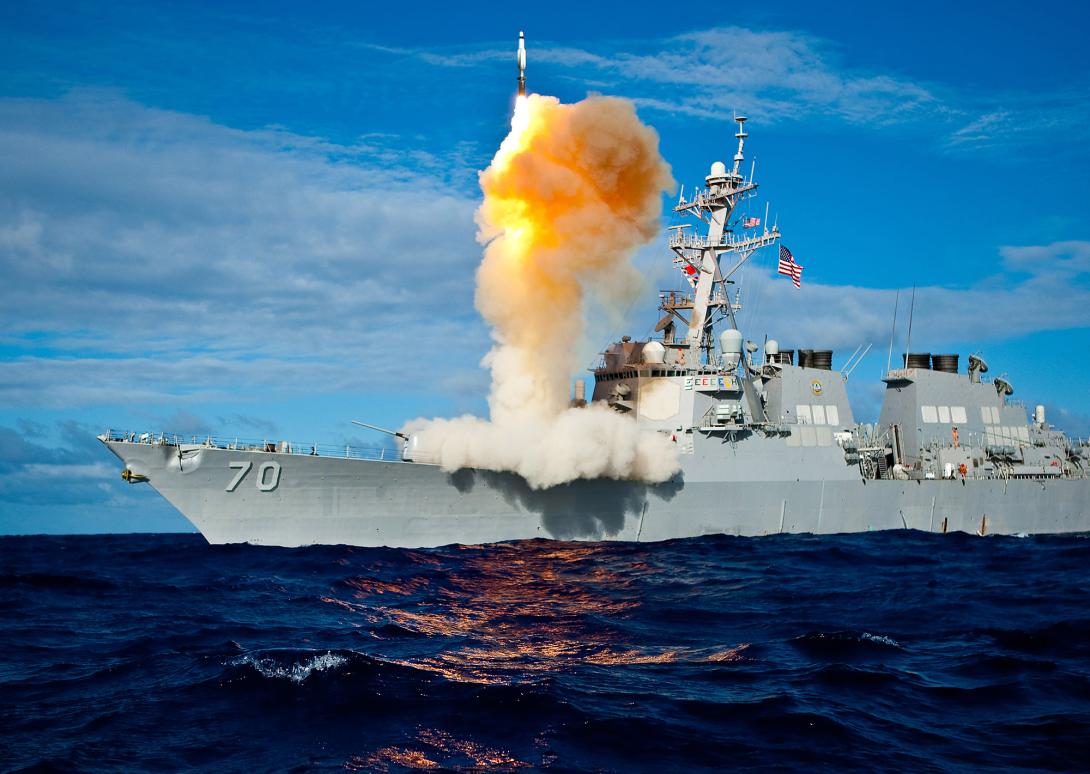
As work on the Golden Dome for America project intensifies, focus remains largely on the U.S. Space Force and space-based systems, leaving questions on the U.S. Navy’s role in the initiative. With current capabilities in place, the Navy is poised to be a potential anchor and force multiplier for the nationwide missile defense system.
The Golden Dome, a project first introduced as The Iron Dome for America in January 2025, is a strategic initiative to combat threats targeting the United States. In May 2025, the missile defense initiative was renamed to its current title. “I’m pleased to announce that we have officially selected an architecture for this state-of-the-art system that will deploy next-generation technologies across the land, sea and space, including space-based sensors and interceptors,” the president stated during a press conference from the Oval Office.
In March, Golden Dome Director Gen. Michael Guetlein announced an additional $10 billion spending necessary for space capability procurement, totaling about $185 billion for the full missile defense system. According to a report by Defense Scoop, the funds would be used for tools, including an airborne moving target indication, the Hypersonic and Ballistic Tracking Space Sensor, and the Space Data Network.
“When you look at the posture ... some of the locations where the Navy is operating, 24/7, the response time to be able to be in a position to create an effect, in this case knocking down ballistic missiles or cruise missiles or drones, is impressive,” said J.D. Gainey, former commander of the USS Hopper (DDG 70), an Arleigh Burke-class Aegis guided-missile destroyer.
Gainey spoke during a 2025 Missile Defense Advocacy Alliance webinar discussion about the Navy and the Golden Dome.
“Nobody else in the world can do that, so when it comes to what they are supposed to do, the good thing is they have the capability; they have the tech; they have the experience to do it,” he stated.
The Aegis Weapon System, for example, is the Navy’s automated command-and-control (C2) system created to detect and engage threats. According to the Navy website, the first Aegis ship, titled USS Ticonderoga (CG47), was commissioned in 1983 and deployed just six months after.
The Aegis Combat System is “capable of simultaneous operations against multi-mission threats: anti-air, anti-surface and anti-submarine warfare,” the website states, closely resembling the Golden Dome mission.
“Sea-based weapons systems like the Aegis Combat System, the Long-Range Discrimination Radar and homeland defense radars in the range play a critical role in integrated missile tracking, interception and destruction,” Eric Velte, chief technology officer at ASRC Federal, told SIGNAL Media. “Assets like the Aegis Ashore, a land-based version of this system, have long served as the backbone of broad ballistic missile defense against nation-state-based threats.”
Modern day conflicts have showcased the Navy’s operational capability in an active environment, with reports stating that an Arleigh Burke-class guided-missile destroyer USS Pinckney fired a Tomahawk Land Attack Missile amid Iran operations. The ship is one of the few in the Destroyer Modernization 2.0 program, which aims to upgrade the destroyers’ electronic warfare, radar and combat systems.
Notably, all Arleigh Burke-class destroyers are equipped with Aegis Combat Systems, which comprise various lethal capabilities. Those include the AN/SPY-1 Radar, developed by Lockheed Martin; anti-air warfare and anti-submarine warfare systems; vertical launching systems; and Tomahawk Weapon System.
Founder and Chairman of the Missile Defense Advocacy Alliance Riki Ellison, who also spoke to SIGNAL Media in an interview, commented on the Navy’s critical role in the Golden Dome, as is being proven in the Middle East.
“When you look at the fact that 13 countries were hit with ballistic missiles, cruise missiles and drones in a layered approach, the only vehicle or platform that can defend against that right now is the ship,” he said. “You cannot defend the United States of America in the Golden Dome without a couple of those on either coast, just off the chart, right now, so I think their value has increased.”
According to a March report by The Washington Post, the United States had fired more than 850 Tomahawk cruise missiles during the conflict with Iran. The Center for Strategic and International Studies later reported that the Navy is set to receive 110 Tomahawks in fiscal year 2026.
The Navy has demonstrated integrated and coordinated operations for nearly two decades, Gainey said during the webinar. “They’ve been using a capability mix of aircraft, space-based capabilities and maritime ships for 10-plus years ... and you can even make an argument that they are leading the way, utilizing more space-based capabilities for holistic kill chains through some of their activities, using space-based sensors to space-based communications down to the maritime environment,” he said.
Gainey also mentioned that as the Navy continues to advance its systems, it’s outpacing its fellow services in maturing advanced concepts. He went on to use Department of the Navy Chief Technology Officer Justin Fanelli’s priority technology areas, published in summer 2025, as an example. The priority areas include artificial intelligence (AI) and autonomy, quantum, resilient communications, enhanced C5ISR (command, control, communications, computers, combat systems, intelligence, surveillance and reconnaissance) and counter-C5ISR, and cyberspace operations.
“The fact that the Navy ... is going after some of the foundational principles that Golden Dome has to deliver shows why the Navy should be a part of this,” Gainey said.
Furthermore, the large-scale missile defense initiative may involve the use of unmanned and autonomous vehicles, a capability highly leveraged in the modern age of warfare.
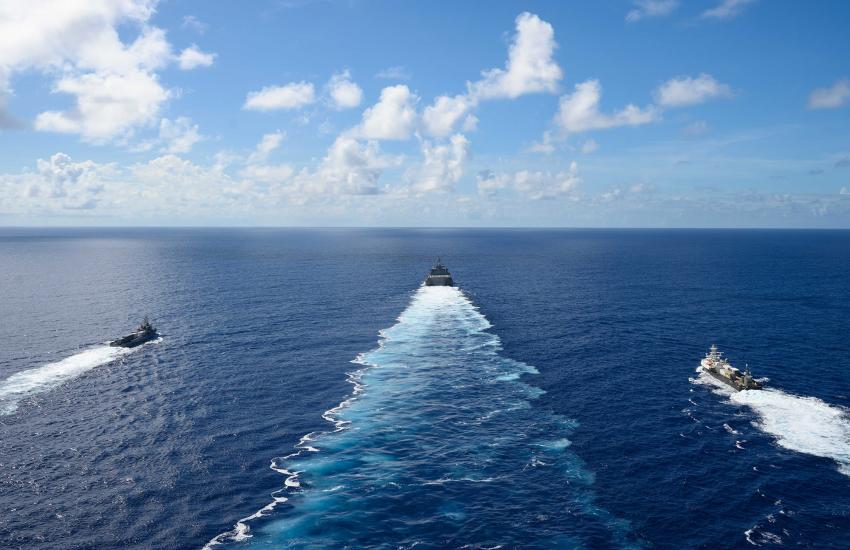
“Unmanned surface vehicle (USV) platforms ... could significantly enhance the Golden Dome solution,” Velte stated. Surface command and control systems like Aegis could seamlessly integrate with USV platforms, he said. “While Aegis defends against long-range threats, Ship Self-Defense Systems defend against short-range threats and anti-ship threats. These systems operate in unison with low-profile sensors that provide warfighters with greater situational awareness and broader engagement capability, using launch-on-remote and engage-on-remote methods to eliminate incoming threats.”
The conflict in Iran has highlighted an asymmetric challenge of low-cost drones working against high-cost precision systems, noted Seasats CEO Mike Flanigan. “You’ve got Shaheds coming along, and they cost 30 or 40 or 50-thousand dollars, and you’re shooting them down with Patriots or THAAD [the Terminal High-Altitude Area Defense] that cost millions of dollars,” he explained in a call with SIGNAL Media.
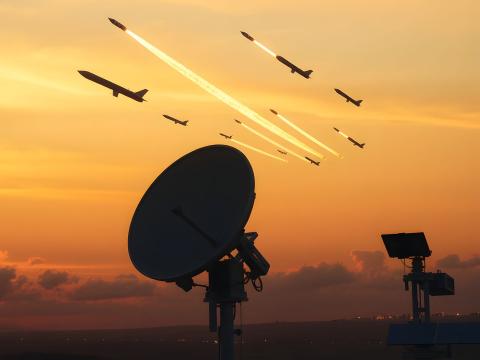
Shahed drones are Iranian-designed unmanned combat aerial vehicles that can be flown in swarms. The THAAD system, however, is a Lockheed Martin interceptor with a 100% success rate, according to the company’s website. While the Patriot interceptors cost around $4 million each, THAAD system costs can range from $12 to $15 million.
“That becomes a very favorable situation for an adversary,” Flanigan continued. “I think one of the places where the Navy and USVs in particular can play a big part in coastal defense, which probably relates to Golden Dome, is ... a low-cost attack system with lower-cost intercept systems.” This is an idea Ukraine has proven successful in its war with Russia.
Although more cost-effective, USVs do have accuracy limitations, Flanigan noted.
“Let’s say you’ve got a Shahed coming in. You’d like to shoot it down, but you don’t want to spend your multimillion-dollar missile. Well, you’d like to then try to intercept that system as far away from civilian populations and from its intended targets as possible. And for these low-cost interceptors, this actually ends up making maritime defense being very relevant because we’d actually love to be able to stock up on lock duration USVs hanging out a couple of miles off the coast with big radars, and they can work in tandem with ground-based systems,” he said.
Once an incoming threat is detected, a cheaper and smaller USV can target it and potentially intercept it. “If you do get it, then at least all the debris and everything crashes down in the ocean as opposed to on land over the population,” Flanigan said.
In a case where the USV fails its mission, the high-cost and high-accuracy intercept systems will have time to react.
“I think the layered defense is going to make a lot of sense, and there’s definitely conversations we’re having with folks right now about how to defend U.S. and allied assets that are coastal with this type of approach,” Flanigan stated.
Velte echoed Flanigan’s remarks, emphasizing the maritime industry’s impact on the Golden Dome initiative.
“While the space-based segment of Golden Dome will consist of satellites providing early warning and tracking threats as they are initiated and approach the U.S., the sea-based segment and associated systems will pick up threat tracking mid-course and intercept these deployed threats,” he said. “These segments must work together through an integrated [C2] network for rapid, AI-enabled coordination and decision-making.”

Comments