
It Is Time for Military Space, Study Says
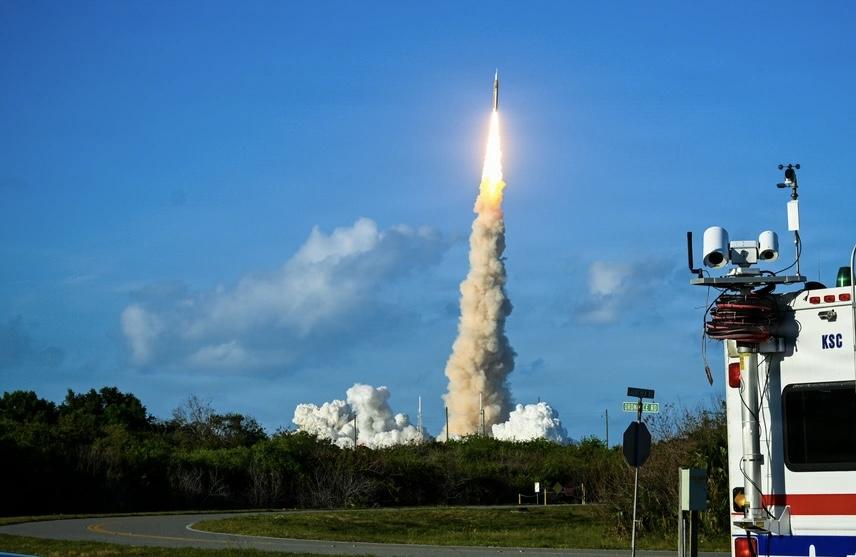
Due to the threat of the People’s Republic of China (PRC) controlling the domain of space, the United States needs to begin preparing warfighters for in-space operations and defense.
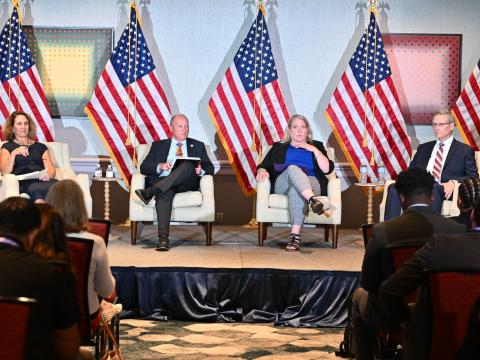
The United States’ civilian space flights and operations, and military defense through satellites and machines, are not enough to protect the nation from China’s adversarial threats in space, especially given its incursions on Earth, said Col. Kyle Pumroy, USSF (Ret.), during a media briefing on May 21 at the Mitchell Institute for Aerospace Studies.
“China's demonstrated a consistent willingness to use hard power to secure territorial claims on Earth, so it'd be strategically irresponsible to assume that behavior will not eventually extend the cislunar and lunar operations,” Pumroy said.
Pumroy and the institute prepared the study, "Military Human Spaceflight: A key Component to American Space Superiority." He emphasized the PRC already has militarized its space activities, compared to U.S. civilian efforts under NASA.
“China's approach to human spaceflight has been remarkably different over three decades,” he said. “They steadily achieved nearly every major state of human spaceflight objective: crew launch capability, docking, space station operations, continuous habitation and now credible lunar ambitions. All this occurred under military leadership.”
He noted the PRC currently holds a continuous military human presence in orbit through its Tiangong military space station. The nation also plans to significantly expand its lunar infrastructure over the next decade.
“The Chinese outlook for space habitation presents itself as an extension of their Belt and Road Initiative, a ‘Space Silk Road,’ so to speak, and that Silk Road will be fortified by their military-armed government,” Pumroy said.
The United States, meanwhile, has struggled greatly with its space program consistency over the years.
“Lunar timelines have repeatedly slipped, national objectives have shifted between administrations, commercial space station plans remain uncertain and, critically, human space flight has not been consistently linked to national security strategy,” he explained. “The bottom line is China treats space habitation as a strategic national imperative. The United States has often treated it as science, inspiration and prestige. That difference in strategic framing matters enormously over time.”
In addition, the PRC is planning a strong foothold on the moon by 2040. And the country's military-led approach “creates strategic flexibility, which involves civilian activities to rapidly transition toward military objectives,” he said.
The United States has not taken the same approach but should start taking concrete steps now, he said.
The idea is to take experts from the existing and elite Space Test Program to pull together a Guardian-based military astronaut force, scaling slowly over time.
“It is a seed to plant and grow slowly, that in 15 years [provides a base force],” Pumroy offered. “[It is important] to just start the muscle movements.”
Also, any U.S. effort must be additive, he stressed. While leaders do not know when it will be a strategic imperative and are dealing with different priorities currently, “it becomes compelling to say that we ought to start something now,” Pumroy stated.
The bottom line is China treats space habitation as a strategic national imperative.
The PRC’s actions are already giving the nation an advantage.
“Because the distinction between civil military space operations is already blurred inside the Chinese system, that creates a future scenario the United States must take seriously,” Pumroy stated.
Pumroy said Title 10 provides the correct delineation between NASA and civilian activities in space versus what military activities would look like. Without a Title 10 defense force in space, the United States is at great risk, he warned.
“NASA astronauts or commercial astronauts are not organized, trained or equipped for national defense missions, leaving them at the mercy of Chinese actions and activities,” he clarified. “The United States, therefore, risks entering a future strategic environment where China possesses both the infrastructure and the norm to enforce its desires in space, while the United States does not.”
In addition, it is logical to have Guardians be the military space service, Pumroy stated.
“Guardians are trained from day one to think in terms of space superiority and its foundational elements, such as orbital mechanics, the harsh space environment, operating in microgravity, electromagnetic spectrum superiority, space objects in motion, multi-body problems, etc.,” Pumroy said.
Lastly, the study's thesis is not a call to stop pursuing autonomous systems in space.
“Importantly, this is not an argument against unmanned systems; we want to make that clear,” he said. “The Space Force absolutely requires advanced unmanned capabilities to counter current risks, but long term, we're talking multi-decades, space security will likely require both unmanned advanced systems and missions. Humans bring adaptability, persistence, judgment, credibility and term value that machines alone cannot.”
Comment
The idea that military…
The idea that military organizations need to take space more seriously is hardly surprising today, but the discussion remains relevant because space has become essential to almost every modern military capability. Communications, navigation, intelligence, surveillance, and early-warning systems all depend heavily on space-based infrastructure.
Comments