
Five Key Takeaways From the Five Eyes Discussion
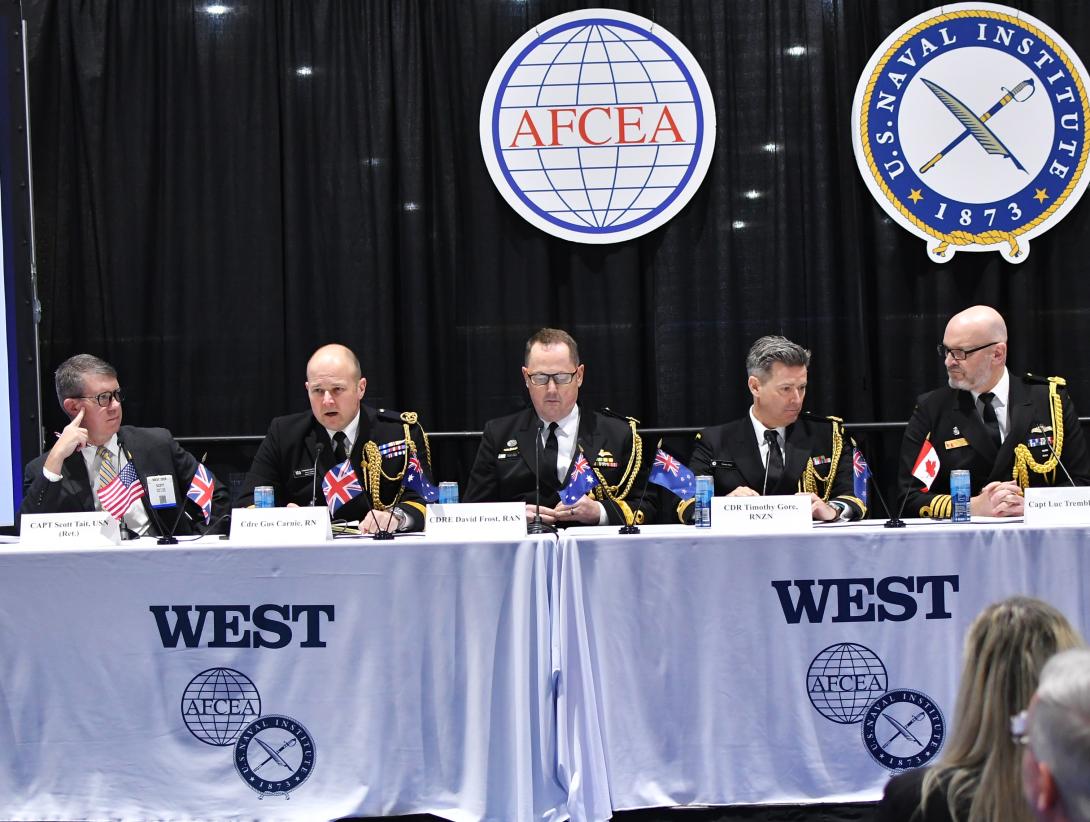
Joining one of the last panel discussions at WEST 2026 were members of the Five Eyes nations: Commodore Gus Carnie, naval attaché to the United States for the Royal Navy; Commodore David Frost, naval attaché to the United States for the Royal Australian Navy; Timothy Gore, commander for the Royal Navy New Zealand; Capt. Luc Tremblay, naval attaché to the United States for the Royal Canadian Navy; and Capt. Scott Tait, chief operating officer at StartupScience.IO with 27 years of service for the U.S. Navy.
The speakers covered topics ranging from emerging threats to strategic alliances. Here are five key takeaways from their discussion.
China is an existential threat.
Pressure in the Indo-Pacific region continues to grow, and the contested environment is intensifying the need for further presence. As 2027 looms on the horizon, the Five Eyes are closely watching China’s moves.
“I think it’s very important to see the actions in the South China Sea … as part of a much bigger hybrid campaign to influence and control parts of the region,” Tait said.
The People’s Republic of China (PRC) has established and followed an effective framework consisting of four key components, he continued. “The first is ‘demoralize,’ which is to undermine people’s confidence in the international system, their own political system, their own institutions.”
The second element is destabilization; and the third is conflict, which can include anything from a civil war to political violence and coercion, he said.
“Finally, when people are willing to trade away their former rights and systems, they help to restabilize or to resolve those problems on setting a new condition that is favorable to them,” Tait said. Currently, he explained, the situation lies between the third and fourth components.
What’s important to understand is that rather than what may seem like independently disconnected efforts, they are “dots on a well-crafted line.” Seeing it as a single coordinated campaign would help nations like the Five Eyes become more resilient against the adversary.
Another key is preparedness, Carnie added. “You have to take every Chinese fishing boat as an intelligence-gathering asset,” he said. “You have to take every single action that is done as premeditated by them.”
Through strategic coordinated efforts and information-sharing, close allies can continue to detect, monitor and deter. “Russia is our acute and immediate threat,” Carnie noted, “China is our existential threat.”
A coordinated presence is key.
Throughout their discussion, the panelists repeatedly emphasized the importance of coordinated efforts as the means to resilience and deterrence.
“The things that we need to do better as Five Eyes nations and other people is coordinate our presence in the Indo-Pacific,” Frost said. “We all just can’t have our national interest of showing up, passing through and then moving on. We need to make sure our policies are aligned,” he added. “That way, we will deliver that stable and prosperous region that we also desperately require.”
Coordination also requires partnership, which means military, political and diplomatic engagements within the Five Eyes and beyond. “We do not need to duplicate what is already being done,” Carnie said, noting the importance of each partner bringing its own specific strength to the table.
Tremblay echoed Carnie’s statements, stressing that Canada is a Pacific nation. He also mentioned Operation Horizon and Operation Neon, which showed presence in the Indo-Pacific region.
Partnerships with nations outside the Five Eyes are also vital, Tremblay said, pointing out relations with the Philippines, Japan and South Korea.
“It’s about how we’re working in the background,” Carnie said. “If something kicked off tomorrow, we, the U.K., have got a submarine in the theater, that then needs to be tasked by the Americans, by the Canadians, by the New Zealand or Australians to make sure that it’s doing the job on the behalf of those regions out there, not on behalf of us.”
While the Five Eyes is currently a credible deterrent, he stated, it’s up to all member states and their senior leaders to ensure it remains that way.
There’s an additional element of necessary changes to regulations for critical information-sharing and advanced combined operations that embrace speed for readiness.
As an example, Carnie offered, if a U.K. ship needed resources from a nearby U.S. naval ship, restrictions would make that process unnecessarily long.
Similarly, Carnie echoed Navy Secretary John Phelan’s statements about speed at scale. “Waiting 18 months for an agreement between two countries to share a bit of information or capability just doesn’t happen. I want it tomorrow,” he said.
Canada’s Defence Industrial Strategy will soon go live.
Although initially expected to be released last year, the North Atlantic nation will be releasing its first-ever Defense Industrial Strategy any day now, Tremblay told SIGNAL Media.
The strategy is said to be a roadmap for innovation, resilience and readiness.
“In order to lay the groundwork for the forthcoming Defence Industrial Strategy, we are making targeted regional investments to expand Canada’s defense industrial capacity—from coast to coast to coast,” a December 2025 Government of Canada press release stated. The investments will focus on research and development, domestic supply chains and Canada’s small-to-medium-sized businesses. The press release also noted more than $357 million for the establishment of the Regional Defence Investment Initiative, or RDII.
Of note, the 2025 budget proposed $81.8 billion over five years for the Canadian Armed Forces, with $6.6 billion over five years for the Defence Industrial Strategy.
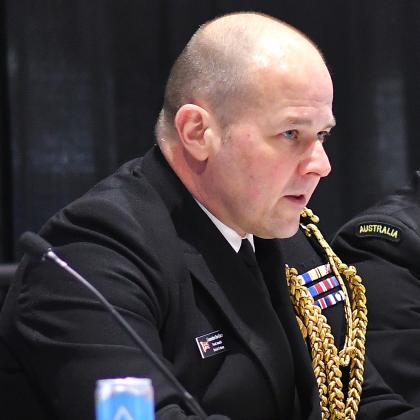
Russia is our acute and immediate threat. China is our existential threat.
The United Kingdom welcomes pressure to increase its defense spending.
The NATO and Five Eyes member state needs sufficient defense spending in the industrial capacity to be ready for the next fight, Carnie stated.
“That’s my challenge to you guys,” he told the audience, “I want industry to be writing into the U.K. to say, ‘You’re not doing enough, you need to be spending more, you need to be doing more.’”
Carnie also welcomes the U.S. political system to put pressure on the U.K. government to increase defense spending for the resource-constrained nation.
“The plea really is the more you press us, the better it is, because me telling my politicians that I need more money falls on deaf ears like most countries does, but if it’s coming in from our international partners, then we stand more chance of that," he said. "Otherwise, we may face overextension in the theater."
The Coasties are doing more than one may think.
Following an audience question, the panelists were in full agreement of the U.S. Coast Guard’s essential role in global and maritime security.
For one, relations between the USCG and Five Eyes nations are extremely strong. Additionally, the USCG has had a committed and integral presence in the Indo-Pacific region.
“We work as much with the U.S. Coast Guard as we work with the U.S. Navy,” Tremblay said. Canada is also increasing exercises with the USCG in the Arctic, with fully integrated assets and close collaboration.
Gore agreed with Tremblay’s statement and noted close coordination between New Zealand and the USCG.
For Carnie and the United Kingdom, the USCG is a reminder that force is not always necessary.
“We embark your law enforcement teams whenever we’re out in the Caribbean," he said. "We’ve got USCG sailors in U.K. warships back in the U.K., and it just brings that different mentality, reminding us ever so often that the answer might not be a missile, it might be shooting an engine out."
The USCG teaches those lessons every day, he said. Additionally, while the United Kingdom has long ignored its own coast guard, it is now investing in the service and learning directly from USCG techniques.
WEST 2026 is co-hosted by the U.S. Naval Institute and AFCEA International. SIGNAL Media is the official media of AFCEA International.

Comments