
DOW, Army Advance Secretary's Main Priority: Autonomy
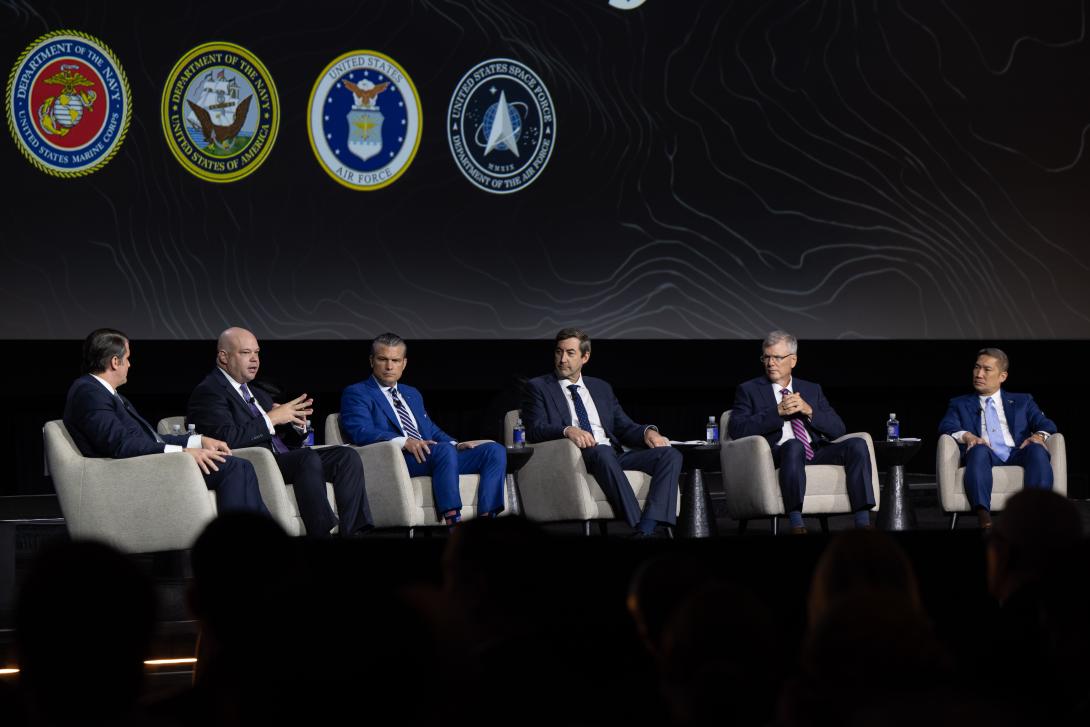
Defense officials announced Wednesday they are pursuing a plethora of avenues to achieve autonomy, which Secretary of War Pete Hegseth called a critical investment area and the Pentagon's number one priority. Hegseth and Adam Telle, acting secretary of the U.S. Army, highlighted and described the developments that defense and Army leaders are implementing to address this need and promote the space forward.
During an unprecedented panel discussion at the 2026 Association of the U.S. Army's Annual Meeting & Exposition, Hegseth unveiled that about $50 billion of the total defense reconciliation bill, which Hegseth is requesting at least $350 billion for, will fund work related to autonomous and robotic systems, which is a significant spike compared to the initial allotted funding of $1.2 billion in the One Big Beautiful Bill Act—a nearly 4,067% increase.
The secretary said scaling this rapidly will require the establishment of an autonomous warfare command and collaboration among the branches of the military to ensure that their directions and priorities are aligned.
"That's how you get from 1,000 drones to 100,000 [drones] to a million [drones]," Hegseth said.
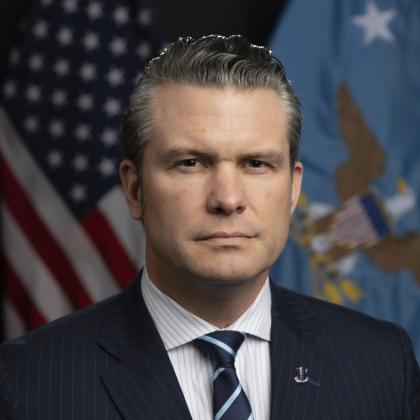
"Now, we're changing the cost paradigm for our adversaries on the battlefield, and they're the ones having to understand how they deal defensively with our capabilities. We're already seeing that in some places. It's a critical investment. It's our number one priority," he added.
Collaboration is a huge component to accomplishing this goal. Hegseth said he and Gen. Dan Caine, chairman of the Joint Chiefs of Staff, met Wednesday morning to discuss the topic. He further explained that the Department of War (DOW) and White House are working together to rebuild the armed forces across the globe.
"We're in lockstep on that with the White House," Hegseth assured. "We will ensure, regardless of what happens in the midterms, we're running fast immediately with the committees to ensure that that reconciliation bill, at a minimum of $350 billion and potentially more, ultimately fills up what this department needs in order for the president to ensure that we reestablish deterrence and rebuild military around the world. It couldn't be more important."
The Army specifically is establishing the Futures and Autonomous Systems Command (FASCOM), Telle announced during the panel. This effort will aim to centralize all the work and resources in this space, which Telle said will boost cooperation among the various teams in the Army.
“We’re pushing autonomy down into our units, but when it comes to having and making sure that the left hand of the Army knows what the right hand of the Army is doing, and this happens in FASCOM, and then FASCOM feeds up into the autonomous warfare command, and we work across the services. There’s commonality. There are best practices. There’s scale,” Telle said.
During the discussion, Telle provided an update on the Army’s new drone marketplace. The acting secretary of the branch revealed they are opening this platform up to their partners. In fact, on Tuesday, they signed nine agreements with their counterparts.
Leaders launched this tool in March, and since its release, the Army has run $800 million worth of purchases through the marketplace, which is just the beginning, per Telle. This capability connects soldiers directly to builders, and it eliminates layers of bureaucracy. Warfighters can leave positive feedback or improvements they would like to see the developers make directly on the platform, and the builders can iterate based on that feedback, Telle added, expediting the overall process.
We're changing the cost paradigm for our adversaries on the battlefield, and they're the ones having to understand how they deal defensively with our capabilities.
Telle also highlighted the Army's new DOW-specific test ranges. These places provide soldiers with the space to evaluate, experiment with and iterate on new capabilities jointly. Similar to the drone marketplace, the test ranges can help smooth out and speed up the feedback process.
These capabilities are about cutting the bureaucratic red tape and freeing up innovators to develop capabilities quickly to help the soldier.
“You think about a creative person who develops a new capability; they’re fueled on that positive feedback loop, or if something doesn’t work, on the negative feedback loop, and to the degree that our bureaucracy is getting in the way of our most innovative people from iterating quickly, it’s a shame,” Telle said. “So, we’ve opened up these test ranges in a way that we’ve never done before. Again, [this is] just the beginning. We’re going to keep going.”
Lastly, Hegseth announced the plan to establish the autonomous warfare command during a State of the Force address late last month. This group will be a four-star level combatant command that will prioritize developing and integrating autonomous and robotic capabilities across the joint force, per the Army public affairs team. This effort will be one of the two major components of Project Agincourt, which Hegseth revealed and detailed in a memorandum he released on September 30. The target establishment date is October 1, 2027, according to the document.
The second goal of Project Agincourt is to “execute the existing direct reporting portfolio manager for Unmanned Offensive and Defensive Systems mission while prototyping a new acquisition model for unmanned and autonomous systems,” the document stated.
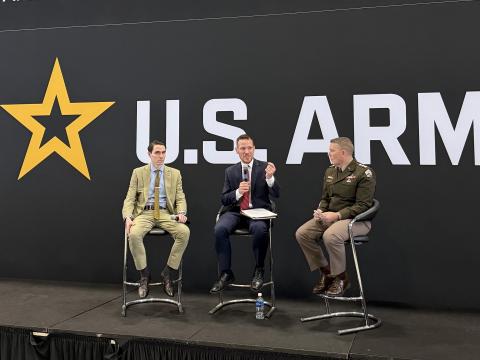
These announcements came Wednesday during a groundbreaking panel covering Project Agincourt at the 2026 Association of the U.S. Army's Annual Meeting & Exposition.
In addition to Hegseth and Telle, the panel included Hung Cao, acting secretary of the U.S. Navy; Troy Meink, secretary of the U.S. Air Force; Owen West, chief executive officer of Project Agincourt and the direct reporting portfolio manager for Unmanned Offensive and Defensive Systems (DRPM-UxS); and Derrick Anderson, assistant secretary of war for Special Operations and Low-Intensity Conflict. The discussion was the first time that all of these leaders and positions spoke on the same panel and on the same stage, according to Sean Parnell, assistant to the secretary of war for public affairs and senior adviser to the secretary of war.
Comments