
DISA Looks to Industry for DODNet Mission

The Defense Information Systems Agency, or DISA, is working to consolidate the U.S. Department of War’s networks into a common enterprise environment through its DODNet program. With industry partners, the agency is focused on standardization and global migration of combatant commands.
Launched in 2022, the DODNet program provides network capabilities to secure, operate and defend the department’s information technology environments.
“Back in 2019, a memo came out of the Department of War [chief information officer’s] office around network optimization, collapsing disparate networks into one network environment, and that is what we have been actively working toward ever since,” said Carissa Landymore, DODNet program manager at DISA.
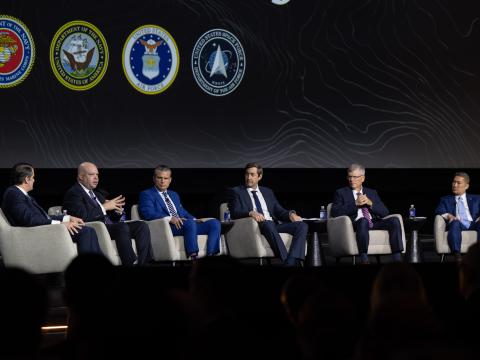
Landymore spoke alongside Michael Butler, DODNet chief engineer at DISA, J6, at TechNet Indo-Pacific 2026 in Honolulu, Hawaii.
“We’ve migrated over 900 sites and roughly, just the last two years … we’ve got over 34,000 users on our unclassified environment and about 10,000, give or take, on the [secret internet protocol router] environment,” Landymore stated. “We are showing that we can do this, and we are continuing to go at speed because that is what the mission calls for.”
According to reports, the agency aims to migrate 11 combatant commands to DODNet by September 30, 2028.
The program is working to accelerate migration through standardization and coordination across regions, Landymore said. Moreover, Butler shared that the goal is flattening the network environment through a common architecture, shared services and consistent management practices.

We are showing that we can do this, and we are continuing to go at speed because that is what the mission calls for.
Industry partners play an integral role on this mission and will continue to do so, the two agreed.
“Our industry partners have really responded to that need, from the acceleration standpoint,” Butler said. “Whether it’s … a unique problem set or a particular capability with our zero-trust edge architecture or scaling up from a monitoring capability, we [have] in turn taken those requirements for acceleration, passed those back to industry, and you guys have helped build what the DODNet environment looks like.”
As DODNet expands, the challenge is modularity, interoperability and standardization across different infrastructure environments. Industry collaboration will continue to be key in integration across enterprise services to achieve the secure architecture, Butler and Landymore stressed.
“We’ve got a director that is pushing us very hard to go faster and to be as innovative as we can to be able to deliver rapidly, so thank you all,” Landymore said. “We definitely need your help to be able to continue to evolve and be an enterprise service provider that can support the warfighter.”
TechNet Indo-Pacific is co-sponsored by AFCEA International and AFCEA Hawaii. SIGNAL Media is the official media of AFCEA International.


Comments