
DARPA Developing Small Robots To Perform Medical ‘Miracles’

The number one cause of potentially survivable fatalities at the point of conflict is noncompressible torso hemorrhage, Lt. Col. Adam Willis, M.D., USAF, program manager in the Biological Technologies Office at the Defense Advanced Research Projects Agency (DARPA), reported. To tackle this problem, DARPA crews are attempting to develop a new tool and strategies to patch up wounds, especially wounds located in the abdomen area, and give injured soldiers more time to get to surgeons for more extensive care.
This “miracle,” as Willis calls it, will be completed as part of the Medics Autonomously Stopping Hemorrhage (MASH) program, through which officials will begin technical work in the next couple of months to accomplish milestones and stay on schedule, according to Willis. More specifically, program leaders seek a checkup with the engineers to see that they are progressing with capability development and to ensure that the ideas behind the technology are attainable.
For example, the proposed MASH system concept will likely use sensors to bind up the wounds that warfighters sustain while in the line of fire. The sensors will ideally be so advanced that they will have the ability to discover where the wounds are in the body and where the bleed is, allowing other facets of the device to stitch the injuries temporarily. DARPA personnel will need to display these capabilities and showcase their effectiveness at some point throughout the developmental stage.
“It’s sort of a staggered set of milestones to show that they’re moving towards that miracle,” Willis said during an interview with SIGNAL Media. “And that’s the work. They’re physically going to be working to bring the robots onboard, get the autonomy going, get the sensors working to show that they’re getting close to achieving that miracle.”
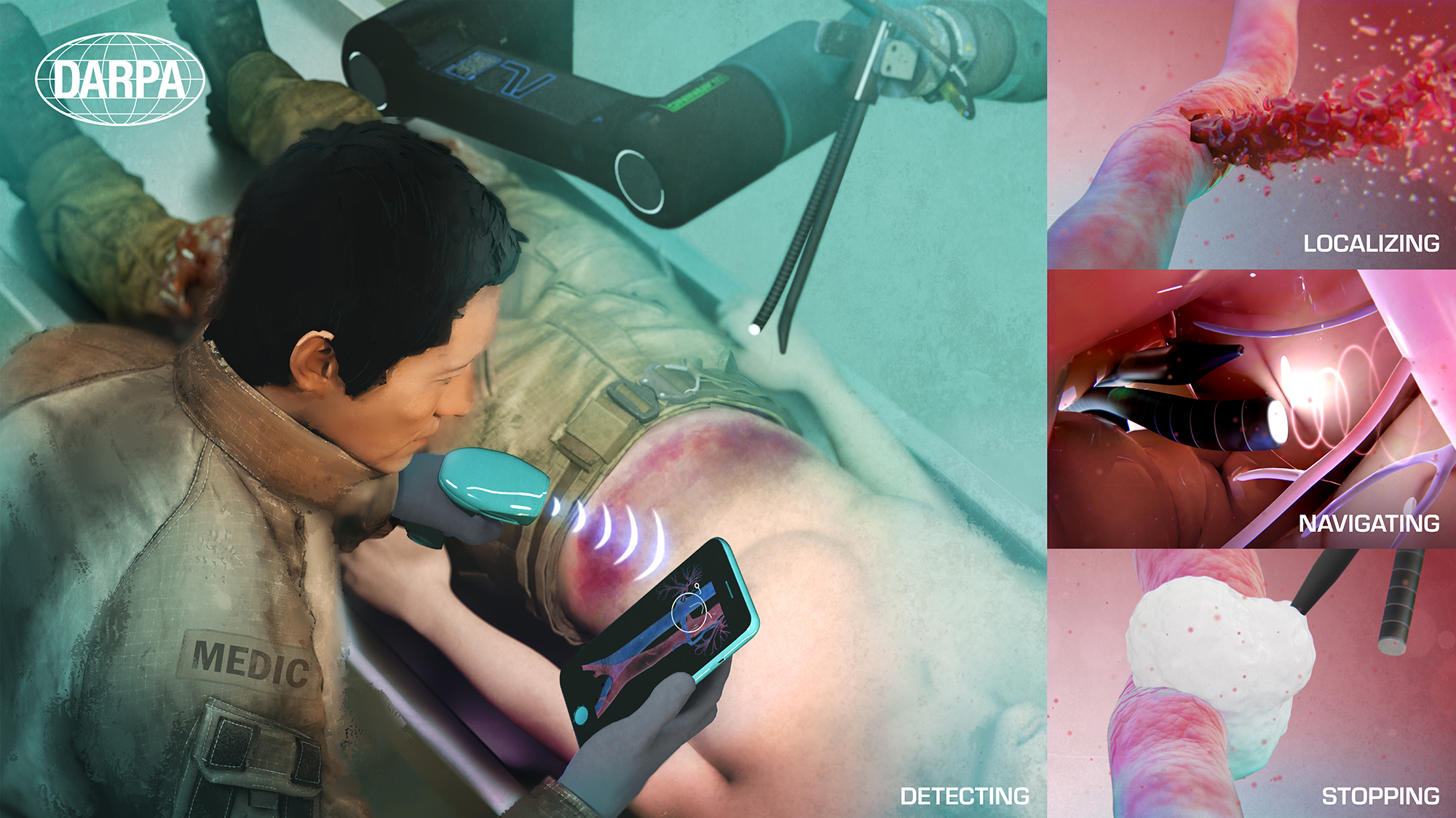
These immediate next steps are part of the MASH program’s three-year plan, which leaders have broken into two phases. Phase I will begin in the late spring or early summer, and crews will signify this commencement by starting technical work. Researchers expect this phase to last for 24 months. During this time, they will focus on producing and exhibiting technologies aimed at finding gashes and then once they master this, they will move on to finding ways to use the MASH system to artificially scab the wound. By the end of Phase I, personnel will have to demonstrate that the MASH system can identify bleeding and locate the wound.
“So not only do they need to detect that bleeding is happening, [but they need to] then find out where it is,” Willis said. “Anatomically speaking, what is bleeding? But also, where is that bleeding? Because you’ll need to know where it is in order to get there and navigate there. Paired with that, they’re going to have to show me that if they are given a set of positions that they want to get to within the abdomen or within the vessels, that they can move their robot appropriately to get to where they want to go.”
As for Phase II, the latter part of the program will last 12 months, and throughout this period, crews must be able to perform everything they learned in Phase I while also showing that they can direct the system to the correct location and ultimately stop the bleeding. Phase II is all about combining every technology they have upgraded into one tool to ensure it is optimal and ready for use.
“They have to bring it all together to find the bleed, and then position their robot in the right spot, and then stop the bleed, all with one device and one capability,” Willis said. “So, we’ll start with separating the components of finding the bleed and showing me that you can stop the bleed, and then, we’ll bring it all together, that you have to find and stop the bleed within a single device.”
These next steps will come after MASH program leaders finish sifting through applications from industry. Once they award contracts and complete the selection process, Phase I can begin. Even though this procedure is still ongoing, the window to apply is closed, Willis stressed.
If successful, the MASH system will be a device that can provide life-saving help to wounded soldiers on the battlefield. While operating on critically injured warfighters—particularly those who have critical injuries to their abdomens—medics can make a small cut in their torsos and insert the device. Due to the amount of fat in the stomach area, this action does not create much additional bleeding.
By using artificial intelligence to guide sensors, or a camera or ultrasound, the tool will autonomously discover and locate the laceration. The MASH system will then spray healing gauze, restrictive foam, electrocautery, which uses electricity to coagulate blood to stop bleeding, or a focused ultrasound, which can activate blood to start the clotting process on the injury, according to Willis. These are all remedies for when medical professionals are working only within the abdomen and not the blood vessel itself. As for clogging a wounded blood vessel, medics can insert a balloon-like device to block the flow of blood.
If done correctly, the application of this tool will give officials 48 hours to get injured soldiers to a surgeon, who can then perform more permanent repairs, saving warfighters who otherwise would have died.
The U.S. Food and Drug Administration and other regulatory agencies will need to evaluate and test the MASH system if, and once, crews complete it to ensure the tool is appropriate and safe to use. Willis also anticipates that anyone who operates with the MASH system will need to receive training.
Willis predicts that developers will create the MASH system by compiling existing tools, rather than inventing brand-new technologies. Due to the challenging, high-cost and long-term procedural nature that comes with building new capabilities, especially in the medical field, leaders want to take advantage of the tools they have already developed and proven to work; however, engineers must still improve these capabilities.
“We’re not really inventing new robots,” Willis said. “What we’re doing is we’re trying to make the robots that exist smart enough, with perhaps new sensors, to find and stop the bleed. Now, at this point in the program, we are not prescribing exactly what robots, what sensors, etc. ... We want people to solve this problem. We’re very open, and people are coming to us with their ideas, and so that is what we’re trying to get done.”
The number one cause of death resulting from potentially survivable wounds on the battlefield is noncompressible torso hemorrhage, per Willis. Researchers at the National Library of Medicine conducted a study covering deaths on the battlefield and implications for the future of combat casualty care. They reviewed and evaluated 4,596 battlefield deaths that happened between October 2001 and June 2011.
Researchers found that 87.3% of all injury mortality took place in the pre-medical treatment facility environment. Furthermore, they deemed that 24.3% of those fatalities were potentially survivable, and 90.9% of potentially survivable deaths were mainly associated with hemorrhage, as reported by National Library of Medicine personnel. The MASH system aims to significantly reduce these numbers.
In addition to helping those wounded on the battlefield, Willis envisions that the MASH system could also provide life-saving treatment to individuals in rural America and people enduring global health issues and disasters.
MASH program leaders have received conflicting feedback from their stakeholders regarding the practicality of the proposed product. Some individuals have voiced their optimism and support for the group, while others have expressed doubt and skepticism. Some people are unsure but are eager to see what the program accomplishes. Despite these varying opinions, Willis said that this is right where he and his fellow agency colleagues feel most comfortable.
“Where DARPA wants to live is between the believable and maybe unbelievable, because we’re supposed to take big swings,” Willis said. “Other groups, other funding agencies, want to be more incremental. We can take a swing and say, ‘This may not work, but if it does work, it’ll change the world.’ So, we’re able to take that risk.”
Comments