
The Next Big Thing: Nuclear Power

As traditional energy sources become increasingly vulnerable to adversaries’ attacks, U.S. military leaders aspire to utilize a safer, more secure and more reliable energy source on a grander scale. That ascending option is nuclear power, and the sought-after changeover from fossil fuel-based energy sources, such as gas and oil, to nuclear power-based energy sources, such as commercially built microreactors, is gaining momentum as Army personnel are in the early stages of making that dream a reality, particularly because of the novel Janus Program.
Despite being less than half a year old, the initiative has already gathered prospective parties who are interested in constructing microreactors. Leaders expect to finalize a list of the companies in priority order that they see as the most qualified and compatible to overcome this challenge. Once they complete this task and after they negotiate with individuals in industry, program contributors hope to sign the contracts and announce the awardees by mid to late spring, per Jeff Waksman, principal deputy at the Assistant Secretary of the Army for Installations, Energy and Environment. This comes after Janus Program officials sifted through and evaluated a large number of submissions turned in by private sector personnel seeking a contract.
Janus Program contributors also revealed their long-term goals and milestones for the project. They are striving to develop a demonstration reactor core that will produce neutrons by the end of this year. This accomplishment does not necessarily produce electricity, but it is a major step toward generating energy, scientifically speaking, according to Waksman.
“Just producing neutrons does not mean you’re producing electricity,” Waksman explained during an interview with SIGNAL Media. “Electricity is electrons. You have to heat some fluid up, and then that has to turn a turbine, so you need the fluid, and you need the turbine. The whole system needs to be figured out, so that is going to take quite a bit longer.”
Furthermore, Waksman wants to complete the entire system and have it power something on a military base by the end of 2028, a target that he called “aggressive” and a goal, not a promise.
In addition to already gathering prospective parties interested in constructing microreactors, Army leaders have zeroed in on nine optimal sites for the initial installation of the proposed microreactors. Those nine locations are Fort Benning, Fort Bragg, Fort Campbell, Fort Drum, Fort Hood, Fort Wainwright, Holston Army Ammunition Plant, Joint Base Lewis-McChord and Redstone Arsenal, according to Army officials.
Identifying these sites signifies a major step toward bringing this proposal to fruition. One Army team highlighted the nine locations listed above following a thorough analysis of the sites, which included an examination of several factors, Waksman explained. That process included inspecting various sites and assessing their importance, current energy and grid situation, electricity costs, compatibility with nuclear, and geologic and geographical ability to support nuclear reactors. Additionally, they factored in state and local politics and whether lawmakers would likely support or rebuke the installation of microreactors. Lastly, assessment team members researched nearby utility companies to determine whether they would likely be interested in working with the military to make this happen, per Waksman.
Microreactors are powered by the nuclear fission process, and ideally, they can provide military bases with reliable and resilient power, which is the ultimate objective that Army leaders had in mind when they launched the Janus Program in October 2025. With the help of the Defense Innovation Unit, program leaders are seeking to develop commercial microreactors via a milestone-based contracting model. Industry teams will build and own the microreactors, while defense personnel will offer technical oversight and assistance. Furthermore, program contributors will team up with Department of Energy crews, leveraging their insights and experience to provide the utmost standards of safety, oversight and transparency, according to Army officials.
The efforts of the Janus Program will ideally lead to the installation of nuclear-backed technologies on military bases, which Army officials anticipate supporting national defense sites and critical missions. Nuclear capabilities, such as microreactors, can accomplish this while also providing a plethora of additional benefits that traditional fossil-fuel-backed options cannot. For instance, fossil fuel lines, specifically diesel and oil lines, can be easily disrupted. That could occur due to a direct strike by an enemy, like the cyber attack launched by DarkSide, a Russia-based cybercrime group, on Colonial Pipeline in 2021, according to FBI personnel. This attack forced the fuel pipeline company to shut down the system for about six days. Americans responded by flocking to gas stations, attempting to fill up their cars as they were unsure when they would be able to buy gas again, per U.S. Department of Energy and Cybersecurity and Infrastructure Security Agency officials.
“Everything that we do in the military requires electricity,” Waksman said. “We are an incredibly electrified force, and in fact, there have been studies that have looked into the amount of electricity used per soldier per year. And since World War II, it’s basically an exponential chart going upwards. That’s the trend. But in previous conflicts, we’ve always operated from a world where everything within the U.S. was not part of the conflict. In World War II or in Korea, we had to worry about pushing forward our fossil fuels to Japan or Korea, but we didn’t have to worry about losing power in the continental U.S. That is no longer the case. We now have adversaries who can threaten our civilian electric grid, so that means that we have to think very seriously about how to provide energy resiliency to our bases.”
Ensuring energy resilience is critical to Army and civilian operations and infrastructure. If the electric grid collapses, it can take months for crews to restore power, Waksman added. “It is extraordinarily difficult to get an electric grid back up once it has gone down. That’s something that, for instance, the Defense Advanced Research Projects Agency has studied. So, that’s really our fear. We have less margin for error than ever before, and if there were to be a serious attack on our electric grid, then we could have a serious challenge for months. So, the U.S. military needs to have some way that we can ensure that we are not just flat and on our backs if the electric grid were to go down.”
Additionally, nuclear power is also significantly more convenient and energy-dense than fossil fuels. Microreactors take up very little space, likely no more than one or two acres, and individuals can place them anywhere as long as there are five feet of shielding between any reasonably sized nuclear reactor and humans for protection, Waksman stressed. To adhere to this requirement, Waksman suggested that crews position the microreactor underground or behind concrete. Nuclear power also offers years of electricity to soldiers without resupply, which fossil fuels cannot. Fossil fuels take up considerably more space, and officials need to resupply them more frequently.
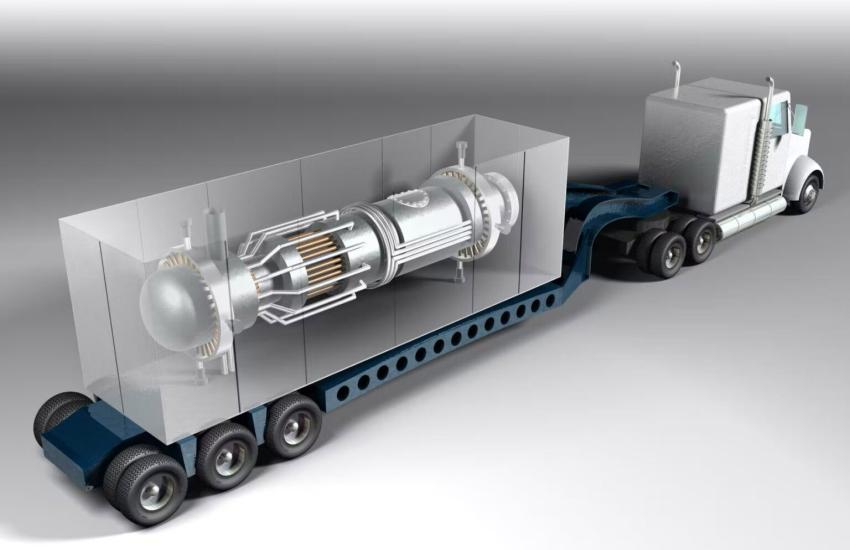
As for energy density, which is the amount of energy that individuals can receive from a specific volume of equipment, nuclear-backed power is far more efficient than fossil fuel-backed power. Populations can access monumentally more energy that takes up a fraction of space by using nuclear capabilities.
“There have been tremendous advantages in batteries, but the energy density of even the best batteries in the world is currently about 2% as energy dense as diesel,” Waksman said. “That’s why you’re not going to see any planes powered by batteries anytime soon. They’re just too heavy and too big to get that amount of power. So, fossil fuels are 50 times more dense than the most advanced batteries in the world. Nuclear power is another two million times as energy-dense as diesel. It is a staggering amount of energy that you can get into a very small space.”
Nuclear power offers a solution to a major problem that the U.S. military is facing. The armed forces are living in a world of energy starvation, Waksman added.
“We are constantly trying to figure out how we can get just enough power to execute the equipment and the operations that we have to do now,” Waksman said. “We’re constantly trying to add extra diesel generators and things we need to do in order to make ends meet. Nuclear power potentially puts us into a world of energy abundance, where we could have so much power in these installations that we can actually look to leverage that power for other things, maybe new technologies or new applications that we can do. It would really be a game changer to move from a world of energy starvation to a world of energy abundance.”
This desired transition is part of a wider effort within the Department of War (DOW) to support two recent executive orders: Declaring a National Energy Emergency and Deploying Advanced Nuclear Reactor Technologies for National Security.
Along with his other roles in the Army and the Janus Program, Waksman was in charge of naming the initiative, and even the name itself signifies the immense change that the program can bring about.
“I hate acronyms, but I love mythological names,” Waksman said. “I did Project Pele, and when I was at NASA, I was the one who came up with Artemis for the Artemis Program, and similarly, I came up with Janus. Janus is the Roman god of transitions, so that’s why the first month of the year, January, is named for Janus. We’ve done these nuclear prototypes. Now we need to actually have a commercial product. That’s the transition that this program is executing, and that’s why it’s called Janus. It stands for nothing.”


Comments