
Experts Caution on AI Use, Call for Preparedness and Strong Data Foundation
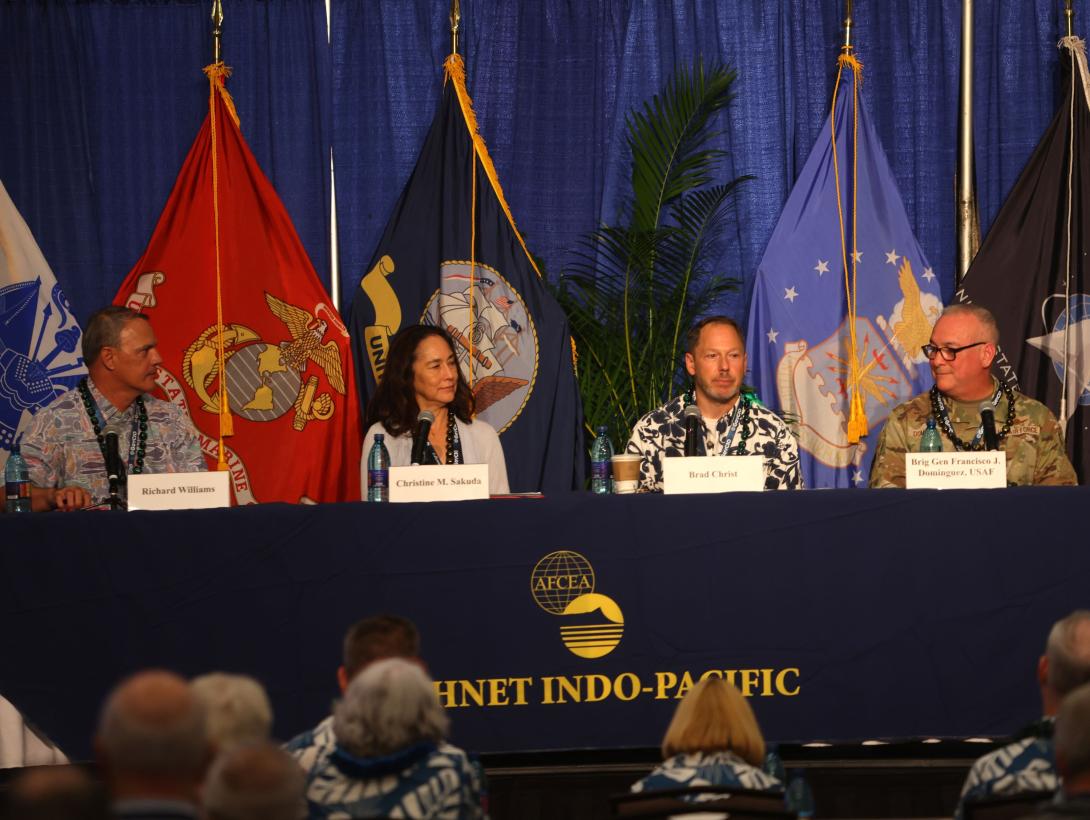
Data is key in the evolution of artificial intelligence capabilities, or super intelligence (SI), as noted by technology experts speaking at TechNet Indo-Pacific 2026 in Honolulu.
“Before we aggressively move toward SI, we really need to look at the data strategy and data problem,” stressed Richard G. K. Williams, technical director, N6, U.S. Pacific Fleet.
Furthermore, an SI-ready workforce within Pacific Fleet and the Navy requires a transition from traditional tactical memorization to algorithmic skepticism and system integration. “What I mean is rather than teaching sailors and marines to operate static, rigid software pencils, they need to act as more critical supervisors of things like automated agents or detecting model drift and looking at the authoritative data sources,” he said.
This type of strategy will help with SI preparedness and in the event that SI fails.
Additionally, as SI is starting to be used across active maritime operation centers, Williams emphasized the importance of a human in the loop to verify the accuracy of SI models.
“With regards to SI and our workforce, we must educate, train and prepare our workforce to leverage SI, but also be prepared in the event it fails, so that traditional capabilities still exist,” he stated.
State of Hawaii Chief Information Officer Christine M. Sakuda echoed Williams’ comments on data.
“While we do have our chief information officer and we have a cybersecurity team that helps keep our networking infrastructure safe, the state government has so much data across its executive branch that relates to the Department of Land and Natural Resources, or the Department of Human Services, and the Department of Health, and much of that data is not in a format that we can actually leverage today,” Sakuda noted.
There is a challenge and an opportunity in making the data available to inform intelligence decision-making and therefore help SI understand said data, she added.
“The data governance and data preparedness is key, and I feel like we’ve been talking about that, at least in state government, for decades, and we always sort of jump ahead without really . . . taking care of the fundamentals that’s really important and, if anything, supercomputing, super intelligence and AI just helps us realize that those challenges still persist today,” Sakuda said.
Meanwhile, University of Hawaii’s Brad Christ cautioned that relying too heavily on generative AI can undermine critical thinking and human judgment. Christ currently serves as the university’s vice president of information technology and chief information officer.
“Generative AI is sympathetic,” he said. “It tells you what you want to hear . . . I’ve certainly seen this with students and others, as well.”
Christ noted risks of AI use, citing a 2025 incident involving Amazon Web Services in which an AI tool reportedly made unauthorized domain name system changes which caused disruptions. This situation underscores the risk of allowing AI systems to make consequential decisions without human verification and oversight, he said.
“. . . if you outsource it, you’re allowing it to do your thinking for you, then you’re not really contributing very much at that point, and that’s very, very worrying in some of these circumstances where people in a position of authority [are] relying on AI models . . .” Christ added.

Generative AI is sympathetic. It tells you what you want to hear.
Moreover, conflicts like the war in Ukraine are accelerating the development of emerging technology, added Brig. Gen. Francisco J. Dominguez, USAF, operations vice director, command, control, communications and computer enterprise directorate (J6) at the Defense Information Systems Agency.
Dominguez went on to emphasize the importance of collaboration between military, industry and technical personnel in identifying and adopting the technologies for mission needs.
“We talked about the data being key—that’s not going to change anytime soon,” Dominguez said. “In fact, that’s going to be the dominant lean-in that we pursue.” Software will be the most flexible way to interact with new technology, he added.
Still, investment in technology and people is what will help adopt modern innovation.
TechNet Indo-Pacific is co-sponsored by AFCEA International and AFCEA Hawaii. SIGNAL Media is the official media of AFCEA International.

Comments