
Looking Into the Minds of Innovators
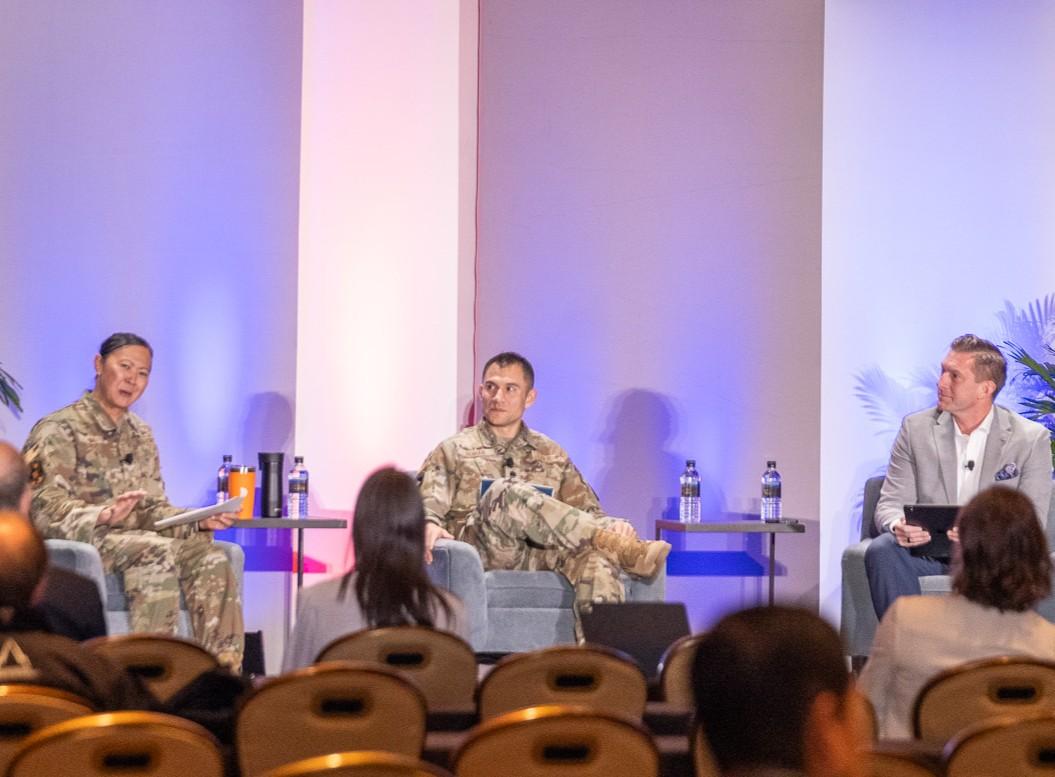
As the director of ARCWERX, Lt. Col. Tyler Johnson, USAF, a member of the Air National Guard who also has worked in the private sector, is making sure technologies reach the total force. ARCWERX is the innovation accelerator for the Air Reserve Component, both the Air National Guard and Air Force Reserve.
The organization, based in Tucson, Arizona, is colocated with the Air National Guard, Air Force Reserve Command Test Center.
“It enables ARCWERX to field capabilities faster and keep the Guard and Reserve from from getting the hand-me-downs,” Johnson said. “Being colocated there and having an amazing relationship with the commander, it gives us a really neat opportunity to take things from our industry partners and VC [venture capitalists]. We actually get them on a jet to bring [solutions] to the field.”
Johnson spoke on February 5 with Col. Tharommony In, USAF, director, Air Force CyberWorx, and Lt. Col. Jeremy "JJ" Homan, USAF, division chief, Assessment and Experimentation, Special Operations Command North/J58, during the Rocky Mountain Cyberspace Symposium 2026.
To be able to pull in emerging capabilities quickly from industry, it helps to have “dual-fluency” airmen, Johnson shared. These are warfighters who have commercial sector knowledge from their industry day jobs as well as their Air Force experience from being in the Guard or Reserve.
“We are kind of at the intersection of military and the commercial sector,” Johnson said. “And now, our industry partners, you all, I would argue, are doing over 70% of the R&D [research and development]. We need to be thinking about that.”
The organization does rely on a wide network of Spark Cells that work closely with other innovation organizations on the joint force, he noted. ARCWERX funds a series of prototypes every year through resourcing, then the Spark Cells do some of the fabricating.
“On the ARCWERX side of the house, we are working on most of the same hard problems that the joint force is working on,” Johnson said.
Next, the Air Force innovation leaders shared that they do see the need for technology integration, especially as the United States intends to work with allies and partners.
However, impediments still abound, Homan pointed out. He had previously worked with the deputy commanding general of transformation for Space Operations Command, a new Space Force role at Peterson Space Force Base. The general was a Canadian exchange officer, Brig. Gen. Kyle Paul, RCAF, and even with the combined workforce at Peterson, there were technology challenges and bureaucratic issues.
“He was an amazing general that helped lead the organization, and he was leading all Americans,” Homan reflected. “And it was fascinating to see this whole concept of allied integration within the command. But there are just some fundamental challenges, like security. Gen. Paul couldn't be read into everything, with the ‘NOFORN’ [no foreign nationals] aspects, and so we had to break through a lot of that.”
Homan also advised that interoperability hinges on whether a party actually wants to share information. Leaders need to examine how they intend to share information from various technologies.
“Especially coming through a lot of the more high-end systems, and then now, having worked some of the more tactical, in-the-field type of tools, this whole concept of interoperability, it does start with the mindset of, ‘Do you want to share this information?'” Homan said. “Because at the end of the day, if you're not willing to share that information, it does not really matter how the tech works.”
And it is quite common for the policies to not line up with the technical operations, he continued.
“What we have learned is that if you want the Canadian or Five Eyes partner sitting in the same ops floor, it does not matter if they have a special terminal to see that data if we don't allow them to see in the first place,” Homan noted.
Regarding artificial intelligence (AI), the innovation leaders pressed industry to be specific about what their AI tools can do and how they could effectively help an Air Force process or task.
“I have seen a lot of one pagers saying, ‘We have amazing AI to integrate into that space,’ but to do what?” Homan asked. “Instead of talking about where AI is going, how are we going to use it? How are we using it in our actions, our daily lives and operational methods?”
So far, he has seen AI that is more focused on feeding information, in response to simple queries, or that can consolidate text or synthesize some information. That is not enough.
“And if we are going to have it help us in our operational [side], like making decisions, we really need to [flush] it out more,” Homan emphasized. “We need to have this thought out well, because just like anything, it's a tool, and garbage in, garbage out.”
Johnson would like to see AI help with mundane processes, “because there's a lot of toil in a lot of our processes, particularly with data integration,” he said.
He warned against demonizing AI right off the bat. Nonetheless, warfighters do need to clearly examine some of the industry tools to begin to understand what is possible at this early point.
“I would really encourage you to know and understand what is there because it could be a big force multiplier,” Johnson offered. “And we are just now at the start of the rollout with generative AI, where we are just finally kind of getting access to a trusted capability to do that.”
Instead of talking about where AI is going, how are we going to use it? How are we using it in our actions, our daily lives and operational methods?
One area in which AI can possibly helping the Air Force—again, very specifically applied—is for aircraft maintenance. Here, Air Force CyberWorx is working with Air Combat Command to harness rapidly informed metrics from the aircraft fleet, In shared.
“How are we the greatest Air Force, and our maintainers are still using Excel spreadsheets?” she asked. “So, it is a very specified [application] when it comes to how do I understand aircraft maintenance when it goes into depot for regular maintenance; where our pilots are with regards to their training hours; and how do we utilize AI to capitalize on our fleet readiness and making sure that we have got aircraft readily available? Those are some of the things that I'd like to make sure that we are diving into with AI."
To bring innovation into AF CyberWorx, In is leveraging “all sorts” of contracting vehicles, from other transaction authority to commercial service offerings.
Additionally, the AF CyberWorx director is seeing a slight shift in requirements generation, for the better.
“Requirements always kind of made me nervous,” In shared. “I grew up, and many of us kind of grew up in the era of, ‘Hey, you got to write this perfect requirement.’ Now we are in this day and age where things are rapidly changing. I cannot write a requirement without having iterative changes ... And I always ask the question of what problem are we trying to solve? That is what our innovation ecosphere has been trying to get after.”
Industry help is needed, she emphasized, to take technologies well into sustainment, from the emerging phases.
“We know that there's innovation, emerging technology that is out there that is going to require sustainment,” she said. “How do we kind of work through that in parallel? At what point do we kind of bake that into our funding so that we gain that sustainment in order to continue to get after what we need to get after?”
Lastly, Johnson, with his team, emphasized how it is a priority to clearly relay ARCWERX’s technological needs and issue sets—especially after the experience of being in the private sector.
“Coming from industry, it is all about, ‘Just tell us what your problems are,’” Johnson noted. “And I've been banging our team in the head going, ‘You need to share this.’ Otherwise, this whole thing, this whole teamwork with industry that we keep talking about over and over again does not work.”
The Rocky Mountain Cyber Symposium is co-hosted by the AFCEA Rocky Mountain Chapter and AFCEA International. SIGNAL Media is the official media of AFCEA International.

Comments