
How To Partner With the U.S. Navy’s Perfect Storm Technology Team


Operating behind the scenes of every complex mission of the U.S. Navy and beyond are more than 2,500 military and civilian members of the Naval Meteorology and Oceanography Command (CNMOC). With 60 locations around the globe—working 24 hours a day, seven days a week and 365 days a year—the CNMOC consists of analytical experts who drive decision superiority through innovation. And much like the rest of the U.S. military, the command looks to industry and academia to further readiness and advance warfighter capability.
“It starts with us,” stressed Jason McKenna, chief technology officer and deputy N8/N9 at the CNMOC. “The deep understanding we have of our physical environment is critical to decision superiority. You can’t control the battlespace if you don’t first understand it, and with that understanding comes the ability to predict it skillfully, which promotes advantage.”
Headquartered at the Stennis Space Center, Mississippi, CNMOC comprises six components: the Naval Oceanographic Office; the Naval Oceanography Operations Command; the Fleet Weather Centers in Norfolk and San Diego; the Fleet Numerical Meteorology and Oceanography Center; and the U.S. Naval Observatory.
“I want people to understand that we’re a warfighting command that really weaponizes the physical environment for strategic advantage,” McKenna said. “Every major naval engagement and every tactical decision the Navy makes is underpinned by our understanding of the environment and what we need to do to use that environment to our advantage.”
A common misconception about the command is its sole focus on weather forecasting, explained Capt. Mike Svatek, assistant chief of staff for requirements and capabilities at the CNMOC.
“We are a pioneer in unmanned systems,” he told SIGNAL Media in an interview. “We operate one of the world’s largest fleets of ocean gliders,” he said, referencing autonomous underwater vehicles, which collect oceanographic data from the seabed to the surface of the ocean.
“Our Naval Oceanographic Office is critical for the safety and effectiveness of the submarine fleet and to undersea warfare at large,” Svatek added.
CNMOC is also responsible for maintaining the Department of War’s authoritative source for precise time, which Svatek and team view as the “heartbeat” of the Global Positioning System, or GPS.
“I wish people knew that [at Stennis Space Center], we have the largest concentration of oceanographers and hydrographers in the world, and that our tie to academia and industry makes working for the Navy in this capacity one of the great jobs in the Navy,” Svatek stated.
With many industry partners on their roster, CNMOC especially values academic institutions. Currently, the command has seven Educational Partnership Agreements with universities around the Gulf Coast and beyond to help develop the future workforce of meteorologists, oceanographers, computer scientists and more.
Reports show current partnerships with Mississippi State University, the University of Mississippi, and the most recent addition, Pearl River Community College (PRCC).
The EPAs are in place to further STEM students in their respective fields. “It gives the students practical experience in the field for what they will be doing in the workforce when they graduate,” said Naval Oceanographic Office Technical Director Wade Ladner, during a January signing of the PRCC and CNMOC agreement, according to a WLOX report.
“Whether they are a subject matter expert and want to give a guest lecture, or we can go on a tour [of] their facilities. Perhaps even create internships,” hydrography instructor Sydni Shoemaker reportedly stated. “Just overall expanding opportunities for the industry and students involved.”
Additionally, McKenna noted, through the partnership with the University of Southern Mississippi, the Navy has access to hydrographic certification and education.
Such collaborative initiatives are pivotal for research and development efforts and technological advancement, the experts added, also highlighting the role small businesses play.
While recognizing the challenges that smaller and newly established businesses may have when entering the arena, the CNMOC says there are routes to success.
For Svatek, the key is not just disruptive and emerging technology.
“You may be the young startup, maybe the small business out there that has something to bear, that just doesn’t quite have the resources or the platforms to make those viable for the Navy,” he said. “They have an idea, they have passion, that’s a big one. If the company has passion to help the Department of the Navy, Department of War, then that is really something we’re invested in, so then we’ll help and try to curate that technology as best we can and see if we can make it work for the Navy.”
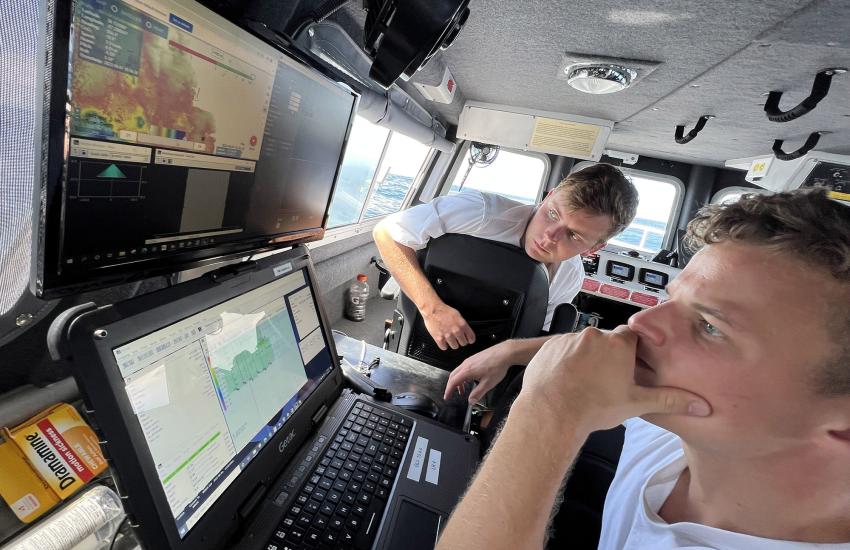
McKenna also referenced the cooperative research and development agreements, or CRADAs, which help advance Navy collaboration with industry partners. “We’re looking for folks that want to work with us that are eager, willing to put the cycles in to help and really kind of roll their sleeves up and listen to what our requirements really are,” he said. “That’s why we really like these CRADAs, because it allows us to legally engage and provide those requirements back to our potential partners and to evaluate that technology and do fit-for-purpose testing collaboratively.”
In a case when a technology is not the right fit for the CNMOC, McKenna explained, CRADAs help match companies with other Navy components to help mature the technology being offered.
Svatek also highlighted the importance of fleet exercise participation for all industry members wanting to partner with the Navy. “They should be seeking out how to get into the fleet exercises more, not [waiting] to be invited by us,” he said.
It all comes down to doing homework, he stressed, to know and understand capability gaps and requirements.
The Department of War has made great strides in hosting outreach events for further industry collaboration, McKenna added. With a strong industry background, he understands how daunting it can be to break into the small-business market.
“One of the things I always tell our industry partners, our startup partners in particular, is that we understand that a path to revenue is critical for your success, so understand how the government does business and learn to take advantage of some great programs,” he said, referencing Small Business Innovation Research Programs and Other Transaction Authorities.
Partnering with larger corporations can also be beneficial for smaller businesses, McKenna said. “There’s lots of ways to break in,” he said.
Having patience for the acquisition process will be worthwhile, he noted, acknowledging the slower speed of government. Improvements are being made however, with initiatives like the DON Rapid Capabilities Office underway.
Still, opportunities remain for those who wish to join the mission.
“The persistent challenges in our command that we deal with are data gaps, access to where we need to collect that data, [and] degraded communications,” McKenna said. “I believe something that’s emerging is the discipline to field and sustain artificial intelligence.” Automating routine workflows through AI capabilities is something that is proving beneficial, he noted.
Investing in talent, however, is of the utmost importance. “I think that’s going to be our sustained, long-term advantage there—our people.”
Comments