
NATO Official Calls for 'Strategic' Digital Transformation
Advanced capabilities are needed across the 32-member alliance.
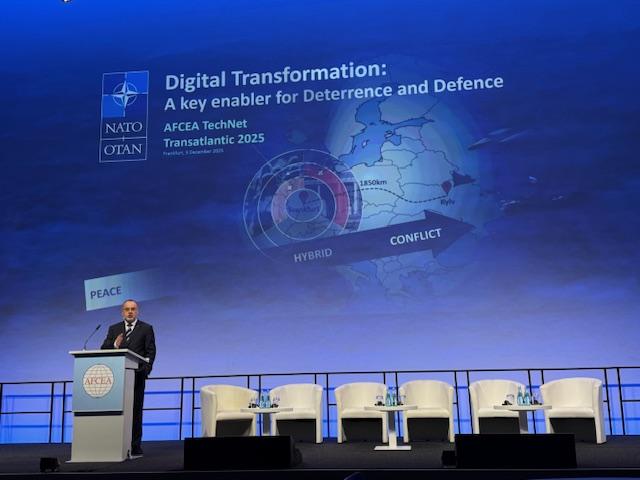
Gernot Friedrich, head of Interoperability and Standardization at NATO headquarters, speaks at TechNet Transatlantic in Frankfurt, Germany.
In his day, Gernot Friedrich, head of Interoperability and Standardization at NATO headquarters, has seen technological changes. The 25-year veteran of working in NATO has seen a lot. But nothing is more serious now than the alliance’s need for a strategic digital transformation. Corners cannot be cut, and the transformation must be comprehensive, he said, speaking December 3 at AFCEA International’s TechNet Transatlantic conference in Frankfurt, Germany.
“We have been able in the past, when operational pressure was there, to also deliver capabilities fast, but it's always the challenge that you have to cut a lot of corners to deliver those capabilities fast and [in] getting the warfighters the capabilities they need.”
Friedrich is seeing signs of digital transformation by NATO, beginning with a changing emphasis on cyber and the creation of NATO’s new Cyber and Digital Transformation Division at NATO headquarters—and even the office’s location.
“The cyber community is not somewhere in the basement now at NATO. This has been lifted all the way up,” he said. “We have an assistant secretary general directly reporting to the Secretary General [Mark Rutte] on the topics of cyber and digital transformation.”
For NATO to succeed, however, the alliance as a whole must build digital interoperability at scale from the tactical edge all the way up to the core NATO command structure across all 32 allies.
“For this, we need something larger than a single system,” Friedrich advised. “We need a strategic digital transformation of the entire alliance.”
At a recent NATO cloud conference that Friedrich attended, the secretary general reminded the group that they were meeting at a moment of profound strategic change.
“We are not at war, but we are certainly not at peace, either,” Friedrich relayed. “And today, if you think about it, we are only a 12-hour drive from Frankfurt on the German and Polish Autobahn to Lviv in Ukraine. This alone underlines how immediate this challenge is.”
This modern battlefield is contested and electromagnetically saturated with all kinds of sensors, along with cyber threats. Hybrid attacks, disinformation, cyber operations and airspace incursions are all blurring the lines between peace and conflict in Ukraine, Friedrich said.
Of the U.S. Maven Smart System, or MSS, which is receiving a lot of attention, Friedrich applauded MSS’ capabilities that integrate data from legacy systems—albeit only within a single organization. The tool also confirms that artificial intelligence (AI) is no longer an aspiration.
“That system shows us what really becomes possible when we integrate what we already have, and we integrate that at speed,” he noted. “It proves that we can break through the stovepipes. And a lot of those stovepipes were actually generated by our very slow and bureaucratic acquisition systems. But breaking through the stovepipes shows us the new insights AI can generate when the data is available on a common platform.”
These advances all lead to accelerated decision-making. However, it is one single tool, he warned.
"A single proprietary system like MSS will not be able to solve the data integration and exploitation challenges across 32 allies and the various NATO enterprise entities," Friedrich stated.
Image
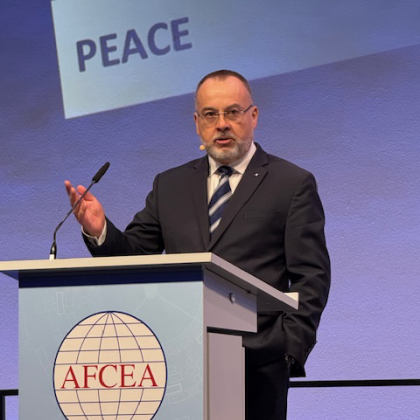
We need a strategic digital transformation of the entire alliance.
Gernot Friedrich
Head of Interoperability and Standardization at NATO headquarters
Since 2015, Friedrich has worked with Ukraine’s team that has created a digital resilient combat software called Delta. The system serves as a single source of truth across Ukraine’s security and defense forces.
The Ukrainian team built Delta based on NATO architectures and a solid foundation of mature standards in the middle of a war, he explained.
“They did not build it as all different systems, where every function has its own acquisition program and its own system,” he said. “They actually looked at the entirety of what NATO had, and they put it into a single multidomain operations system on a solid architecture.”
By having a platform that is interoperable by design, it provides them with battlefield advantages and supports all the weapons and capability delivery by the allies into Ukraine.
They are benefiting from actually being able to integrate at speed Link-16-capable elements, for example, into their system via software integration. They avoided having to go through thousands of pages of standards, obtained the software and integrated it in weeks—three weeks in total—as opposed to what typically requires years in NATO.
“That shows the power of software in terms of integration,” Friedrich said. “Our responsibility now is to match their pace, to transform before we are in a conflict.”
Correction: The position that the assistant secretary general directly reports to is NATO Secretary General Mark Rutte, not a section chief, as incorrectly stated previously.
TechNet Transatlantic is organized by AFCEA International in conjunction with the AFCEA Europe office. SIGNAL Media is the official media of AFCEA International.


Comments