
Guyana Military Signals Modernization
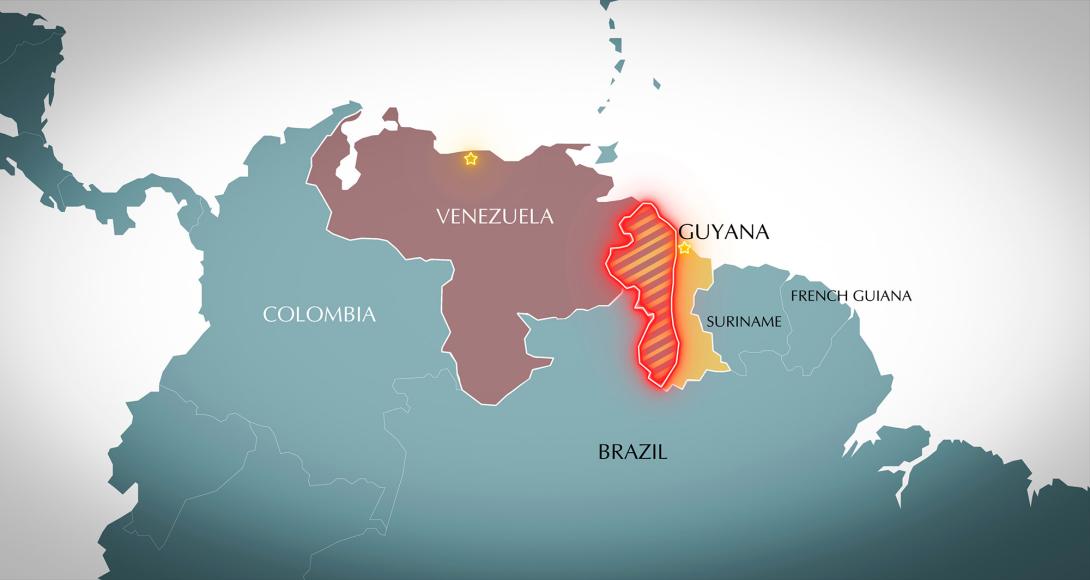
In its complex geographical region, the Co-operative Republic of Guyana has made significant strides in modernizing its security operations through new acquisitions and bilateral agreements.
“While Guyana could never be an aggressor, I think it is more a defense mechanism for early warning … and mechanisms for safety and security, especially related to our borders, which are very porous,” Mark Kirton said in a phone call with SIGNAL Media.
“Even though diplomacy is our first line of defense, we still have to be prepared militarily for any short-term incursion.”
Kirton is director of the Centre for International and Border Studies and former dean of the Faculty of Social Sciences at the University of Guyana. He is also a senior lecturer at the University of the West Indies, St. Augustine.
High levels of aggression have been seen from the Bolivarian Republic of Venezuela (then, the Republic of Venezuela) since the 19th century, Kirton explained.
“As a matter of fact, in 2021, there were attacks by armed Venezuelans on Guyana’s defense personnel,” he mentioned. The academic referenced the February 2021 event in which Guyanese fishing vessels and the crew on board were detained by Venezuelan forces. Due to an intervention by the Caribbean Community (CARICOM), detainees were released days later.
More recently, in March 2025, a Venezuelan naval ship allegedly threatened Guyana’s territorial integrity by entering its waters while approaching an ExxonMobil offshore oil facility.
Notably, considerable efforts have been made by the Venezuelan government to occupy much of Guyana’s region, most importantly, a territory named Essequibo.
“In September 2023, the Venezuela National Assembly initiated a referendum process to gain public support for creating the state of ‘Guayana Esequiba,’ despite the International Court of Justice’s ruling that Venezuela must refrain from action until a decision is reached,” a March 2025 Center for Strategic and International Studies said, using Venezuela’s preferred spelling for the region.
For that reason, military advancements are necessary, Kirton added, highlighting border concerns. “I don’t think we have the capacity, at least not yet, to totally monitor those land borders which divide us from Venezuela,” he said.
For example, Kirton said Brazil’s SIVAM system to surveil the Amazon was built by the Brazilian air force and has been operational since 2004. Such systems would benefit a smaller nation like Guyana, he said.
“Indeed, we have to look for ... an approach for the acquisition of more assets,” he said of Guyana’s defense operations.
Changes to the Guyana Defence Force (GDF) acquisition process have taken place, with recent announcements highlighting a possible security transformation.
One such change emerged from a growing partnership between Guyana and France.
In April 2024, it was reported that Guyana had signed a $42 million contract with France to “acquire a brand-new offshore military patrol vessel capable of patrolling the high seas and monitoring offshore oil assets and waters claimed by Venezuela.” Naval News additionally reported that the 58-metre vessel is owned by OCEA S.A., a French-based shipbuilding company.
In May of that same year, the two nations met for the first joint working group meeting, with discussions focused on security, defense, infrastructure and other key topics.
In July 2024, a military cooperation agreement with France was signed by GDF chief of staff Brig. Omar Khan. Since then, joint military exercises and further partnerships have emerged. In October 2025, Guyana President Irfaan Ali spoke at the opening ceremony of the French Embassy in Guyana, noting that “his country was ready to accept France’s offer of technological assistance—including land and maritime radar systems—to monitor Venezuela’s movements amid pressure over the Essequibo region,” a SpaceWar report states.
Guyana’s Department of Public Information (DPI) in September 2024 announced the launch of its National Defence Institute, a milestone credited to President Ali. The institute aims to educate the public on security to protect the nation’s territorial integrity. “Defence is everyone’s responsibility, security is everyone’s responsibility, and that is why there will be some strategic forces and strategic certificates that are designed to help CEOs, to help the private sector ... guard against various threats that we will confront,” the president reportedly stated.
The announcement came months after then-Venezuelan President Nicolás Maduro signed a bill establishing “Guayana Esequiba” as under Venezuelan control, a move not internationally recognized.
At the end of 2024, the GDF established the Geographic Information System and Drone Operations Centre, according to a Facebook post by the department. The launch “underscores the GDF’s commitment to integrating advanced technology into its operations,” the post states. “The facility is designed to support real-time data collection, analysis and mapping, enabling precise decision-making and enhanced mission planning.”
In April 2025, GDF troops participated in the Fer de Lance exercise with the French forces, “practicing joint operations and rapid responses to emergencies in the area,” a report reads.
In June 2025, Khan issued a statement on the state of the GDF’s budget and modern capabilities. Since 2020, the budget has increased by more than 800%, a DPI report quotes. “This was spread across several areas—technology, training, etcetera,” the Army chief noted.
“We may be smaller, but we are being strategic,” he said. “We are being smart and we are being resolute.”
Khan also noted the importance of international partnerships, including the United States, the United Kingdom, France, Colombia, Brazil and more. He also mentioned collaboration with other Guyanese law enforcement agencies for further security training and implementation, with a specific focus on criminal organizations.
According to the report, $50.4 billion of the national budget was allocated for the GDF, with $2.1 billion reserved for the marine department.
In August 2025, The Defense Post reported a signed memorandum of understanding for aerial surveillance cooperation by the GDF and Colombia’s Ministry of Defense. The announcement took place weeks following the reopening of Colombia’s embassy in Guyana.
Months later, another announcement showed an example of Guyana’s prioritization of bilateral relations and investment in modern technology.
“In a bold step toward shaping the future of technology in South America and the Caribbean, [Guyana] and Cerebras Systems have signed a landmark Memorandum of Understanding to build and operate a state-of-the-art artificial intelligence data center of up to 100MW in Wales, Guyana,” the Demerara Waves reported.
Cerebras Systems Inc,. is an American-based company specializing in AI inference.
Just 10 days later, on November 22, 2025, U.S. Southern Command (USSOUTHCOM) released a statement on a joint maritime interoperability exercise held between U.S. Navy Arleigh Burke-class guided missile destroyer USS Mahan and GDF Defiant-class patrol vessel GDFS Shahoud.
“The GDF has historically participated in several SOUTHCOM-led regional exercises aimed at enhancing security, interoperability and cooperation among partner nations,” a U.S. Navy spokesperson told SIGNAL Media. “Exercises like the one conducted ... are designed to enhance interoperability, communication and cooperation between partner nations.”
According to the press release, the deployment of USS Mahan to the Caribbean region was part of Operation Southern Spear, which is a mission to “enhance security and stability across the Western Hemisphere by detecting, disrupting and degrading transnational criminal and illicit maritime networks.” The aim is to enhance maritime domain awareness and protect the U.S. homeland, according to the statement.
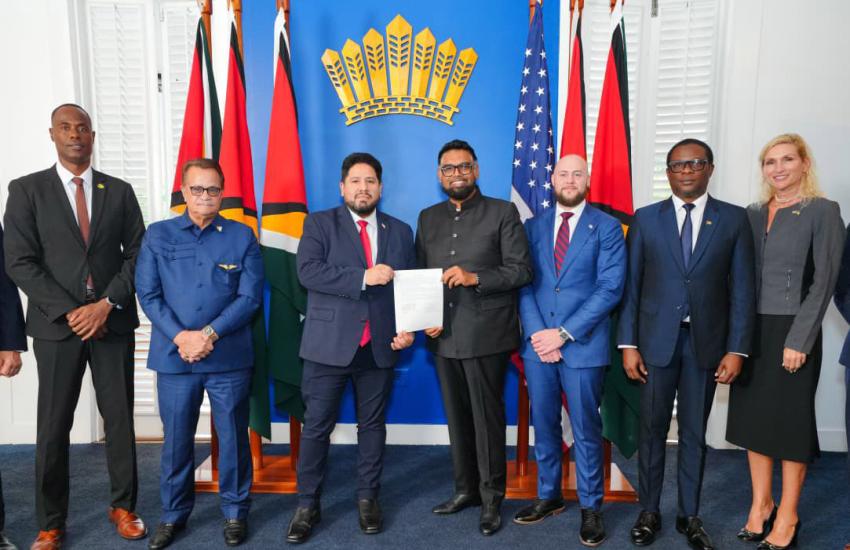
In December 2025, just weeks before Operation Absolute Resolve, which captured former president Maduro—and weeks after USSOUTHCOM commander Adm. Alvin Halsey visited GDF headquarters for a discussion on defense and security—senior advisor to the U.S. Secretary of War Patrick Weaver and Acting Assistant Secretary of War Joseph Humire met with President Ali and Khan to sign a statement of intent as a commitment to Western Hemisphere security.
Ali noted the agreement’s role in Southern Spear, which also “permits U.S. security forces to pursue, intercept and board drug trafficking vessels in Guyana’s waters,” the Caribbean National Weekly reported. The president additionally noted further access for joint training and security operations.
Finally, at the beginning of this year, President Ali and U.S. Secretary of State Marco Rubio discussed further security cooperation. A statement by Department of State Principal Deputy Spokesperson Tommy Pigott notes an ongoing U.S. commitment to support Guyana’s role in maintaining stability in the hemisphere.
The call came following a “vow” Rubio made in March 2025 about a U.S. response should Venezuela attack Guyana. “I want to be frank, there will be consequences for adventurism,” he stated. “There will be consequences for aggressive actions.”
“There’s a wider issue in that the benefits of the oil and gas sector, which, as you know, is a new sector in Guyana, has not readily trickled out to the populace,” Kirton said of the public’s perception of the nation’s military spending. “I think there’s concern that the cost of living is increasing and therefore more prudent management of that sector and prudent spending generally by the state is expected.”
A 2015 oil discovery in the Essequibo region by ExxonMobil led to a large economic shift for Guyana, with more eyes on the nation than before.
“While we are concerned as citizens about the issues of territorial integrity, the need to upgrade our military assets and to be ready, there’s also the need for broadening of access to the benefits of oil and gas by the wider population, and that’s one of the concerns,” Kirton said.
GDF did not respond to SIGNAL Media’s requests for comment.

Comments