
Tightening the Kill Chain
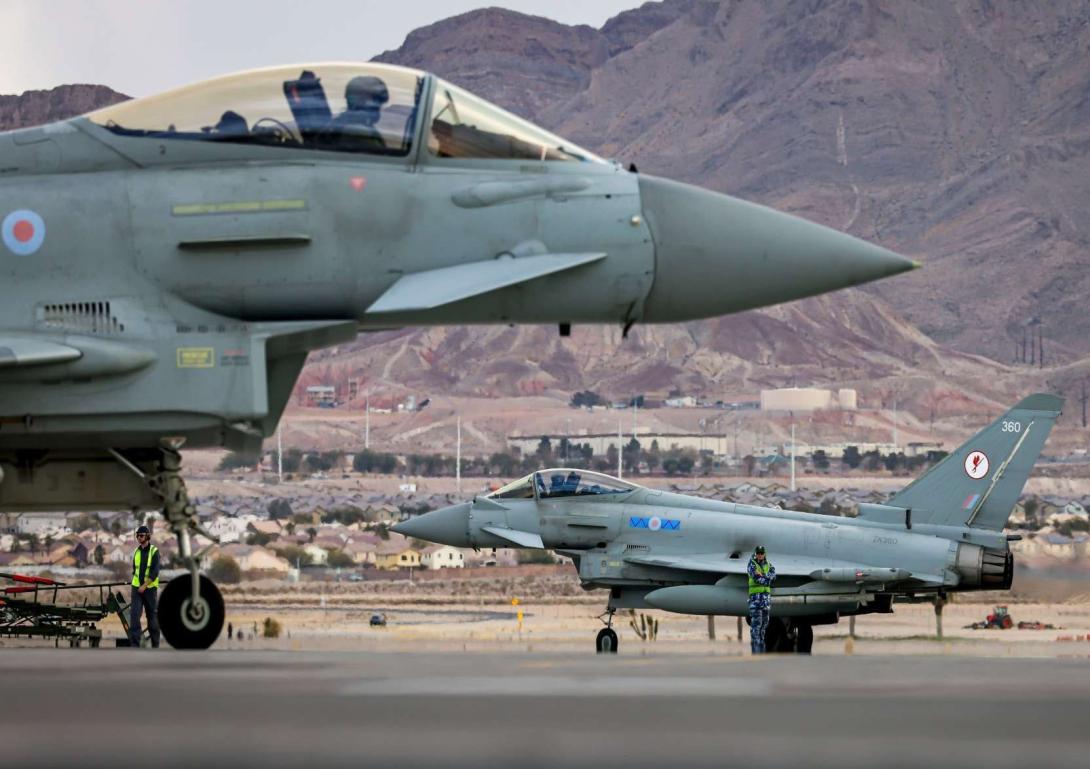
The U.S. Air Force’s Bamboo Eagle exercise is meant to test the service’s tactical and operational command and control (C2) in a contested environment.
The latest iteration, Bambo Eagle 26-1, held February 11-20, tested a global framework of airpower, warfighters and their systems to analyze the execution of the kill chain—the sequential phases of an attack.
“This exercise is about sharpening our warfighting edge,” Bamboo Eagle 26-1 exercise lead, U.S. Air Force Maj. David Blessman, 505th Command and Control Wing, told SIGNAL Media. “We are honing how our advanced technologies and combat approaches are integrated to guarantee air and space superiority. Our focus is on demonstrating how the joint and coalition force fuses these capabilities into a single, overwhelming combat effect.”
At the center of the exercise was the advancement of such joint and coalition C2 and tactical operations with United Kingdom Royal Air Force and Royal Australian Air Force partners.
“We worked intensively with our allies from the Royal Air Force and Royal Australian Air Force to design realistic scenarios that guarantee our ability to win complex warfighting engagements as a unified team,” Blessman stated. “We have mastered the integration of systems to forge a force that operates at the speed of trust, ensuring every element is synchronized to achieve the commander’s intent and guarantee mission success.”
To have these countries dedicate “some of their iron” to the exercise enabled sorties together in the U.S. military flight training areas above California and Nevada. This level of participation builds on last year’s Bamboo Eagle exercise series and raises the bar for the kind of environment warfighters need to experience for future threats, the exercise lead said.
“Our preparation was fundamentally about honing our ability to dominate in a high-end fight,” Blessman noted.
In all, the exercise involved roughly 10,000 personnel operating 150 aircraft across approximately 25 units.
Australia sent 429 aviators and 18 aircraft—including six F-35A Lighting IIs, six F/A-18F Super Hornets, four EA-18G Growlers and two E-7A Wedgetails. They were also part of the Red Flag-Nellis exercise, of which Bamboo Eagle is a subset. Red Flag 26-1 was held at the end of January for two weeks, just before Bamboo Eagle, and is largely considered one of the world’s leading air combat exercises.
The RAF deployed 14 aircraft to Bamboo Eagle, including an RC-135W Rivet Joint from its Number 51 Squadron from RAF Waddington to provide intelligence, surveillance, target acquisition and reconnaissance; a KC-3 Voyager air-to-air refueling tanker from RAF Brize Norton; and 12 Typhoon FGR Mk4 combat aircraft from RAF Coningsby and Lossiemouth.
“The RAF has rolled straight into Exercise Bamboo Eagle, where they act as the defending team alongside USAF and RAAF partners,” said RAF Group Captain Holt, detachment commander for the exercise, in a February 20 RAF release. “Operating with partners’ aircraft such as the F-35A and RAAF E-7, the RAF continues to push boundaries and strengthen international partnerships.”
“We are deliberately stressing our ability to lead and synchronize this large, distributed force across more than 15 locations, proving that we can fight and win together, regardless of distance,” Blessman explained.
On behalf of the U.S. Air Force’s Air Combat Command, the Air Force Warfare Center at Nellis Air Force Base, Nevada, hosts the event, with U.S. airmen from Joint Base Pearl Harbor-Hickam, Hawaii, Hurlburt Field, Florida and Kirtland Air Force Base, New Mexico, and in-person U.S. Navy, Marine Corps and Army joint partners.
Leaders emphasized that Bamboo Eagle is the testbed to examine and stress-test the unified command structure, or the C2 “nervous system” of the combined forces, and to find the weak links in the C2 architecture that connect sensors to shooters.
“The RAF continues to support the exercise series with an ever-increasing number of C2 experts, who are fully embedded within the AOC’s [air operations center] command team, contributing to the entire operational planning and execution cycle alongside the USAF and RAAF,” U.K. Wing Commander Richard Kinniburgh, BE 26-1 U.K. exercise architecture lead, told Debora Henley, PAO for the U.S. Air Force’s 505th Communications Wing in a February 20 release.
“When you have a team this unified, you’re not just sharing data; you’re building a single, resilient command and control nervous system,” Kinniburgh stated. “That is the level of interoperability required to win in a peer conflict.”
Another key aspect of Bamboo Eagle is the live, virtual and constructive (LVC) platform, Blessman noted. It is provided by the U.S. Air Force Distributed Mission Operations Center (DMOC), part of the 705th Combat Training Squadron at Kirtland, which is the hub of training networks for the service and is supported by Nellis’ 505th Combat Training Squadron.
“This integration of live and virtual players is key,” Blessman said. “It is how we present our forces with the realistic, high-end problems to tackle any conflict they may face.”
The LVC environment threw out complex short-notice threats, including simulated adversarial actions across several mission sets, to which the integrated coalition team had to respond.
For Lt. Col. Sajjad Abdullateef, USAF, the 705th Combat Training Squadron’s director of operations, the DMOC’s simulation scenarios had to be just right to test and advance warfighters’ abilities.
“Our scenarios are really designed to simulate the cognitive stress of combat,” Abdullateef explained. “We really focus all of our planning efforts in coming up with scenarios that look at some of the ‘what ifs,’ things like rapid information flow, uncertainty, and time pressure, so that personnel develop that mental resilience to think clearly and act decisively under pressure during the exercise.”
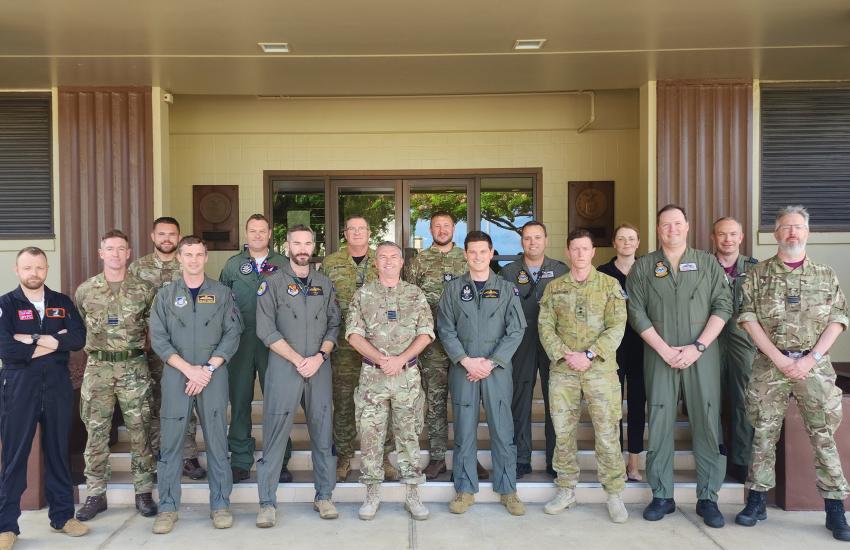
The DMOC works with a wing-level exercise director who coordinates what is needed across the wing’s 14 states, which helped inform the Bamboo Eagle scenarios.
“We have planners from all of the [weapons] platforms on the tactical level up to operational level, and we work across the board to make sure that we have the correct networks plans, so that we have a very robust scenario that keeps everyone on their toes,” Abdullateef noted.
In addition, the DMOC can control and augment the LVC throughout Bamboo Eagle.
“I think that what is great about the virtual and constructive elements, during the exercise, we can pause or restart when necessary just to reinforce key decisions,” he stated. “That is the really unique thing about the synthetic environment. It is the way that we gain real decision-making experience in a denied environment.”
In addition, the LVC platform enabled virtual participation and training for the Royal Canadian Air Force and its 22 Canadian Air Cadet Squadron in British Columbia.
And for the first time, Blessman noted, they were able to connect to the four-year-old U.S. Marine Corps 3rd Marine Littoral Regiment, Kaneohe Bay, Oahu.
“[Our goal is to] demonstrate global reach,” Blessman said. “Our live-fly operations projected dominant air power across designated sea and air spaces in the eastern Pacific. We amplify this realism by seamlessly integrating the robust virtual and constructive environment, managed by our experts at the 705th and 505th Combat Training Squadrons.”
The melding of international fighters, aircraft and systems with virtual and constructive simulations pushed the limits of C2 coordination and tested the tactics and operations of the integrated coalition team, the leaders claimed.
“This exercise demonstrates a fundamental shift to guaranteeing our forces can win as one integrated team,” Blessman clarified. “Bamboo Eagle is designed to validate our command and control of a lethal, globally integrated force against any threat, anywhere. We are sharpening our warfighting edge to ensure we can make decisions faster and project decisive combat power under the most demanding conditions. The ultimate goal is to leave no doubt for our partners or potential adversaries about our collective dominance.”
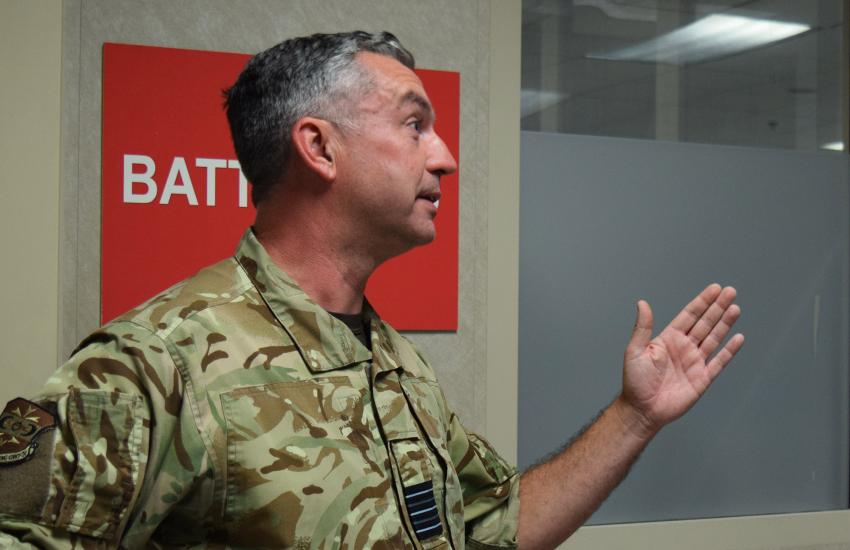
In addition, Abdullateef emphasized that the DMOC is accustomed to bringing emerging technologies into their LVC environments for warfighters to experience.
For instance, in January, the center enabled the Headquarters Air Force’s Directorate for Strategy, Integration and Requirements (HAF A5/7) to test air component operational plans with airmen, the Army and industry planners.
The effort was part of advancing combined all-domain command and control (CJADC2) under the Army’s Project Convergence 6, according to a February 20 report from Airmen First Class (A1C) Alenne Mojica.
“The experiments are focused on advancing long-range kill chains and point defense capabilities while improving joint interoperability between the Department of the Air Force’s Battle Network and the Army’s Next-Generation Command and Control system, both of which are foundational to the CJADC2 ecosystem,” Mojica said.
Just like for Bamboo Eagle, the joint, contested training environment for Project Convergence allowed warfighters to examine emerging technologies across different mission threads—in the case of Project Convergence, 15 technologies across seven mission areas in a joint and coalition multidomain environment.
“Our role in Project Convergence is to provide a robust and realistic virtual battlespace where joint and international forces can truly test the limits of new technologies,” U.S. Air Force Lt. Col. David Jones, the DMOC commander, said in the report. “The DMOC’s ability to seamlessly merge live and synthetic environments allows us to train thousands of participants and experiment with tactics that will define the future of multidomain operations, while achieving significant cost savings.”
Whether it is for Project Convergence or Bamboo Eagle, the main goal is to increase warfighter readiness.
“The single most important gain is readiness,” Blessman said.
And already, the parties are gearing up for the next Bamboo Eagle, scheduled for August.
“It will be a development, not a repeat,” Blessman noted. “We will immediately apply the lessons from February to present the next rotation of warfighters with a more advanced adversary and more complex mission sets. This rapid, iterative cycle is fundamental to our strategy of outpacing any potential competitor. We will continuously sharpen our combat edge to ensure our teams are always ready.”



Comments