
Military, Industry Leaders ‘RAPIDly Eyeing’ the Future of Homeland Defense
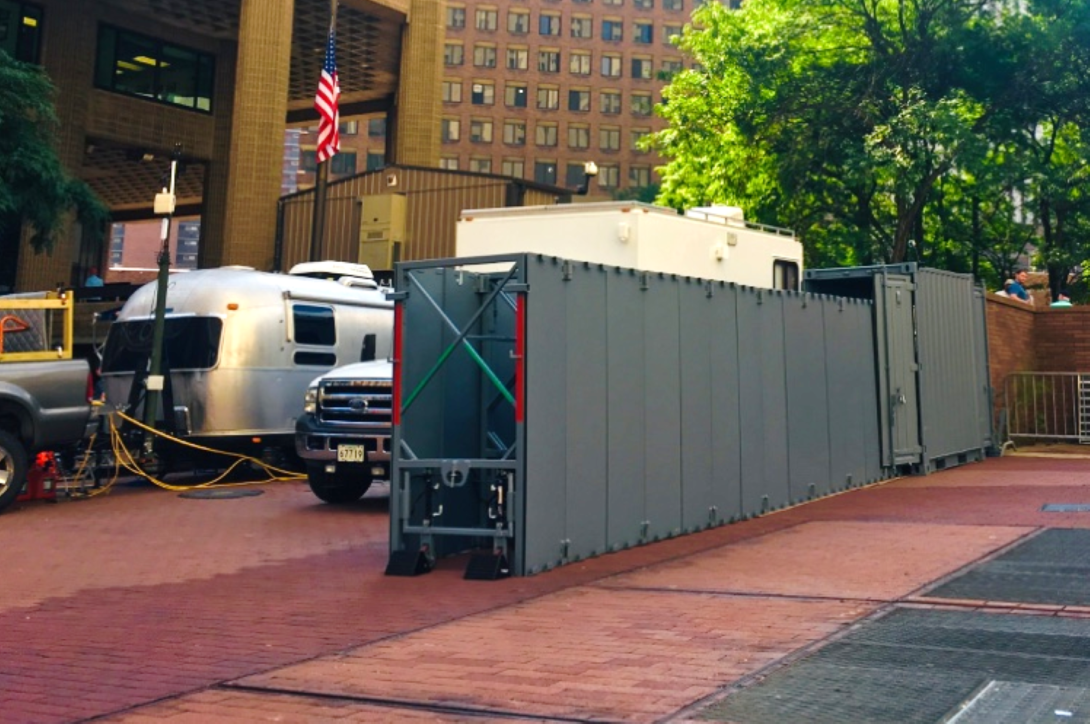
To prevent terrorist attacks at events or locations with large gatherings, including military bases, defense and industry personnel have developed and are refining two new tools: the Ready Armor Protection for Instant Deployment (RAPID) barrier and Guardian-iiS.
A quarter century has passed since the 9/11 terrorist attacks, in which 2,976 people lost their lives, marking the deadliest terrorist attacks in history, according to FBI officials. Since then, individuals and groups have carried out other terrorist attacks and mass casualty incidents, such as the D.C. sniper attacks in 2002, the Boston Marathon bombing in 2013 and the Bourbon Street attack in New Orleans on New Year’s Day in 2025.
The RAPID barrier is heavy and sturdy, meaning that it can defend against an attempted shooting, ballistic or explosive strike or vehicle ramming attack at those types of events or other locations that require critical security, per Matt Hossley, a program manager for protection of critical infrastructure and soft assets at the Engineer Research and Development Center (ERDC) for the U.S. Army Corps of Engineers.
Hossley and Omar Esquilin, a research civil engineer with ERDC and one of the five main inventors of the RAPID barrier, discussed the tool, its purpose and its benefits during an interview with SIGNAL Media. The gentlemen noted that despite its heftiness, operators can still transport the RAPID barrier from place to place, and crews can easily and quickly install the structure at their desired location.
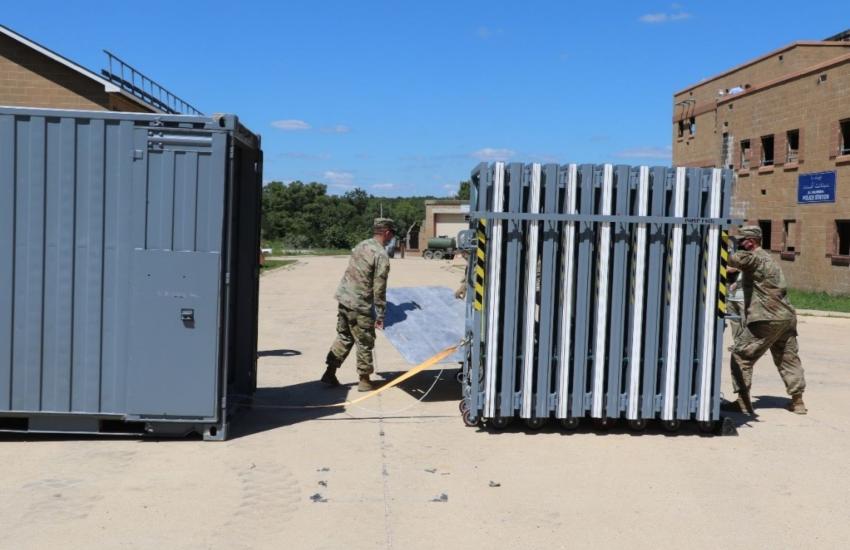
Engineers at the ERDC designed the RAPID barrier for users to implement it temporarily and for specific events. Once that event is over, operators can move it to the next site. Furthermore, the barricade can fit in and expand out of a shipping container, according to Hossley. Once on the site, the RAPID barrier requires only a small team of professionals to put the system in place, and builders can set it up in fewer than 30 minutes without the need for any specialized equipment apart from a trailer, Esquilin added.
These features may sound basic, but they are crucial qualities that separate the RAPID barrier from technologies that have played similar roles since the early 2000s. In the past, military bases and large events used concrete blocks and walls, Jersey barriers and dirt- and sand-based barriers; however, these solutions had several drawbacks. Crews cannot uproot and take away concrete wall barriers after establishment, meaning they lack mobility, creating an unnecessary permanent structure; Jersey barriers are too small and are easily avoidable regarding an attempted shooting or ballistic or explosive attack, meaning they cannot comprehensively protect large gathering event attendees; and dirt- and sand-based barriers take too long to construct and remove, meaning they lack a “rapid” installation process.
“In the follow-on to 9/11, we had forces deployed around the world on high alert, and in many cases, they were getting attacked,” Hossley said. “So, the things we saw deployed in Iraq and Afghanistan required lots of massive walls being built, and heavy equipment and soil are needed for that.”
Additionally, Hossley remarked that the natural barriers—made of dirt and sand—fail to offer the same conveniences as the RAPID barrier. “We don’t want to bring in dump trucks of dirt and fill up barriers that must be cleaned up afterwards, so the speed of operation becomes really critical when considering the equipment footprint needed to install some of the things traditionally used,” he explained further.
The RAPID barrier fills in gaps left by its predecessors, which is pivotal for homeland defense as the active threat “keeps increasing,” according to Esquilin. Despite this detail and the barrier’s ability to address it, he acknowledged that distribution of the tool is not where he wants it.
“From 2001, I’ve seen the threat evolve; the protective measures have evolved, but the implementation is still not there yet,” Esquilin said. “We developed this technology for the military forces, but there’s a huge potential for this to be implemented in our nation and in new environments.”
Esquilin touted RAPID’s versatility. “I see it as a leap in efficiency, since this technology provides a solution for everything, and I see there’s a lot of potential to tailor the ERDC’s solutions to specific needs for specific agencies and finally implement the solutions to their specific problems so we can start saving more lives,” Esquilin added. “From 2001 to today, I’ve seen a huge improvement in where we are with this technology.”
Officials have deployed and utilized the capability in real-world situations, such as the NFL Draft, the Big Game and the United Nations General Assembly.
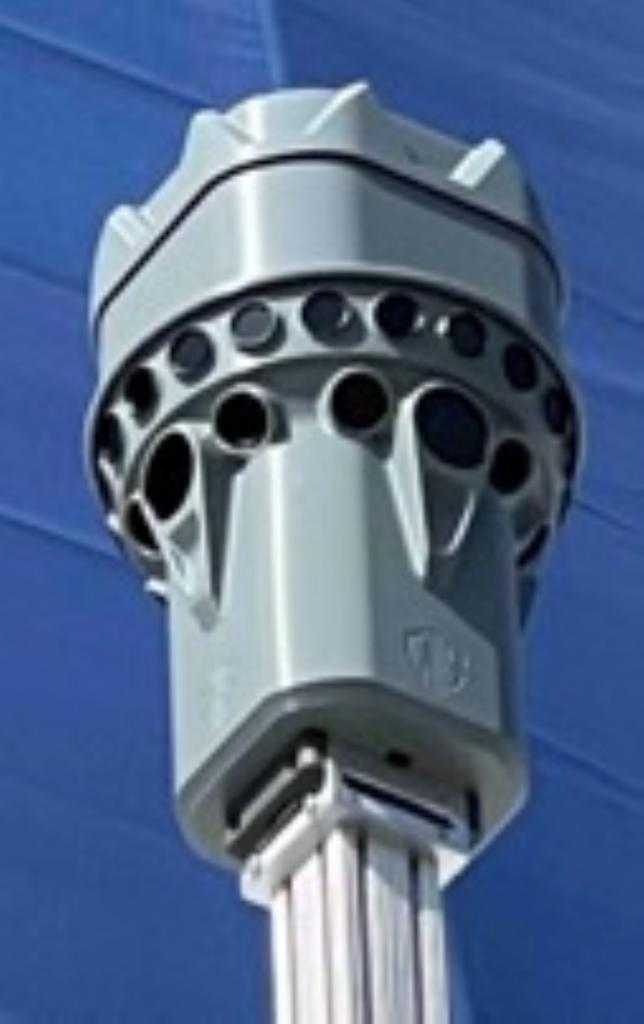
Guardian-iiS, pronounced Guardian- “eyes,” can be an eye in the sky. Developed by the team at Consolidated Resource Imaging (CRI), the system is a set of video cameras that operators can use to obtain a 360-degree view of an area, and Guardian-iiS can zoom in and provide clear, high-resolution images of specific people or objects. In other words, crews can deploy this technology ideally between 25 and 35 feet in the air at events like large outdoor concerts or political rallies, and it can offer security officials complete coverage of the area, per Nathan Crawford, CEO and founder of CRI.
It consists of several improvements compared to the tools that have played similar roles in the past, particularly in the imaging and processing areas of the technology. The current model uses eight NVIDIA processors that enable edge processing, and it can execute 360-degree stitching. Specifically, the Guardian-iiS features 32 cameras connected and stitched together into a 360-degree uniform environment and operating at around 10 hertz, according to Crawford. The system then sends the images through its NVIDIA cores and into its processors.
These advancements are significant, and CRI personnel are working to improve the system. Guardian-iiS requires a human in the loop, but the goal in the long run is to apply automation and autonomous detection capabilities.
“The kind of detection that I think, in general, what we’d like to have is if you walk up to a garbage can and I throw in an eight-pixel cluster, like a 32-ounce cup, into there, it says fine,” Crawford illustrated. “But if I walk up and throw an 80-pixel cluster, like a backpack, into the garbage can and walk away, I want it to go red and give me an alert. So doing bounding boxes and stuff like that might be a way in the future to reduce the impact of someone doing something not good.”
The camera capability is a product of the Imaging System for Immersive Surveillance program, which started around 2012—right before the Boston Marathon bombing. Crews were supposed to implement the Imaging System for Immersive Surveillance system at the finish line at the 2013 Boston Marathon, but they decided not to due to privacy concerns. Having access to the capability likely would not have stopped the bombing from happening, Crawford clarified, but this decision forced authorities analyzing the scene to use the Lord & Taylor store security camera, which captured two reactions from the approximately 100 people in the frame. Crawford described the scene:
“There’s fight or flight, so the large number as a whole run away,” Crawford said during an interview with SIGNAL Media. “The people that are cut from that cloth run towards wanting to help, and out of all of them, there was one cluster of pixels of an individual that didn’t change, that didn’t fight or flee. It just kept walking, and all of a sudden, the bomb went off, and it kept walking and didn’t change. And immediately from analysis, you know that that’s probably the perpetrator because he knew it was going to happen. So, Guardian-iiS rises out of that to try to find the needle in the haystack and hopefully prevent further unfortunate events.”
The entire Guardian-iiS apparatus—the generator, server, mast and imaging system itself—takes up the equivalent of one parking space.
A Department of Homeland Security official commented on the RAPID barrier and Guardian-iiS. Via email responses to SIGNAL Media, the spokesperson said that “RAPID [barrier] provides separation and protection of pedestrians and facilities from vehicle, ballistic and other known terrorist attack threats” and “Guardian-iiS provides early detection of dangerous crowd conditions and identification of threats to civilians. It also improves the overall efficiency of security operations, allowing analysts to focus on the most important information and to direct additional security resources and law enforcement personnel to where they can be most impactful.”
Furthermore, the spokesperson detailed how these two technologies can provide more extensive and expansive security than legacy systems.
“Crowd protection and vehicle separation were previously handled using jersey barriers. RAPID provides stronger protection against vehicle ramming, improvised explosive device attacks and ballistic protection for civilians.”
“Video camera technology previously required placement of individual cameras in various configurations to fully cover 360-degree views of large facilities. Guardian-iiS allows the same action with a single unit that can be effectively staffed by a single operator.”

Comments