
Providing the Cross-Domain Contact Layer
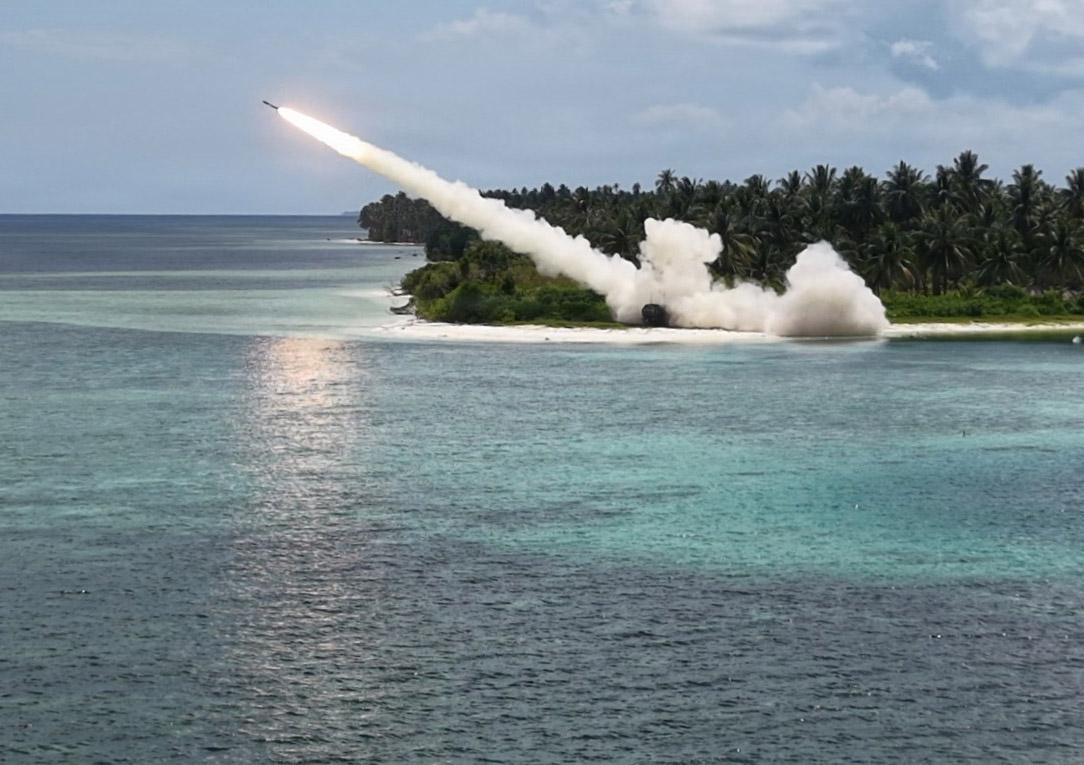
The new 7th Infantry Division Multi-Domain Command Pacific, also known as the 7ID (MDC-Pacific), is harnessing a specific approach, the cross-domain contact layer, to make sure multidomain capabilities get to commanders and warfighters facing a complex battlefield environment.
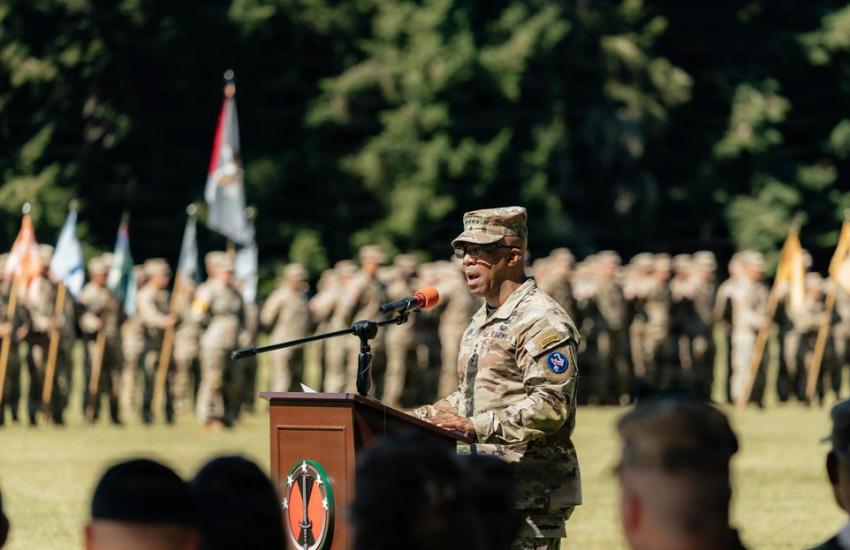
As a new command, 7ID (MDC-Pacific) was rededicated this spring to provide the Indo-Pacific with integrated cyber, space, electronic warfare, intelligence, air defense, long-range fires and maneuver capabilities, explained Gen. Ronald Clark, USA, commander of U.S. Army Pacific.
“It is the Army’s commitment to transformation and putting real capability forward on a timeline that meets the demands of this theater and the changing character of war,” Clark stated. “What it is allowing us to do is to field formations and capability. It allows us to see, sense, make sense, affect, protect and sustain the force forward in the Pacific.”
Clark spoke to reporters on a call June 18, along with Lt. Gen. Matthew McFarlane, USA, commanding general, I Corps and Joint Base Lewis-McChord, and Maj. Gen. Bernard Harrington, USA, who is the first commander of 7ID (MDC-Pacific). The 7ID (MDC-Pacific) is part of I Corps, which is headquartered at Lewis-McChord.
The Army saw the need to elevate multidomain operations in the Indo-Pacific to the command level, under a two-star commander. The 7ID (MDC-Pacific) will help commanders understand the complex multidomain environment and create various warfare options across all domains—land, air, sea, space and cyber, the leaders clarified.
“The Multi-Domain Command-Pacific is not tied to a specific mission area,” Clark emphasized. “It is not tied to a specific location. It is a capability that we have built to counter any threat from any adversary. It is not necessarily focused on a specific part of the region or a specific adversary.”
The organization will provide distributed teams with multidomain expertise to operate in austere environments in support of joint force requirements across the Indo-Pacific.
“We, as a service, in the Pacific, in I Corps, in particular, are meeting the nation’s call to adapt at the speed of need to the changing character of war on a modern battlefield,” said McFarlane. “We are adapting our organizations, our tactics and capabilities to prevail. As technology is increasing the speed and scale of operations, we are adapting our organizations to deliver key capabilities for Admiral Paparo and U.S. Pacific Command and his joint team for General Clark and the Theater Army, and our partners and allies across the region.”
Harrington explained the 7ID MDC-Pacific’s genesis, a historic WWII division. The idea for the command grew out of the Army’s Multi-Domain Task Forces (MDTFs), which began as a concept in 2016 from the request for U.S. land forces to be able to perform essential multidomain warfare.
“Admiral Harry Harris, in the 2016 timeframe as this concept was being developed, stated that, ‘I need the Army to be able to do four things for us to be successful as a theater in the Pacific,’” Harrington remembered. “‘I need you to be able to sink ships. I need you to be able to neutralize satellites. I need you to be able to shoot down aircraft and missiles. And I need you to be able to hack and jam adversary command and control (C2) networks.’ So, as we are building this tailored force, we are really looking to solve unique problems for the theater.”
And through that cross-domain contact layer, warfighters in the region will be able to leverage joint networks, multidomain effects and C2 across the vast U.S. Indo-Pacific Command area of responsibility, Harrington stated.
“One thing that we have looked at is our employment methodology, which we describe as the cross-domain contact layer,” Harrington stated. “How do I build a concept that makes sure that I can connect any sensor to any shooter and then tie it into the joint networks that are being established across the theater? Then it can publish and be received by anyone operating on that network. We are doing tremendous work [on that].”
Harrington sees four layers to the cross-domain contact architecture, including sensing, effects, networking and modern C2.
“That cross-domain contact layer I describe as an equation with four parts, with us having a diverse sensor array that is sensing at ranges of hundreds of kilometers, and that is from space, stratosphere, air, maritime and terrestrial,” he said. “Then we are tying those to agile-effects formations, offensive and defensive capabilities.”
Part of the agile effects will be connected to a system that the command is currently testing with adaptive and agentic C2.
“[This is] for the ability to make that automated through AI with a soldier on-the-loop and not having to be in-the-loop for that to occur,” Harrington noted. “Then we maintain our durability on the land with our land force. Our ability to set this cross-domain contact layer, leveraging joint networks, allows us to connect not only our own forces but forces across the theater.”
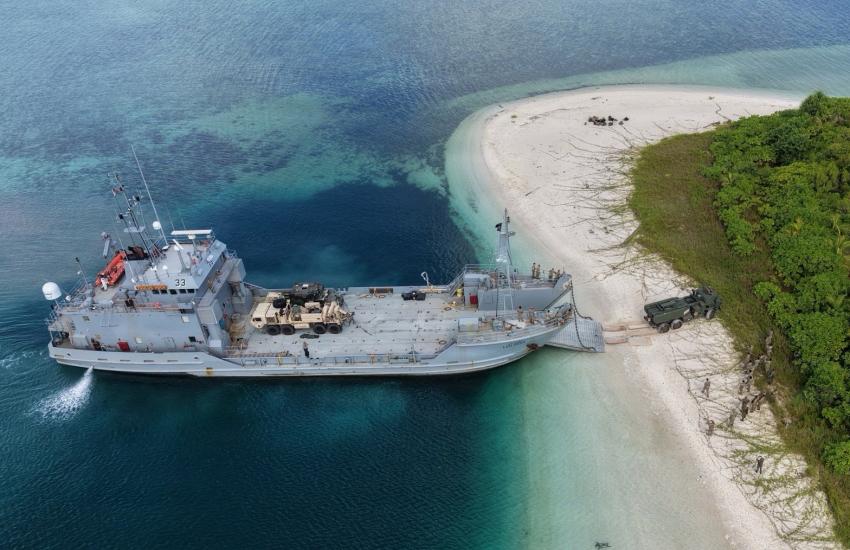
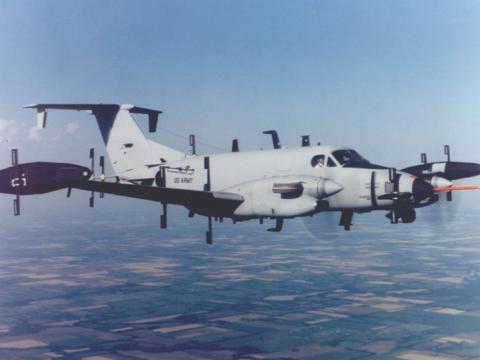
The Army sees this layer as what will connect a diverse array of sensors, such as high-altitude balloons, long-range drones and other unmanned aerial systems, including stratospheric unmanned aerial systems, and connecting those to the maritime and land domains.
“That maritime layer is one that we have been exploring now for some time,” Harrington stated. “That really provides us some additional information. We have been working with multiple companies and multiple formations, both conventional and with our special operations partners, to look at our ability to sense, make sense from that maritime environment, and then if we need to transition those, what can also be effectors.”
Experimentation within the Multi-Domain Command-Pacific, as well as international exercises—such as Exercise Balikatan 2026 with the Philippine military—will continue to provide ways to apply greater capabilities across the domains, the 7ID (MDC-Pacific) commander noted.
As for cyber offense and defense, those are inherent capabilities for the 7ID (MDC-Pacific), included from the beginning, clarified Lt. Col. Richard Barker, USA, public affairs officer, 7ID (MDC-Pacific), in a statement to SIGNAL Media.
“At the approved public level, cyber is one of the domains 7ID (MDC-PAC) was built to integrate from the start,” Barker said. “The redesignation is not creating a separate or future cyber requirement that the formation still has to figure out; the command was organized with multidomain capabilities in mind, including cyber, space, electronic warfare, intelligence, fires, air defense, maneuver, sustainment, and command and control.”
The new command includes trained soldiers and formations already experienced in cyber operations and the other multidomain environments, he continued.
“While we cannot discuss specific cyber equipment, technical capabilities, offensive or defensive cyber methods, or operational employment details, the larger point is that MDC-PAC is designed to bring these capabilities together under one command so they can support commanders and the joint force across the Pacific.”
And given the changing security environment, 7ID (MDC-Pacific) will continue to learn, adapt and identify new requirements through training, exercises and operations, Barker indicated.
“That innovation is not limited to this command; it is part of the Army’s broader transformation across the other MDTFs, the theater Army, and the Joint Force,” he noted.
Moreover, the cross-domain concept layer is not only 7ID MDC-Pacific’s effort, Harrington continued.
“This is what our 4th Infantry Division is doing with next-generation command and control. This is what 25th Infantry Division is doing, as they are also partnering and looking at those command-and-control systems,” he said.
Lastly, Harrington stressed that any multidomain warfare capabilities from industry must be integratable and scalable for the joint force.
“It is really important to make sure that we are not developing or building anything that is bespoke, that cannot support and provide connectivity, that cannot connect to the larger force,” Harrington emphasized. “That is not just the Army. That is our ability to be able to do that with our joint partners, the Navy, the Air Force, the Marine Littoral Regiment that is serving forward.”


Comments