
Zero Trust Develops Through Military Collaboration With Industry Partners

The Army is currently working on centralizing commercial software testing for industry partners using artificial intelligence (AI) to automate the security and compliance process. The Army is also ensuring zero-trust elements and their capabilities, highlighting their importance in data security.
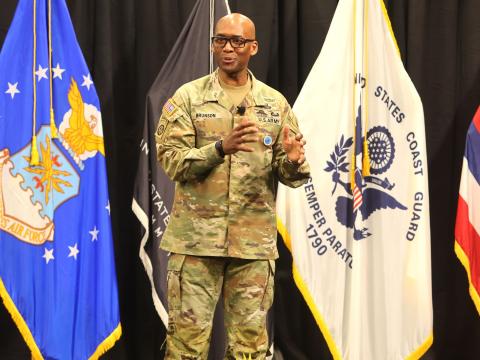
The second day of this year’s Annual Data Forum, hosted by AFCEA International, opened with an informative fireside chat with acting Army Chief Information Officer Gabe Chiulli. Chiulli explained integration phases, industry partnership, military collaboration and zero trust.
Chiulli discussed Project Gatekeeper, an ongoing initiative to centralize a DevSecOps sandbox in pursuit of accelerating commercial software testing, accreditation and deployment in military systems. The platform uses AI that allows commercial partners to submit code and applications for automated security and compliance testing. In practice, this will look like software tools that employ a “checklist” that verifies code through production. This allows partners to more efficiently secure contracts. Regarding the implementation of AI in Project Gatekeeper, Chiulli includes open-source and Army-developed intelligence.
“The first phase is one-month OpenAI to kind of work through, like, what do we want to check first? Because there's a lot of good tooling out there that does validation checks on software already, so we don't want to repeat and just use token just for token purposes. After the first base, we will start opening up to other open-source and commercial model providers,” explained Chiulli.
Chiulli hopes for feedback on the system by January or early February to assess the system's success. He measures the system’s success by its real-world impact to partners.
“When I start getting handshakes,” Chiulli describes. “Hey, it actually helped. Like it did what it was expected to do. You're getting me that exposure I need. I got the right way to contact both,” explained Chiulli. “So, I think that is the indication I'm looking for. Not necessarily that I feel like I did something successful, but that industry is telling me that this thing has made them a success story.”
Chiulli also says the Army is on track to meet the September 2027 deadline to achieve zero-trust capabilities, including zero-trust targets and the automation of posture assessments. This initiative will not only further integrate zero trust’s motto, “never trust, always verify,” but also address the risks of security vulnerabilities. As technology and cyber systems rapidly evolve, the automated process will allow for equally rapid review of misconfigurations, vulnerabilities, and risk gaps before a threat can become present and dangerous.
Chulli also emphasized collaboration with Army personnel to ensure implemented policy can be effectively practiced and move from theory. He specifically mentioned U.S. Army Lieutenant General Jeth Ray as an active partner.
“When we start talking about zero trust stuff, we always are trying to figure out, okay, we can make something very secure, but not useful, or we can make stuff not very useful, but not secure. So, I always use that as an index, and then it's really between me and him to figure out how do we make sure that is implementable in a fashion that makes most sense to the military fight?”
The Annual Data Forum is hosted by AFCEA International with assistance from the U.S. Army G-6. SIGNAL Media is the official media of AFCEA International.

Comments