
The U.S. Navy Breaks New Ground With Unmanned Autonomy
For centuries, military commanders have struggled to collect enough information about the adversary to give them the edge in combat. As the U.K.’s Duke of Wellington famously said: “All the business of war is to endeavour to find out what you don’t know by what you do; that’s what I called guessing what was at the other side of the hill.” Another British commander, Admiral Lord Nelson, was victorious at Trafalgar in large part because he used his small, fast ships to scout the position of the French and Spanish fleets.
In the past two decades, nations and militaries sought to “lift the fog of war” by gaining knowledge of adversary positions and movements, with military platforms that were expensive and scarce, to say nothing of the need for them to only conduct missions for which they were designed. That made learning “what is on the other side of the hill” challenging.
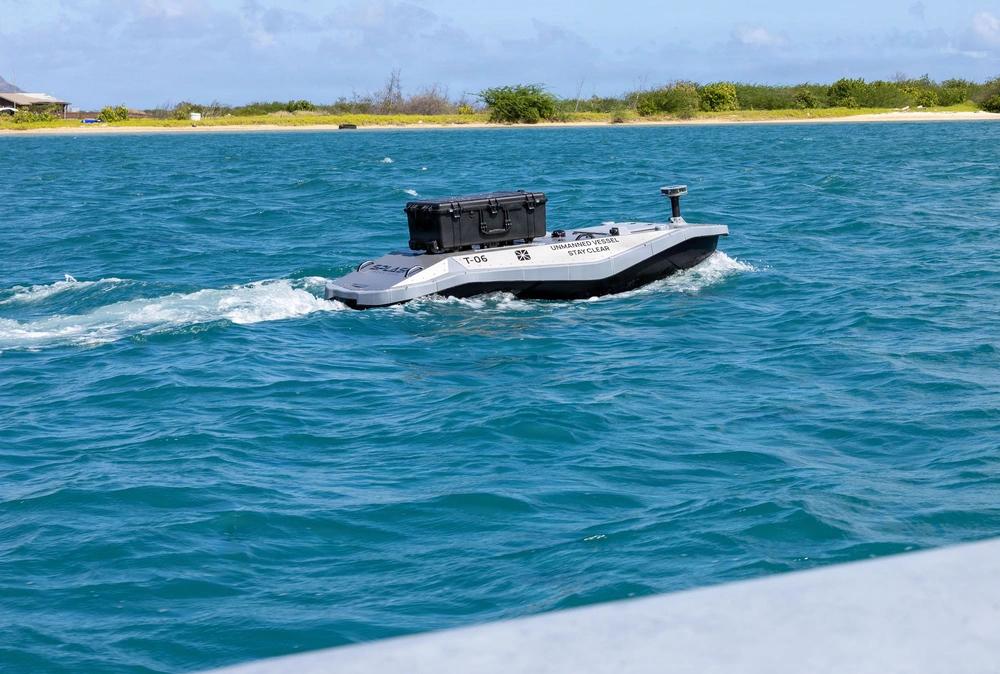
However, in the third decade of this century, unmanned systems—air, surface, subsurface, and ground—have taken center stage on the battlefield. One primary mission of these platforms is to determine the position of adversary military assets and their direction of movement.
What Constitutes Autonomy?
When people talk about systems that are unmanned—meaning that there is no human operator aboard the craft—they often conflate the terms “unmanned” and “autonomous” and use the terms interchangeably. This leads to confusion and obscures the fact that there is a human footprint—and often a very large one—needed to operate and maintain an “unmanned system.”
To be sure, one of the most pressing challenges for all the U.S. military services—and especially the U.S. Navy—is to reduce the manpower footprint necessary to operate unmanned systems. Most unmanned platforms in use by the Navy today are operated as remotely piloted vehicles, meaning the controller must be “in the loop” 100% of the time.
Aboard Navy ships, where space is severely limited, the manpower footprint needed to support multiple operators to drive the platform, operate its sensors and curate the data it gobbles up is often a severe obstacle that decreases the effective use of these platforms. This has led to the imperative to design and field unmanned platforms that are more autonomous.
Achieving Autonomy Is Not a Trivial Task
As American journalist and essayist H. L. Mencken famously wrote: "For every complex problem there is an answer that is clear, simple and wrong." While there is some truth in this assertion, when it comes to making unmanned platforms more autonomous, emerging technology does offer an answer that is correct.
It is the triad of big data analytics, artificial intelligence (AI) and machine learning (ML), which are generally grouped together under the catch-all phrase “AI,” that are making unmanned platforms more autonomous.
These emergent technologies were not mature enough to meaningfully deliver more autonomy to unmanned systems until just a few years ago. That said, AI technologies are not condiments that are sprinkled on platforms, systems, sensors and weapons to make them better, but rather technologies that must be used purposefully.
But this begs the question: “autonomy to do what?” While there are a plethora of military missions that unmanned platforms can perform, the most basic function for them is to discern “what’s on the other side of the hill.” This is especially challenging in the maritime context, for unmanned maritime systems performing intelligence, surveillance and reconnaissance (ISR) missions across vast oceanic spaces.
Here, AI technologies can enable unmanned maritime systems, and especially unmanned surface vessels (USVs), to become not only more autonomous when conducting ISR, but also be better equipped to process and communicate the data they acquire. There are many viable ways that this can be done, most of which can be delivered by commercial-off-the-shelf technologies available today.
To enable USVs to navigate safely and efficiently, AI technologies can help the vehicles plan optimal paths based on real-time data and environmental conditions. This is vastly more complex and effective than simply putting pre-determined waypoints into the USV’s “brain” before it is launched.
The famous military saying, “No plan survives contact with the enemy,” is as true for unmanned systems as it is for manned military platforms. AI technologies can also enable USVs that are over the horizon from human controllers to adapt to new situations and to make optimal decisions in dynamic and uncertain environments.
In addition, AI capabilities can help unmanned systems with target identification. AI-powered computer vision and ML algorithms can be trained to recognize and track specific targets, such as adversary vessels, with far greater speed and accuracy than human analysts.
Ultimately, what unmanned surface vessels discover during their ISR missions must be communicated back to a decision-maker. There are no communications channels used by modern militaries where bandwidth is unlimited. To prioritize the relevant data that can be pushed through the atmosphere, AI technologies can curate and transmit only what is vital for the decision-maker.
Numerous U.S. military exercises, experiments and demonstrations have shown that one of the most effective uses of unmanned systems is having them collaborate and operate in swarms. The science and engineering to do this has advanced most rapidly with aerial unmanned systems, but now unmanned surface vessels are entering this arena. As validated in recent military demonstrations, AI technologies can help these USVs operate collaboratively to perform complex tasks.
These are only some of the ways in which AI technologies can enhance the success of the basic military ISR mission. As big data analytics, AI and machine learning continue to advance, they will likely continue to offer additional ways to enhance the ISR military mission as well as other missions.
Unmanned Surface Vessel Autonomy Is No Longer ‘Aspirational’
Just a few short years ago, suggesting that AI technologies could accomplish some of the goals above would, at best, be aspirational, and at worst, only a distant, but likely unattainable, dream. That is why the U.S. Navy has been eager to marry unmanned systems—in this specific case unmanned surface vessels—with cutting-edge AI technologies to achieve tactical and operational goals.
In 2025, the U.S. Joint Staff (J7 Warfighting Directorate) organized an ambitious demonstration to not only conduct the basic ISR mission, but to show how USVs could operate as a swarm. The J7 Warfighting Directorate conducted an extensive search to find companies with commercial-off-the-shelf assets that were at a high enough technology readiness level to ensure a successful demonstration. Ultimately, the J7 leadership brought together two small, innovative technology companies, one a provider of high-performance unmanned surface vessels and another that specializes in automating threat detection and monitoring multiple sensors simultaneously.
The objective of this Joint Staff demonstration was to evaluate the combined capabilities of one company’s USVs and the other company’s automatic target recognition software in delivering an integrated, AI/ML-enabled, autonomous maritime ISR and targeting solution. During this demonstration, the USVs patrolled maritime areas detecting, identifying and targeting specific maritime “threat” vessels.
Each USV was equipped with a suite of electro-optical, forward-looking infrared and marine radar sensors. The software stack was installed in all three vessels, enabling each USV to process sensor inputs locally and autonomously detect, classify and track simulated threat vessels in real time. The threat vessels were also identified in real time, validating the concept of AI/ML-driven maritime automatic target recognition (ATR) and targeting.
The software stack triggered confirmation of the contact of interest on the detecting USV. This message was then relayed through a mesh network, triggering the autonomous swarm. The USVs accelerated into a coordinated intercept formation, executing an overtaking maneuver and then conducting fully autonomous swarming operations. This is important tactically, operationally and even strategically, as swarming is increasingly recognized as the “coin of the realm” in autonomous operations.
Advancing Unmanned Vessel Autonomy Through Additional Military Exercises
This significant breakthrough bodes well for future unmanned systems autonomy. Continuing—and accelerating—the development of high-speed USVs and AI/ML/ATR technologies is a viable way forward to deal with seaborne threats. Indeed, machine-directed action to deal with these threats is a strategic imperative for maintaining dominance in increasingly contested maritime environments.
One successful demonstration, however, is insufficient to convince a wide array of stakeholders that these technologies should be fast-tracked ahead of other worthy defense investments. Every year the U.S. Navy conducts a substantial number of exercises, experiments and demonstrations. It is time to scale up demonstrations like the one described above to include larger numbers of unmanned systems working autonomously and in concert with each other to conduct ISR and other important military missions.
Retired U.S. Navy Capt. George Galdorisi is director of strategic assessments and technical futures for the Naval Information Warfare Center (NIWC) Pacific. Prior to joining NIWC Pacific, he completed a 30-year career as a naval aviator. He also served as an executive officer, commanding officer, commodore and chief of staff. During his final tour of duty, he led the U.S. delegation for military-to-military talks with the Chinese Navy. Galdorisi was also a winner in the 2021 The Cyber Edge Writing Contest.



Comments