
The Army Sets Its Sights on Ways To Win the Future Fight
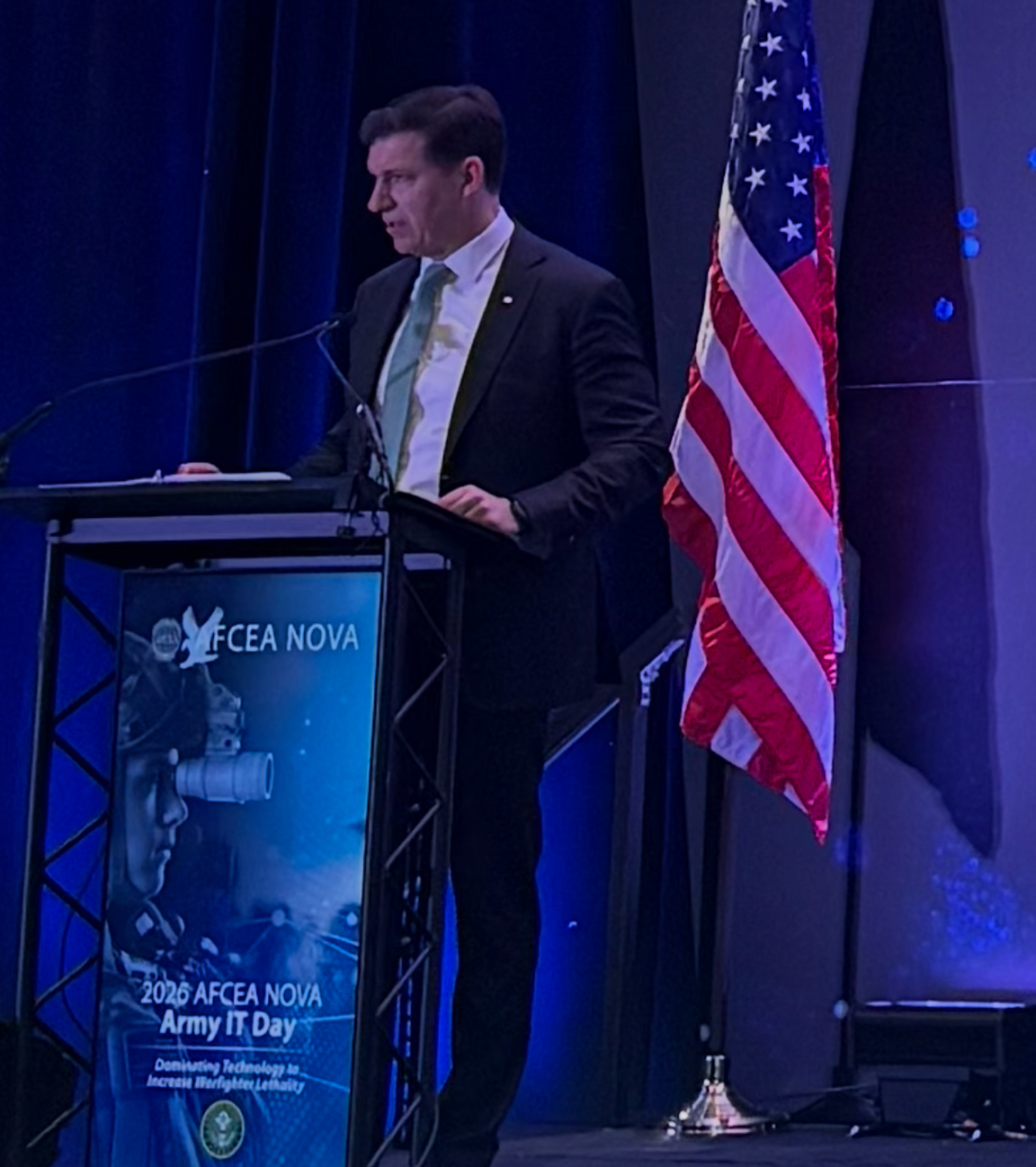
Undersecretary of the Army Michael Obadal revealed spaces that the branch will prioritize as it proceeds.
Firstly, leaders will strive to change policy and delivery approaches that bring about barriers to entry, preventing the integration of new systems and technologies.
Next, they will look to solve a problem they are facing regarding an overabundance of systems. Currently, they have hundreds of solid programs, each with its own full stack of software. To fix this issue, they will look to converge and consolidate these platforms down to a few cornerstone systems. Ideally, individuals would be able to perform most functions in application suites and in low-code, no-code environments, according to Obadal.
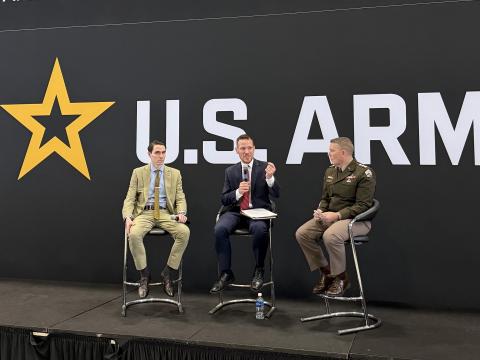
“Where we want to end up is power down authority, where commanders control more of their systems, applications and data than they do now, and minimal barriers to entry for companies to offer their test price,” Obadal said during a keynote address at AFCEA NOVA Army IT Day 2026 held in McLean, Virginia. "So, at its core, Army IT exists for one reason: increased warfighter lethality and survivability, not efficiency for efficiency’s sake, not modernization for its own sake, but lethality.”
Lastly, Army officials will attempt to set up the foundation for artificial intelligence (AI) and create enterprise capabilities that can run AI at scale.
Obadal noted that these concrete priorities will help the branch attain its goals.
“For years, years and years, like many of you I heard [saying], we need AI; we should incorporate AI, but what people in units and practitioners, I think, were really saying was we need the ability to operate at the scale and speeds beyond manual processes,” the undersecretary of the Army said. “To achieve that goal, we need better data management and better platform management. We need compute resources. Only once we solve that can we really leverage AI. Our goal for AI is to enable the warfighter. Deploying AI isn’t an end state; it’s a means to make our soldiers more effective and more lethal.”
During his keynote address, Obadal provided attendees with several concrete examples of how AI/large language models are already warfighters.
This month, an AI program helped update and classify 30,000 civilian employee position descriptions in only 72 hours. This advancement would have taken humans about seven years to complete, Obadal exclaimed.
“AI is no longer experimental for us; it’s operational, and it’s driving real-world outcomes for our soldiers and our workforce,” Obadal said. “AI helps us use intelligence from multiple sensors into a coherent battlefield picture, identify targets faster than human-only processes allow, predict equipment failures before they happen, and optimize logistics so units can move, fight and sustain longer and better.”
In September, through the Army’s Artillery Execution Suite (AXS), soldiers with the 4th Infantry Division fired live cannon rounds, and by using its machine learning capabilities, the AXS tool could predict ballistics at an unprecedented rate of precision. Additionally, it helped cut mission planning time by 30%, per Obadal.
Furthermore, the Army Intelligence Data Platform analyzes 50 to 100,000 individual intelligence objects at the southern border. The technology can select five or 10 of the most important objects and present its choices to commanders, saving humans a plethora of time and resources.
However, this process does not come without its challenges. Firstly, it is not cheap. The U.S. government has already invested about $18 billion in cloud migration, cybersecurity, AI development and other IT modernization efforts, according to Obadal. Additionally, crews must constantly work on these types of systems. But the most difficult is the cultural challenge.
“The cultural shift is to not go back and have a human review 30,000 position descriptions,” Obadal stressed. “We have to trust that our technology is doing what we want it to do. That cultural acceptance demands faster acquisition timelines, acceptance of iterative delivery and comfort with change. It challenges traditional requirements, budgeting, testing models, all the things they’ve done for years.
“It requires our leaders at every level to trust the software and software updates the way they trust their machines,” Obadal added. “And then finally, IT expands the attack surface. Every connected system is now a potential and very lucrative weapon. So, cybersecurity is no longer a support function. It is integral to our combat power, our lethality and our survival.”
Comments