
Novel System Expected To Enhance Long-Range Fires Space
Global conflicts are providing U.S. military personnel insight into the landscape of the modern-day battlefield, and as additional data becomes available, the importance of several technological areas is rising above the rest. That list includes artificial intelligence (AI), large language models (LLMs) and autonomous vehicles and systems. Specifically, regarding the autonomous vehicles and systems field, Army officials are addressing the call from branch leaders for modernization in this space, particularly in relation to drones and capabilities that can execute long-range fires.
Furthermore, Army personnel are striving to integrate the Switchblade 600 system into their operations. The new drone is only in the experimentation phase, and so far, it has proven to give warfighters the ability to accurately launch attacks against targets and eliminate threats while keeping personnel far away from the point of conflict. Crews with the 2nd Armored Brigade Combat Team in the 1st Cavalry Division, which is a transforming-in-contact armored unit, observed this success during simulated exercises at Fort Hood, Texas. Transforming-in-contact units are the first ones to receive the newest warfighting capabilities to foster feedback and conduct experimentation in the field, ideally leading to rapid integration of new technologies in a changing battlefield, per Army personnel. Because of the system’s effectiveness up to now and its potential, Army officials announced several developments: They will soon distribute the Switchblade 600 to additional units to further experiment with it, and they will take the Switchblade 600 to future training rotations where additional soldiers can put it to the test.
Army leaders will begin to allow personnel within the 1st Armored Brigade Combat Team in the 1st Cavalry Division, otherwise known as IRONHORSE, to get their hands on the Switchblade 600 for their training cycle, per Capt. Jeffrey Weller, multifunctional reconnaissance troop commander of the 2nd Armored Brigade Combat Team. They expect the training cycle to last throughout the rest of 2026. Weller added that IRONHORSE, another transforming-in-contact armored unit, soldiers will be taking Switchblade 600 to the National Training Center (NTC) in Fort Irwin, California, in the next year or so. Engineers will use this next development to observe ways in which they can enhance and bolster the system, and then another unit will assess the system, and they will then repeat this process, which is a common procedure among transforming-in-contact armored units, Maj. Scott Kuhn, director of Public Affairs of the 1st Cavalry Division, said. Not only does this allow crews to dive deeper into the system and analyze it thoroughly, but it also increases transparency between the units and Army leaders, as leaders can then gain deep insights into the system and see all the benefits it can offer soldiers in the field.
Additionally, Army units will take the Switchblade 600 to future exercises where they will continue to train on it, along with other systems and capabilities. There, they plan on evaluating the new drone and learning more about the ways in which they can improve the system itself and the tactics, techniques and procedures that they use while operating the system, according to Weller.
These next steps come after soldiers in the 2nd Armored Brigade Combat Team tested the Switchblade 600 during exercises at Fort Hood. At this controlled event, the unmanned aircraft system successfully showcased its capabilities, including its forward pass capability, and effectively completed the tasks at hand, Weller said. Because of the controlled nature of the exercise, the Switchblade 600 was not required to endure any unexpected hardships or adversities; nonetheless, crews were still able to prove that the device works, and the ideas behind the system are practical.
“[The forward pass] is basically just handing over the controller to a different person,” Weller described during an interview with SIGNAL Media. “It’s two controllers down the battlefield. The drone goes in range; when it reaches a certain point where both controllers can talk [to each other], the second controller [takes over]. And then they push it to the next objective. We were able to test that out at the live-fire range. It was controlled. The controllers were only about 20 feet apart, so it wasn’t over a crazy distance, but we were able to prove a lot of those concepts.”
Furthermore, soldiers also exhibited the Switchblade 600’s ability to accurately strike a target, as the munition hit its mark every time, Weller added.
Personnel in the 2nd Armored Brigade Combat Team also took the Switchblade 600 to the NTC, where they were able to experiment with the device in a more realistic and uncontrolled environment than what the system encountered at Fort Hood. At the NTC exercises, soldiers proved that other features of the drone worked as well, highlighted by its ability to keep an eye out for additional targets while completing the mission at hand.
“We saw the lethality of the system itself and how it could be used to shape the battlefield,” Spc. Drake Cross, a Switchblade 600 operator on the multifunctional reconnaissance team of the 2nd Armored Brigade Combat Team, said. “We were given multiple targets and multiple points. We were able to simulate firing those rounds in our fire control unit [by] taking out those targets and seeing and using the other side of it, which was the intelligence, surveillance and reconnaissance asset. And we were able to also identify targets while going towards our target or look for targets to acquire for other Switchblades or other units [to attack].”
The uncontrollable nature of these tests also allowed crews to uncover vulnerabilities in the system and realize that it still needs improvements. They discovered that the device takes up a plethora of space in the electromagnetic spectrum, which led to communication interruptions.
“We figured out [that] when there are lots of drones flying, lots of radios and lots of people trying to talk to each other, the spectrum can get filled very quickly, and it can cause some issues with communication, both between personnel and, as we saw, between the drones,” Weller said. “We experienced link-loss issues, meaning we weren’t able to talk to the drone the whole time. There were safeties put in place so it would just loiter until we could talk back to it, and then we would continue [the] mission.”
Other uncontrollable factors, such as weather, wind and terrain, hinder the Switchblade 600’s effectiveness. The system cannot fly in storms, and excessive wind will blow it over and cause it to crash, according to Weller.
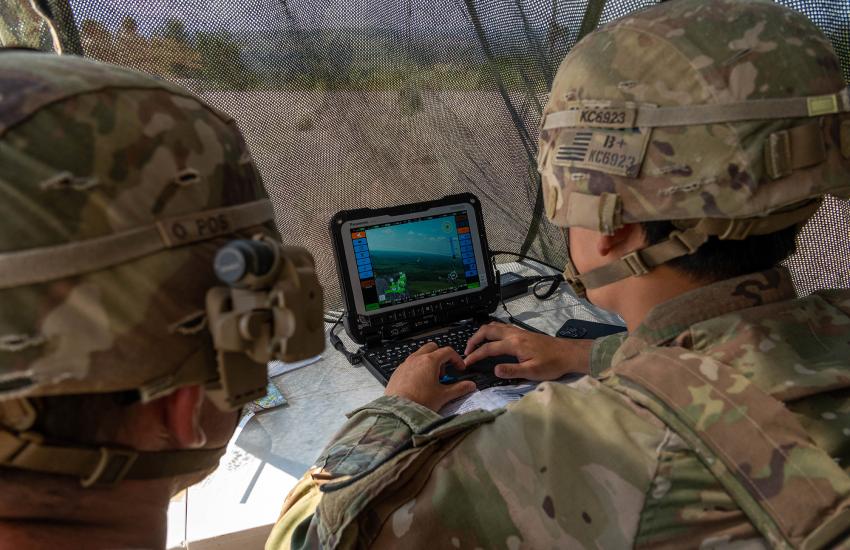
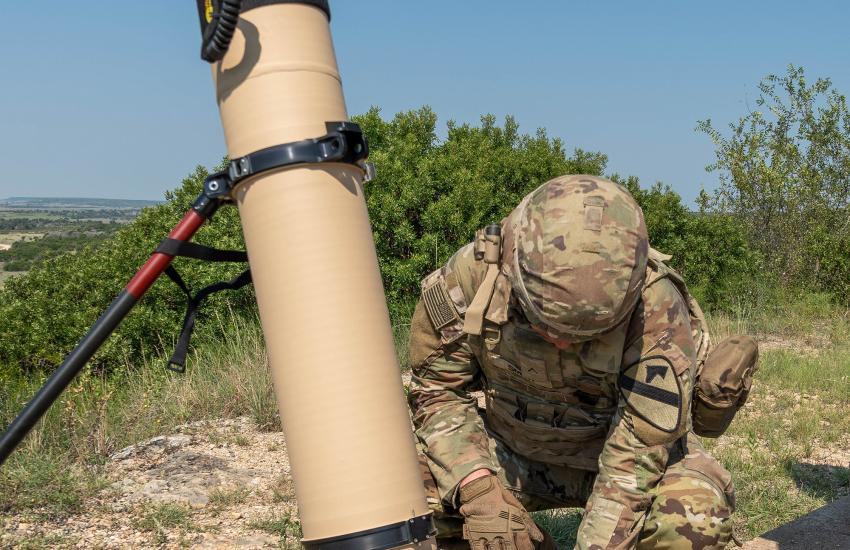
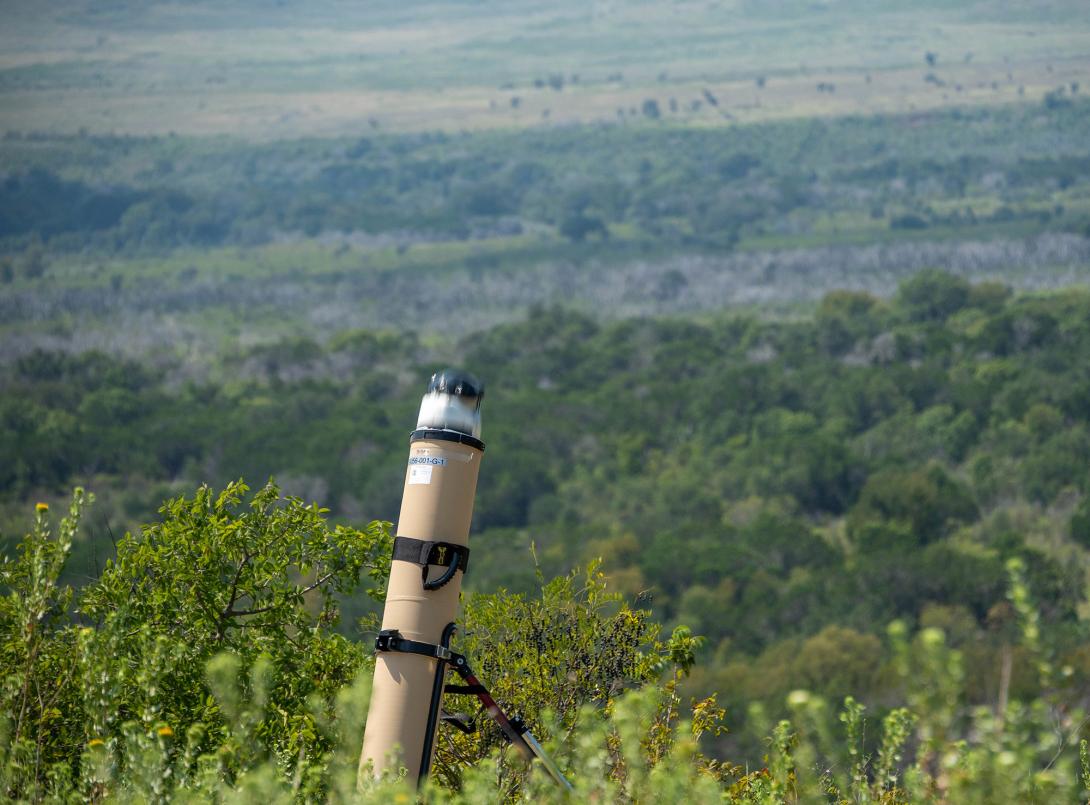
The Switchblade 600 is an unmanned aircraft system intended to carry out long-range strikes. It will ideally allow warfighters to attack and eliminate enemies from far away. Fire teams and fire control units can operate the system. Fires team operators press the button that frees the system from its outer shell. Fire control units control the computer system and the munition capability from takeoff to flight. These individuals also have access to a live feed that the drone provides, allowing them to receive 10-digit grids and drop target points while the drone is in the air, which operators can change midflight, according to Cross. The drone uses artificial intelligence to detect infrared contrasts, which helps it identify a target, but a human being confirms the target and orders a strike, Weller added.
The unmanned aircraft system has a range of nearly 25 miles, and the forward pass capability allows it to fly even further. It can operate for up to 45 minutes at a time. The entire system weighs between 60 and 75 pounds, meaning that two people can carry it. Additionally, the Switchblade 600 can hold one Javelin warhead explosive, per Cross.
As aforementioned, the Switchblade 600 emerged as part of a larger effort by the Army to advance and enhance its capabilities in the long-range missiles and unmanned aircraft systems space. This is in response to what Army leaders have observed on the modern-day battlefield.
“[On the current battlefield,] we can’t get into stagnation and stalemates and World War I types of battles,” Kuhn said. “We have to be able to maneuver, and the way we maneuver is through having fires that can not only shape but [also] finish the enemy to free up the maneuver units.”
This is an element of Maj. Gen. Thomas Feltey’s, commanding general, 1st Cavalry Division, wave-based approach to the modern battlefield, which consists of four waves: detect, suppress, precision and maneuver, Kuhn added.
“What we’re seeing in Ukraine, what we saw in Israel and Azerbaijan, places like that, where drones have played a more significant role, and not just as detection methods, but also as lethal payload-carrying methods, whether it’s dropping a grenade from a drone or, in this case, launching a drone that can loiter and identify a target and then kill it,” Kuhn said.
“It’s a way to get precision fires into the hands of our soldiers down at echelon so that they can then have better standoff and provide more freedom of maneuver for our tanks or Bradleys, and we don’t end up in that stalemate. This is driven by current battlefields. It’s driven by the rapid changes in technology that we’re seeing, and it’s driven by the need to keep up with that within our formation so that we remain the most lethal force on the planet.”
Comments