
Artificial Intelligence May Affect Every Warfighting Function
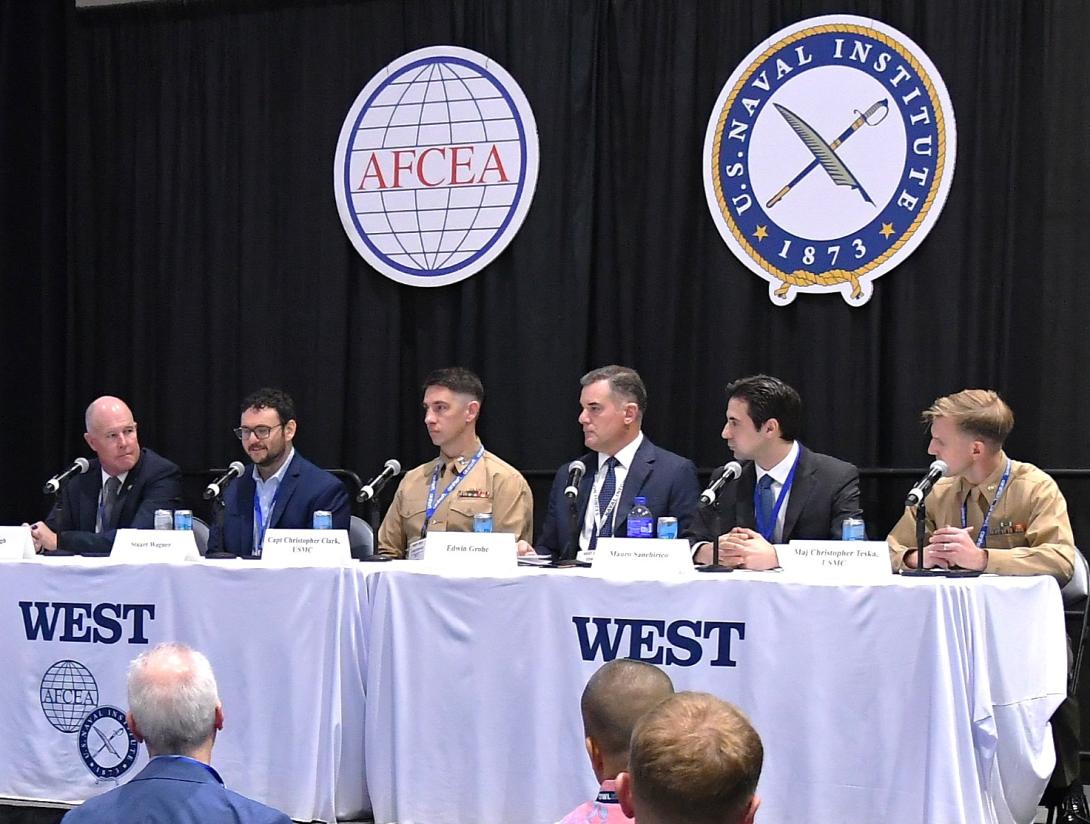
Artificial intelligence (AI) will yield widespread influence across all military functions, from administrative tasks to logistics, command and control, and cyber operations, according to a panel of experts at 2026 WEST in San Diego.
The panel entitled Beyond Human Speed: Applied AI for Combat Advantage, included Stuart Wagner, chief data and AI officer and chief information officer for the Department of the Navy; Capt. Christopher Clark, AI lead, Service Data Office for the U.S. Marine Corps Deputy Commandant for Information; Edwin Grohe, technical director, Naval Information Warfighting Development Center; Mauro Sanchirico, AI subject matter expert at Lockheed Martin, and Maj. Christopher Teska, USMC, a doctoral student at the Naval Post Graduate School.
Asked which area AI will affect the most, Teska suggested that AI solutions and use cases will be found in all different warfighting functions. “I can't pinpoint one. On a weekly basis, a new model comes out that has a new capability. And some of them are our language—obviously fits with [command and control]. There are a number of tools that are very applicable to logistics and predictive maintenance that exist [and] that we need to get working, specifically in the Marine Corps [and] Department of the Navy, that we haven't quite gotten worked out yet. Those are the lowest hanging fruit,” he said, adding intelligence, maneuver, fires and scheduling to the mix. “Every single warfighting function you know will be different a year from now and two years from now.”
Clark said much the same. “I think it applies everywhere. We're just making the human workflows faster, really, whether they're on the loop or in the loop is, you know, yet to be determined, but we mostly concentrate on maneuver fires, defend and resupply,” he said. “But making human workflows faster is everywhere.”
As an example, he cited a subordinate command that used AI to produce a course curriculum, reducing the amount of time needed to do so by 93%. “And it's actually a pretty good curriculum. So, it applies everywhere. I don't think I can name a specific area where it's going to be the most applicable.”
Clark expanded on AI’s influence for intelligence analysts, who spend long, tedious, exhausting hours staring at surveillance videos. “Machine learning models can do that. We have to look at that kind of carefully, but for the most part, they can do that, and the analyst will then just need to look at however many minutes of clips that the machine learning model flagged. And that frees up the analyst to do a lot of other things.”
Clark also cited predictive maintenance in the area of logistics. “A major issue is getting the right parts to the right place at the right time. If you have an aircraft part that breaks down, and you don't have a part nearby, it can take days or weeks to get that part where it needs to go. If you look at what Amazon and UPS and others—not to call anyone specifically out there—but with same-day delivery, they are predicting what part needs to be in what warehouse at what location, based on the prediction of who is going to be ordering or requesting that thing. That is the kind of stuff that we need to do.”
He noted, however, that the military operates under harsher and more challenging conditions than commercial package delivery companies. “We need to be able to measure at like the food consumption level, the ammo consumption level, the vehicle breakdown level, all of the different things that can happen, and all the different parts and pieces that are going to be needed to keep and sustain a unit.”

I think it's mind-blowing what I'm doing on my personal computer right now, and I can't do that, or try that, or even show that at the Department of War today, and I think senior leaders don't understand what's coming in the next three, six, nine months.
Grohe said the development of AI impacts every one of his organization’s mission areas. Those missions include writing tactics, techniques and procedures for information warfare capabilities in the fleet, including electronic warfare, cryptologic operations, intelligence, cyber, and communications. The other mission areas include pre-deployment training, assessing capability gaps and developing innovations solutions, information warfare instruction, and electronic warfare.
“We provide electronic warfare reprogramming services to about 30 fleet and joint systems. So that is providing datasets that our electronic warfare systems use out in the fleet,” he offered. “That area is my number one application of AI, machine learning, data science. It is a very mature dataset, and we are working hard to gain efficiencies with rules-based automation, artificial intelligence, and dare I say, machine learning.”
Asked to name one thing he would like to change to educate and develop leaders to operate in an AI-enabled force, Wagner reported that some expected the excitement for AI to die down, but that hasn’t proven true.
“There was a belief that there was a diminishing returns curve on the recent AI excitement, and I think in the past two to three months, we’ve seen actually the change accelerating. The only way to even observe it is to try to understand it, to actually work with it,” he said. “So, the change I would make would be the ability to try these new things, which are often untrusted and not yet accredited capabilities, to be able to combine them with and commingle them with DoD [Department of Defense] data for particular use cases. Because I think it's mind-blowing what I'm doing on my personal computer right now, and I can't do that, or try that, or even show that at the Department of War today, and I think senior leaders don't understand what's coming in the next three, six, nine months.”
WEST 2026 is co-hosted by the U.S. Naval Institute and AFCEA International. SIGNAL Media is the official media of AFCEA International.

Comments