
Changes Within the Coast Guard Are Enabling Faster Ship Construction
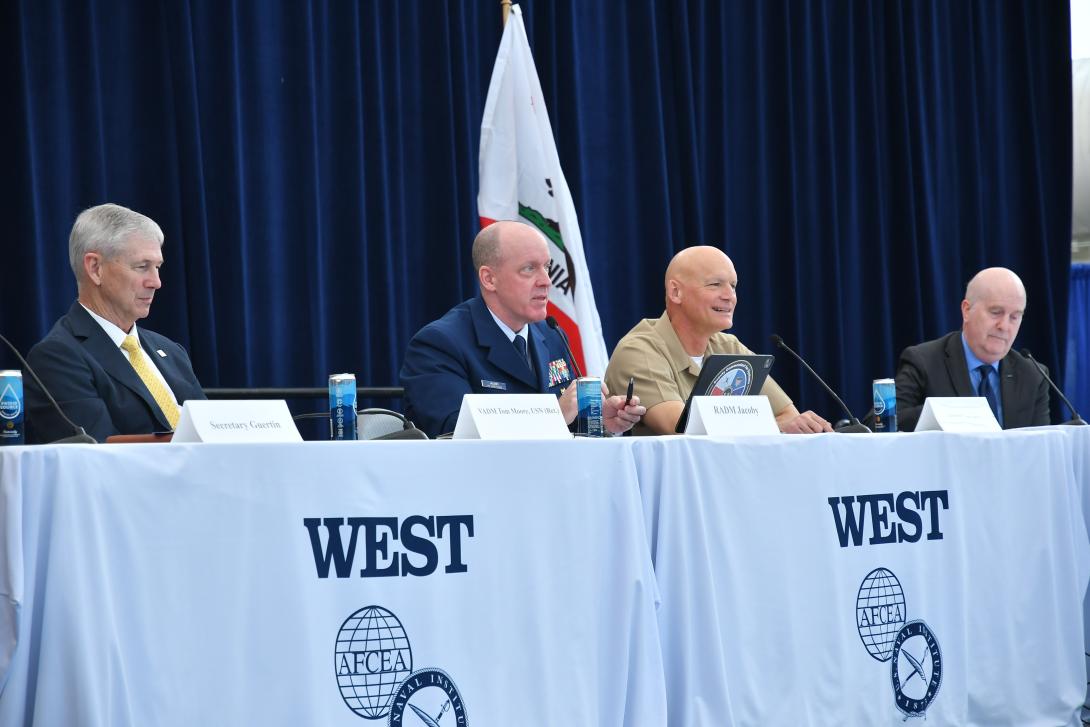
U.S. Coast Guard officials are striving to break the chains restraining ship development within the branch. To accomplish this, Coast Guardsmen and Coast Guardswomen have reformed the organization, refined its processes and improved funding protocols to open the door for speedy ship production.
Firstly, they separated the Coast Guard into three domains: the commandant, the vice commandant and deputy commandants. Deputy commandants can specialize in three different concentrations: operations, personnel and systems, the last of which covers a wide range of areas such as engineering, acquisition, sustainment, cybersecurity and contracting, per Rear Adm. Chad Jacoby, deputy commandant for systems/component acquisition executive in the Coast Guard. These individuals will ideally knock down the traditional barriers that prevent smooth and quick transactions and, in turn, allow officials to hand things back and forth in a timely manner.
Coast Guard leaders also appointed an integrator who oversees the domains to review the enterprise architecture, modeling, data and cybersecurity, and who will make good decisions across the five domains: cyber, space, air, ground and sea, according to Jacoby.
Secondly, Coast Guard officials have reimagined the procedural side of ship development. They have made significant progress in doing away with processes that, despite their effectiveness, are too time-consuming.
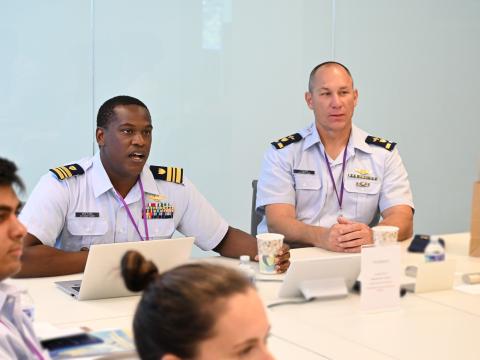
“We had processes that required 200-page requirements documents that needed 27 signatures, and that turned into a year-long process of getting an acquisition started,” Jacoby said during a panel at West 2026 held in San Diego. “We have thrown that away, and I have already executed multiple programs with a one-page requirements document that consists of five key performance parameters. We are leveraging Federal Acquisition Regulation (FAR) Part 12 Commercial Acquisitions much more than in the past, and that’s been able to allow us to reduce timelines.”
Every domain is different, but in many cases, these changes are playing a role in crews cutting timelines down from about 18 months to 45 days, Jacoby added.
Additionally, they officially reorganized their priorities related to cost, schedule and performance. In the past, Jacoby reckoned that performance was ranked number one, cost was ranked number two and schedule was ranked number three. Now, their number one priority is schedule, then cost, then performance, the combatant of the Coast Guard announced, according to Jacoby.
“We will pay a little more to get operational capability out there to the fleet, and if we don’t get all the performance, we’ll circle back and add that to another acquisition,” Jacoby said.
Lastly, receiving the necessary funding to accomplish all of this is crucial in tying everything together and making this a reality. The Coast Guard received $25 billion as part of the One Big Beautiful Act, the largest single commitment of funding in the service’s history, according to Coast Guard officials.
To think about our old processes limiting us, we probably executed $1 billion a year on our old processes, and we’re looking at executing $20 billion by the end of this calendar year.
“We could have set up all these policies and organizational [changes] but not been able to do anything about it [without the funding],” Jacoby said. “That funding piece comes in and allows us to action it very quickly. I would summarize [that] this isn’t theoretical. We have already done the organizational change. We’ve already made the policy changes, and I’ve already obligated $8 billion of the $25 [billion] that we received, and we’re going to obligate $20 billion by the end of this calendar year. To think about our old processes limiting us, we probably executed $1 billion a year on our old processes, and we’re looking at executing $20 billion by the end of this calendar year.”
Coast Guardsmen and Coast Guardswomen have also leveraged the expertise of industry more frequently than in years past. Previously, they had been hesitant to work with private sector individuals unless they had already entered a contract, but now they are meeting and connecting with industry personnel to possibly agree to a small contract, complete industry studies and work with private sector officials in that requirements phase to move quickly, per Jacoby.
It was crucial that branch leaders carry out all three changes, instead of only one or two, and they needed to do so at the same time, according to Jacoby.
WEST 2026 is co-hosted by the U.S. Naval Institute and AFCEA International. SIGNAL Media is the official media of AFCEA International.

Comments