
GPS Spoofing and Other Challenges Prompt Additional Coast Guard Adaptation
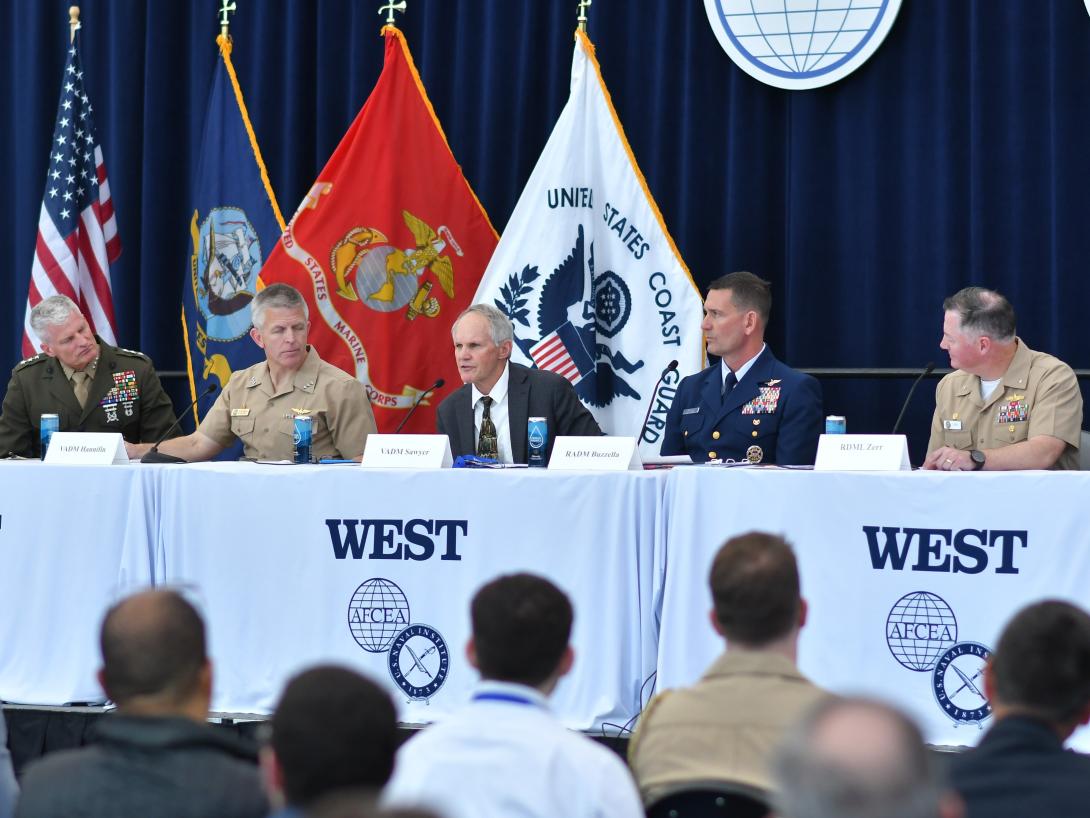
An adversarial capability is presenting challenges for Rear Adm. Joseph Buzzella, USCG, acting commander of the Pacific Area and Defense Forces West, U.S. Coast Guard Pacific.
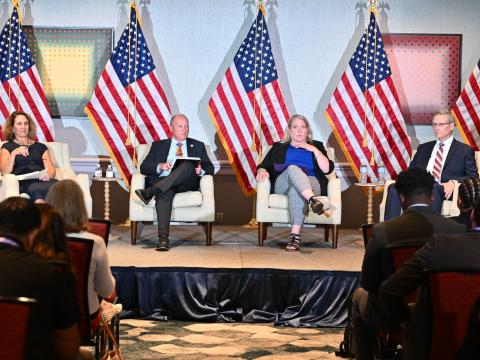
GPS spoofing and jamming is threatening the safety of maritime operations, Buzzella explained at WEST 2026 on February 12.
“This new technology that is starting to rear its ugly head, especially in weather-degraded environments, is GPS spoofing,” he said. “When commerce vessels enter into our ports, we need to make sure that what they are seeing on their GPS and our navigation systems are exactly what they need to see, and not as it is, not some distorted vision, especially in a degraded environment. Because, if they go aground, we've got problems.”
The Coast Guard needs counter solutions for GPS spoofing and jamming, especially now with the advent of unmanned aircraft systems (UAS).
“We have got to get after some sort of counter capability for that,” Buzzella noted. “It is a problem now, and I think it is going to be more of a problem, especially when it comes to surveillance from [adversarial] UAS.”
As one of the nation’s six services, the Coast Guard—created in 1790 by Alexander Hamilton under President George Washington—has a complex set of missions under Titles 10, 14 and 50, pertaining to war, national defense and armed services, as well as law enforcement.
The largest in the world, the U.S. Coast Guard is also responsible for the security of the U.S. Marine Transportation System (including ports, waterways, shores and rivers), drug interdiction, search and rescue, and globally illegal, unreported and unregulated fishing, arctic operations and access to international waterways.
Under Buzzella’s purview, the Coast Guard Pacific’s area of responsibility starts in the Arctic, goes all the way down to the Antarctic, includes Central and Latin America, the U.S. West Coast and extends all the way over to Africa, he said.
The problem, the rear admiral said, is the drastic budget cuts the service has faced over the last decade.
In 2017, during President Donald Trump’s first administration, he proposed cutting $1.3 billion of the Coast Guard's $9.1 billion fiscal year 2018 budget, sending more funding to the Department of Homeland Security instead.
“The Coast Guard has experienced horrendous, horrendous budget cuts the past 10 years to the point where, and these are my words, we were broken and bankrupt,” Buzzella stated.
“Everybody wants a lot of Coast Guard globally, but our readiness was plummeting because we just were not getting funded,” he continued. “I had cutters that were supposed to be underway, that were at the pier waiting for parts ... I had to shut down stations, and what went away with those stations was level one [armed] escort capability. And we had to cut back on that as well. I need to build that all back.”
The inadequate funding has also greatly impacted the Coast Guard’s ability to conduct mission support, especially in the Pacific region, Buzzella stressed.
“Right now, in the Coast Guard, because we have had horrendous budget cuts, we have operations over here, and then we have mission support in a stern chase,” he stated. “What I want is, and what I need, is for mission support to be out front, driving operations.”
The service has had to scramble parts just to get ships or aircraft underway, Buzzella continued.
“We have to get away from cannibalizing our ships and aircraft, taking parts off of them to put on another aircraft or ship, so they can get underway or get airborne," Buzzella said. "When they come back, we take those parts off and put the parts back on the aircraft or the cutters, and it is insane.”
His ask is for a full logistical support package, especially as the service pushes forces farther into the Western Pacific. “And my wish list is that we restructure how we do mission support,” Buzzella added.
And while the Coast Guard’s cybersecurity capabilities have grown—with the addition of the Coast Guard Cyber Command and cyber coasties embedded in U.S. Cyber Command—the service must expand its efforts with U.S. ports and the maritime industry to ensure its operating and information systems are cyber secure.
“We are going to continue to build on that and build the authorities that allow us to get after securing the ports,” the rear admiral stated.
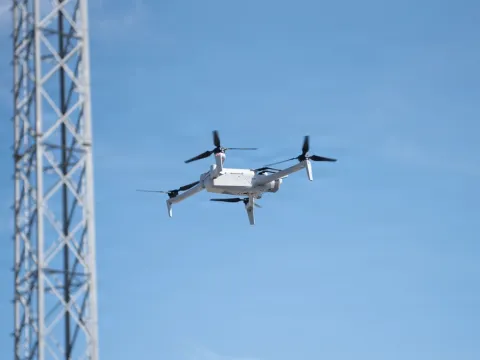
Another challenge the service is working to address is the counter UAS threat. “If we go to conflict, make no mistake, there will be, and there already are UAS in our ports, and we are working aggressively to counter as this technology advances,” Buzzella mentioned.
Notably, an area that the Coast Guard is just beginning to approach is underwater domain awareness. “That is starting to evolve, and I’ve got to get a round turn on that,” he stated. “The last thing I want as the Pacific area commander is for our ports to become points of failure for the fight to the west, and that includes the Panama Canal. That's an area of my responsibility as well. We need to keep that Panama Canal running so we can push people, weapons, supplies from the Atlantic side.”
In the Arctic, the Coast Guard is seeing increased activity by the People’s Republic of China (PRC) and Russia.
“We have Operation Frontier Shield, and we are mainly focused on countering the PRC and the Russian presence, especially when they enter into our extended continental shelf and our exclusive economic zone (EZ),” Buzzella explained.
The Coast Guard has experienced horrendous, horrendous budget cuts the past 10 years to the point where, and these are my words, we were broken and bankrupt.
The service sends in Coast Guard forces, either by air or sea, to shadow and conduct surveillance of the adversaries and provide imagery back to the U.S Northern Command for analysis.
In the Eastern Pacific, the service is executing its law enforcement authorities, working with the U.S. Navy’s Seventh and Third Fleets.
“You put a Coast Guard law enforcement detachment on a U.S. naval vessel, and now that becomes a law enforcement platform supported by the Navy,” Buzzella shared. “And we have Operation Pacific Viper in the East Pacific, that is counter narcotics. We also have our own Coast Guard cutters, new national security cutters, in the fight down there.”
Under President Trump’s current instructions, the Coast Guard was ordered to help secure the U.S. Southwest maritime border under Operation Border Trident. “We are countering illegal smuggling through the U.S.-Mexico maritime border and the maritime approaches,” he noted.
In Oceania and the Western Pacific, the service is conducting Operations Blue Pacific and Pacific Eagle, and under the latter, is using its specialized forces in Indonesia and various other locations to help U.S. partners learn how to counter and resist coercion.
“This is on my mind all the time, as a new commander, of how do we counter this and do it in the Coast Guard fashion,” Buzzella considered. “The adversary is competing in the Indo-Pacific, typically below the level of conflict. But we win that competition in the gray zone through a persistent, lawful presence. That is the uniqueness of the Coast Guard and the authorities that we bring to the fight.”
The service is continuing to see illegal, unregulated, unreported fishing by the PRC.
“We run our fleet specifically through the distance water fleet that the Chinese have, especially when they are encroaching on other countries’ EZs,” Buzzella explained. “And make no mistake, they are off Latin America, as well as the island Pacific nations, and they are in their EZs. So we are there to help [those nations], and we help enforce their laws as well.”
Additionally, because of its focus on maritime domain dominance, the Coast Guard has to succeed in maritime domain awareness, which includes information-sharing with partners and vice versa. As such, the service is working on several bilateral and multilateral agreements.
“We are modeling out there how coast guards should operate, and we enforce laws,” Buzzella emphasized. “We help other countries enforce their laws, especially in their EZs, typically without conflict. But we are ready for conflict, and make no mistake, if conflict comes our way, we are warfighters as well.”
WEST 2026 is co-hosted by the U.S. Naval Institute and AFCEA International. SIGNAL Media is the official media of AFCEA International.
Comments