
Building Trusted Enterprise AI: Why Governance Matters More Than Algorithms

Artificial intelligence (AI) is quickly transitioning from experimental use to being an everyday part of enterprise. AI is becoming a part of organizations' mission-critical operations, such as finance, supply chains, cybersecurity and customer support, to boost decision-making, automate complex tasks and improve operational efficiency. With the rapid growth of AI adoption, enterprise leaders are presented with a fundamental challenge: not only what AI can do, but how it is handled responsibly.
Technically, machine learning and generative AI continue to push the boundaries of what can be achieved, but in the long term, business value will be driven by trust. The organizations that have a combination of innovation, governance, transparency and human oversight are going to be better equipped to scale AI responsibly and make sustainable transformation.
Artificial Intelligence Enters Mission-Critical Enterprise Operations
AI is becoming a part of the business world. From being sporadic automation projects, it now helps with decision-making in supply chains, financial systems, cybersecurity, healthcare, logistics and critical infrastructure. Along with automating repetitive tasks, organizations are turning to AI for enhancing situational awareness, speeding up decision-making and fortifying operational resilience.
This is truly a paradigm change in enterprise technology. AI is not just for data scientists anymore; it is being integrated into the very business systems that are the lifeblood of businesses. The use of predictive analytics, machine learning and generative AI in the business world is increasingly becoming part of everyday operations to manage increasingly large amounts of information and better adapt to changing conditions for workers in both public and private sectors.
New expectations are being set as AI moves into mission-critical settings. Nevertheless, enterprise leaders are asking more than just questions about the models' accuracy: Can AI explain its recommendations? Are decisions subject to an audit? Is it secure for sensitive information? Is it able to deliver outputs when operational, financial or security consequences are of great importance? The questions highlight a shift toward the need for enterprise AI to be both intelligent and trustworthy.
The National Institute of Standards and Technology (NIST) takes this stance, with its AI Risk Management Framework stating that governance is needed throughout the AI life cycle, not just during model development. The discussion, in other words, has just shifted for enterprise leaders from whether AI should be adopted to how it can be deployed responsibly on scale. In the coming years, it will be about the organizations that successfully govern their use of AI as much as those that deploy more of the technology.
When High Accuracy Is Not Enough
The first metric for success with AI is accuracy for many organizations. When a model makes reliable predictions, can summarize information well, or find patterns faster than traditional methods, it is deemed ready for deployment. However, success means different things in the real world of business. Technical performance can be quite high, but the confidence of the people making critical decisions is not.
The difference is between action and faith. Enterprise AI impacts business processes, business decisions and increasingly regulated environments. Confidence can be lost rapidly if a recommendation is not explained, if it is based on a different set of data than planned or if it is an unusual outcome in varying conditions, even if the model is accurate.
Technology leaders are posing a different set of questions, then. Is it possible to explain and audit AI recommendations? Are the data sources being used to support the conclusions sound? What are the scenarios when a human's judgment should take precedence over an AI recommendation? The questions are now at the core of enterprise AI as they go beyond mere technical capabilities to focus on operational resilience.
The U.S. Government Accountability Office (GAO) has also highlighted four key attributes of responsible AI: accountability, transparency, reliability and governance. Trust, in the eyes of the enterprise leaders, does not happen by chance when things are technically good; it is an actual business need. Businesses with robust AI capabilities and governance and human oversight will be well-positioned to scale AI responsibly and to realize long-term business value.
Governance Is Becoming the Competitive Advantage
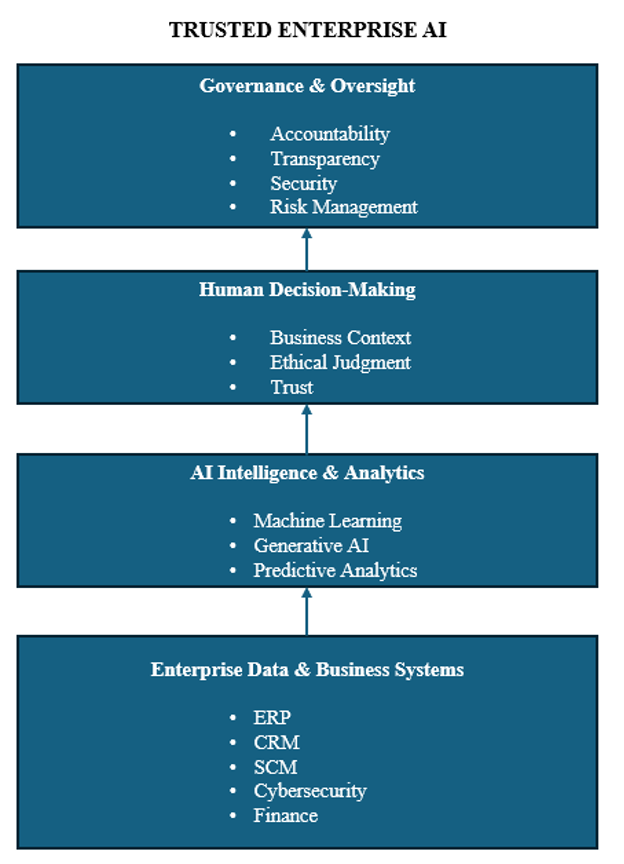
The governance of AI is emerging as the key differentiator between an organization that uses AI in a transformative way and one that is just using it as a technology. Now that organizations are deploying AI across enterprise functions, governance is quickly becoming the element that makes the difference between effective enterprise transformation and cost-effective, isolated use of AI as a technology. Initial AI projects were about showcasing technical skills. As AI systems grow, today's enterprise leaders are just as interested in ensuring they are reliable, secure, accountable and aligned with business goals.
Innovation is not prevented by good governance; it is what defines good governance. It sets clear requirements for data quality, model life-cycle management, humans in the loop, security, compliance and continuous performance monitoring. These fields enable businesses to remain cohesive and flexible in light of evolving business needs and regulatory requirements.
NIST AI Risk Management Framework (RMF) further endorses this by stressing that AI risk needs to be handled throughout the system life cycle. This is not a job for tech teams alone, but involves business leaders, cybersecurity experts, legal counsel, data specialists and operational stakeholders.
Governance that is integrated early enables organizations to scale AI responsibly, gain greater confidence from their executives, and meet evolving regulatory requirements. In a world that is increasingly reliant on AI to drive a business' success, governance is no longer just about risk management; it is a strategic asset that organizations can use to innovate with confidence and maintain their competitive edge.
Lessons From Enterprise Transformation
Technology has never been the sole key to enterprise transformation success. While investments in modern platforms and digital capabilities can be significant, ultimately, it is governance, leadership, and readiness that will decide the success or failure of the organization and its long-term prospects. It is the same concept as enterprise AI.
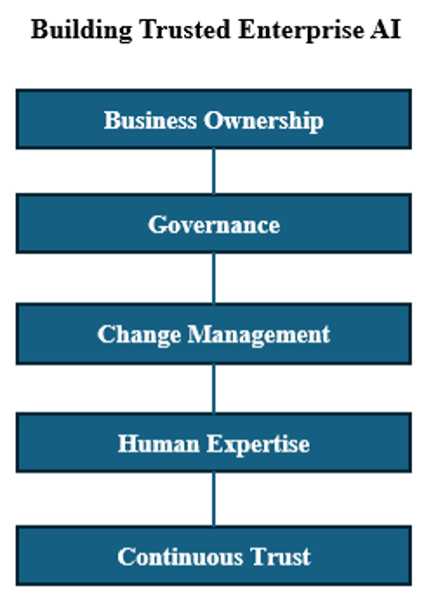
There are some common lessons learned from enterprise transformation initiatives:
- Business ownership is essential. Technology should not set the agenda for the initiatives; it should be a means to achieve business goals. Executive buy-in guarantees that AI will be used for the right things and in the right way.
- Governance must be scaled with AI. The expansion of AI use in enterprise activities necessitates consistent policies to manage data quality, model management, security and oversight. Standardization lowers operating risk and supports responsible innovation.
- Change management cannot be overlooked. The advent of AI transforms the nature of work, necessitating a communication and training process, as well as workforce readiness. When employees grasp the scope, value and applications of AI, they can more easily understand its purpose, its limitations and the role the human mind plays.
- Human expertise remains indispensable. AI can analyze and process information very quickly, but it does not take the place of human accountability, ethical decision-making or business context. The best ones leverage AI to enhance, rather than replace, human decision-making.
- Trust is built over time. Trust in enterprise AI can be achieved by delivering results consistently, transparently, continuously monitoring and responsibly governing. Trust is is essential to enabling widespread and confident use of AI in mission-critical operations.
Enterprise AI is a transformation of the organization and not just another technology deployment. Companies with an effective workforce, robust governance, leadership and responsible AI practices will be more likely to deliver sustainable business value while gaining the trust of stakeholders, customers and employees.
The Road Ahead
While AI algorithms and computing power will still play a crucial role in driving future changes in enterprise operations, their effectiveness will rely on more than just technological advancements. AI is now a part of mission-critical systems, and organizations will be evaluated on their responsible governance, deployment and oversight of AI.
Predictive analytics, generative AI, autonomous agents and human expertise will work together more closely in the next generation of enterprise AI, enabling quicker and more well-informed decision-making. Companies that create effective governance, human accountability and trust at every phase of the AI life cycle will be better equipped to meet the demands of the business, regulatory standards and new technologies.
It is not about replacing decision-makers with AI in the enterprise. It is characterized by enhancing their capacity to use intelligent systems to make better decisions in a trustworthy, transparent and well-governed manner. In the coming years, governance will not just mitigate risk to organizations; it will be the vehicle that facilitates innovation, resilience and ongoing business competitiveness.

Bismit Pratapsingh is a technical program manager, enterprise transformation leader and researcher with more than 23 years of experience in enterprise resource planning and enterprise systems, digital transformation and AI-enabled enterprise initiatives. He writes and speaks on enterprise AI governance, intelligent enterprise systems and human-AI collaboration.




Comments