
Advancing the Golden Dome Shield
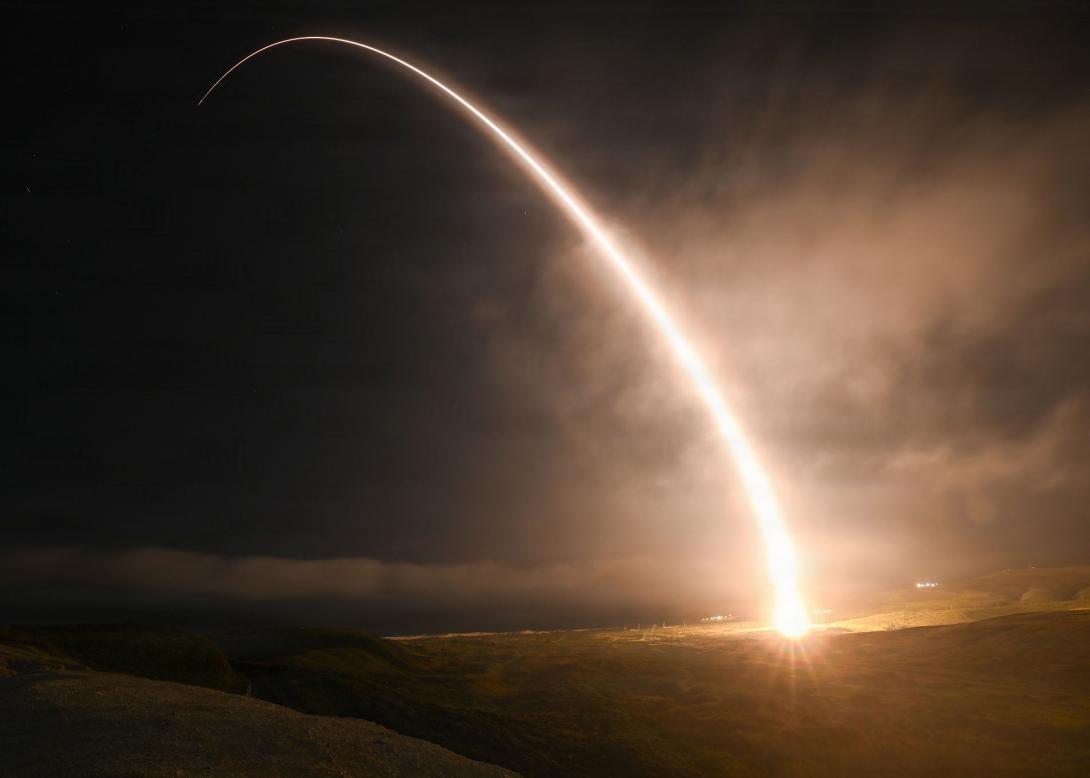
For Gen. Gregory Guillot, USAF, the two most predominant threats to U.S. homeland security today are, first, cyber attacks, and second, advanced missiles.
“The cyber threat is the most persistent and present threat that we have,” Guillot stated February 24 at the Air and Space Forces Association Warfare Symposium in Aurora, Colorado.
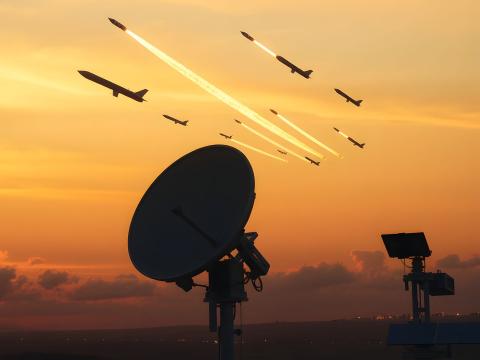
Advanced intercontinental ballistic missiles (ICBMs), hypersonic weapons, cruise missiles, fractional orbital bombardment systems (FOBSs) and other advanced projectiles are the second largest threat to America, Guillot said. The weapons are being paired with increasingly capable air and maritime delivery platforms. And the threat is coming from even more adversaries.
Guillot is the dual-hatted commander of U.S. Northern Command (NORTHCOM) and North American Aerospace Defense Command (NORAD).
“[These threats] are making NORTHCOM and NORAD’s work to accelerate the fielding and employment of advanced missile tracking sensors and defeat mechanisms more critical than ever,” Guillot told Congress on March 17 during a security posture hearing.
The commands are responsible for defending the homeland, with NORTHCOM being the more traditional geographical combatant command for homeland defense across all domains and NORAD as the bi-national command with Canada providing air and maritime warning for North America.
“When NORAD was established, we had one threat, the Soviet Union, from one avenue of approach, which was from the north, over the Arctic, and in one domain—air,” Guillot stated at the Air Force event. “They did not have ICBMs yet, so it was a gravity bomb, [with] no standoff distance capability.”
Now, other countries aside from modern-day Russia are presenting “legitimate” missile-related threats to the United States, to which the Golden Dome for America—the $185 billion plan for the complex, multilayer national missile defense system—is meant to shield against.
“[These are] very critical threats that we need to face from more countries than just a few years ago, and those countries are advancing capabilities significantly with countermeasures, ranges and maneuvering that makes it very difficult to track and kill,” said the NORAD/NORTHCOM leader.
On Capitol Hill, Guillot confirmed that NORTHCOM was driving the development of operational requirements for Golden Dome—with a vision for the “layered system of systems that is integrating land-, space-, and sea-based sensors and interceptors to counter ballistic missiles, hypersonic weapons, aircraft, unmanned aerial systems and advanced cruise missiles,” he said.
“China’s capability to threaten North America is advancing at an alarming pace,” Guillot warned legislators. “China has rapidly expanded its nuclear arsenal to more than 600 warheads and deployed weapons with sufficient range to reach targets inside the United States. Beijing’s modernization program aims to field a variety of novel weapons, including ICBMs equipped with hypersonic glide vehicles (HGVs) and missiles designed to fly FOB trajectories that challenge missile defenses and complicate actionable warning.”
China has already started fielding a conventionally armed and HGV-equipped ICBM with sufficient range to strike Alaska. “In the coming years, Chinese military leaders will also have the option to strike with conventionally armed sea- and air-launched cruise missiles, employing increasingly capable launch platforms like the new Shang III class of guided missile submarines,” he said.
Russia, meanwhile, is the adversary that today has the greatest capability and capacity to threaten North America, Guillot stated.
“At the strategic level, Moscow has fielded a force of ICBMs equipped with the Avangard HGV while continuing to test the Sarmat heavy ICBM,” he told House lawmakers. “Russian President Vladimir Putin has also announced that Sarmat will feature a FOBS capability that will enable it to approach the homeland via a southern trajectory, hoping to evade our legacy early warning radars.”
Given that the advanced missile threats from our adversaries by nature involve the space domain, U.S. Space Command is a key participant in the development of Golden Dome, with Gen. Stephen Whiting, USSF, commander of U.S. Space Command, a central Golden Dome customer, operationally. The command will need operations that can provide space-based tracking, identification and interception of future missiles that will go higher and much faster with more precision than ever before.
Gen. Michael Guetlein, USSF, the former vice chief of space operations for the Space Force, is overseeing the project’s advancements as the director of Golden Dome.
Whiting, Guillot and Guetlein are working closely to identify capability requirements for the Golden Dome architecture, including the crucial command and control aspects that must integrate with existing systems.
“We want to make sure that those capabilities, as they come online, can nest right into our overall command and control system, but more importantly, that those command and control systems can nest well with NORTHCOM and to other combatant commands as well,” Whiting said at the Air Force event.
Guetlein’s goal is to have such an integrated command and control platform developed this summer by the nine companies working on that part of the effort, he said at AFCEA Lexington-Concord’s New Horizons event on March 9. After that phase comes the space-based interceptor capability, with work from the 18 nondisclosed companies awarded Other Transaction Agreement contracts in November to provide concepts for interceptors in the missile “boost phase.”
Things are on track for the command-and-control phase, Guetlein reported at the McAleese and Associates Defense Programs Conference, held in Arlington, Virginia, on March 17.
Lockheed Martin, Northrup Grumman and Raytheon were added as prime contractors to the original six that were conducting the command-and-control efforts, which reportedly include Palantir and Anduril, among four others.
The military is requiring that solutions be made with open architecture.
“We recognized on day one that command and control was going to be our secret sauce of how we pulled together all these various capabilities that were built in various stovepipes, whether it be at the services or in the agencies,” Guetlein stated. “How do I take all these capabilities that were never meant to be integrated networked together, and bring them together into an enterprise manner of which Golden Dome requires that was going to be really dependent on how we crafted the command and control capability.”
Each of the nine companies has an independent contract with the Golden Dome office. The delivery pace is quick, and the group has to report directly to Guetlein on their progress each week. They have learned how to decide which company will build which piece, as no one firm could deliver every aspect of the needed command and control. And any weak performers can be “voted off” the project.
“They operate as a unit ... and they decide who the best athlete amongst them is to build it,” Guetlein said. “And then they hold themselves accountable on a weekly, biweekly basis. And then every Thursday night, they come to brief me, and we take a demonstration on what they accomplished during that week. If at any point during that week one of them did not carry their load, they can vote that individual or that company off the island. My chief engineer has the final say.”
As for what Golden Dome will need from industry, in the future, Guetlein reported that robust data-related capabilities are necessary to sense threats across the United States.
“If you look at what capabilities I need, it is pretty simple: dissect the defense kill chain,” he stated. “This starts off with the ability to sense the threat … across the entire homeland. That is an enormous amount of data, whether that be active data or passive data. I need to bring all that data to bear and make sense out of that data. What is that threat? What’s that threat capable of? And where is that threat going to go? How do I defeat that threat? Who’s the best ‘athlete’ to get against that threat? And once I make that determination, I need to communicate that solution to a command-and-control capability to close the fire control loop with multiple interceptors.”
As such, what he is asking for is “capacity, scalability and affordability” from industry. “The scale is going to be great,” he said.
The successful development of the Golden Dome vision will come when the United States has 'enough capability in the field to defend ourselves' against advanced missile threats.
The general is also looking for high magazine depth with a low cost per kill.
Guetlein stressed that the development process includes a feedback loop in all aspects, with warfighters embedded in his Golden Dome office “completely from end-to-end.” In addition, Guillot sent a two-star general from NORTHCOM to embed in the Golden Dome office.
“He functions as my LNO [liaison noncommissioned officer] back to NORTHCOM,” Guetlein shared. “I’ve got similar LNOs from U.S. Strategic Command, from U.S. Indo-Pacific Command and from U.S. Space Command, to make sure that every step of the way we are embedding the operator in our decision calculus and in our development.”
In addition, the Golden Dome test program is “very rigorous” with operators already working on space-asset consoles providing feedback to the developers of Golden Dome on how well the capabilities are working or not working, and what should be changed, he said.
The acquisition framework for Golden Dome features a direct reporting process for Guetlein that gives him full authorities—contracting, acquisition, technical, direct hiring and security authority—“and a host of other authorities to allow me to run as fast as I possibly can.”
The general can also reach out across the entire department, to include the agencies, to leverage any other existing capabilities or contracts. “That allows me to move exceptionally fast,” he said.
The Missile Defense Agency’s indefinite delivery-indefinite quantity SHIELD contract, for example, is one of the tools he can leverage, along with “any other contract vehicle” across the entire department.
So far, however, the Golden Dome office has only been executing the command-and-control aspects. Everything else is decentralized, the general emphasized.
“When you bring up SBI [the Pentagon’s Space-Based Interceptor Program], the Space Force through Space Systems Command is developing SBI on my behalf,” Guetlein explained. “When you look at radars, I’ve got the Navy and Missile Defense Agency building radars. I’ve got the Army, the Navy and Missile Defense Agency building munitions. We have a very decentralized execution approach.”
As for international partners to Golden Dome—like Japan, potentially—Guetlein clarified at McAleese that the United States is looking for a strategic partner that understands the problem set and is actively trying to solve it.
“To get after something the size of Golden Dome, the problem set we’ve got to get after, it is going to take a full-on partnership of all of us operating with unity of effort,” Guetlein noted.
This includes academia and industry as well.
“We have measured the threats,” Guetlein stated. “We know what they are, whether they are ballistic, hypersonic, a cruise missile or a count of three, four or five UAS [unmanned aerial systems], and will we, in a relatively short amount of time, have enough capability in the field to defend ourselves against those threats. That is how I’m measuring success.”
With industry potentially playing a substantial role in helping the military reach the vision of Golden Dome, subject matter experts provided a frank view of the considerations.

Golden Dome is not a technology challenge. It is fundamentally going to be an execution, acquisition and operational issue.
For Nicki McAllister, senior vice president of growth at Sev1Tech’s Space Division, Golden Dome is much more than just putting capabilities together.
“Golden Dome is not a technology challenge,” McAllister said. “It is fundamentally going to be an execution, acquisition and operational issue. The necessary technologies largely exist today, encompassing early warning radars, satellites, communication networks, weapon systems and even some of those commercial space capabilities that we are seeing being brought to bear. But the true differentiator will be whether the Department of War can acquire these technologies quickly and effectively.”
The military must also contend with how legacy systems will fit into Golden Dome, McAllister continued.
“I would also offer that the future of warfighting, particularly in terms of Golden Dome, relies on legacy technology systems that were upgraded but not fully integrated over time,” she said.
What will make or break the Golden Dome vision is the ability to share data.
“The critical factor that will make this system run effectively is data,” McAllister stressed. “For the data and interoperability piece, we need to be able to facilitate rapid and reliable transfer of data from sensor to decision-maker to shooter, ensuring cross-domain access and integration.”
Adding in allied and partner data-sharing into a Golden Dome construct will also be a “tricky piece,” she stated.
“Golden Dome is the most ambitious mission the government has undertaken, probably, since the Apollo Moon landing,” McAllister noted. “And the industry needs to recognize how this translates into a new operational reality.”
Everfox’s John Carbone, senior director of technical solutions, advised that the government should pursue non-kinetic effects and opportunities to interdict threats ahead of time.
“Golden Dome in itself gives the connotation that you are creating this kind of dome that supposedly can stop things from coming into it,” Carbone said. “But at the point in time that things launch, it is already too late. Once things go boom, you cannot really go back. So, the focus should be on non-kinetic effects and the opportunities to interdict and solve these problems way ahead of time, completely outside of the whole political scheme.”
The Golden Dome vision also requires a complex system-of-systems approach, requiring the military to understand all the pieces of all the systems they are trying to put together and then figure out how to combine or connect them, Carbone continued.
“In the current state of the globe, you also have to prioritize, because you may not be able to enable all of the things that you want to enable in the time you want to enable them,” Carbone said. “Prioritization is important. Sequencing—in terms of the how you are putting these systems together—matters also.”
With every single system communicating with one another, command-and-control information and complex data-sharing are necessary across security classifications (cross-domain solutions).
“The commanding, the controlling, the visualization pieces, the integrity of that data is so critical to those types of environments, and that needs to be protected,” he said. “It is the cross-domain solutions that enable all of that information, all those sensors that sit at different classification levels to be able to share that information between those systems. It is the most critical component.”
Any domestic solution, he continued, would also have to handle the aged infrastructure until modern capabilities, such as quantum communications, are available.
“We are still stuck with the same engineering and the capabilities, for example, the same Transmission Control Protocol infrastructure and the socket infrastructure, that we have had for decades,” Carbone noted. “Until we move to an instantaneous data-moving type protocol and capabilities—quantum communications or something of the like— we are still going to get stuck with the massive complexity that is the interchange between these various different systems.”
Golden Dome in itself gives the connotation that you are creating this kind of dome that supposedly can stop things from coming into it. But at the point in time that things launch, it is already too late.
Comments