
A Complex View of Future Naval Warfare

Concerns are growing as the People’s Republic of China steams ahead on its remarkably quick naval power buildup. By 2030—in just four years—China will have 130 more battle force ships than the United States, when just 20 years ago, it had about 70 less ships than the U.S. Navy.
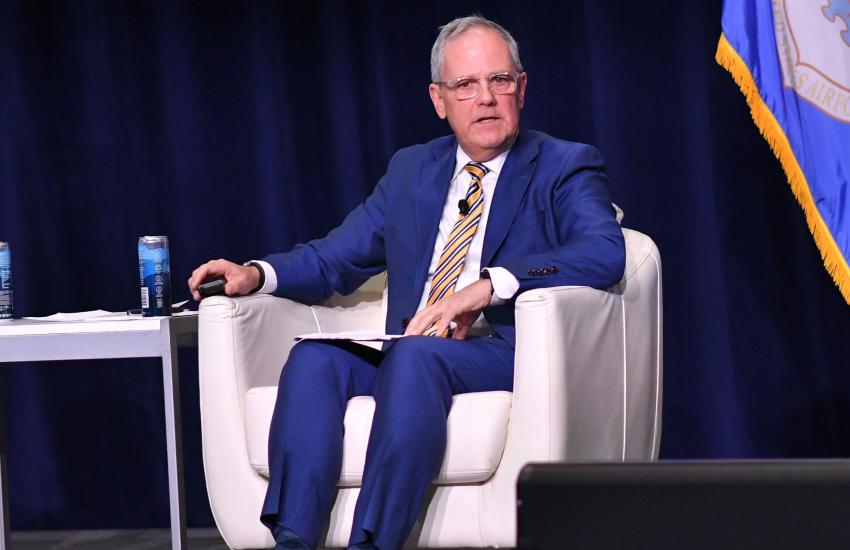
“By around 2020, the Chinese were outbuilding us,” said Michael Stewart, former director of the U.S. Navy Disruptive Capabilities Office, as part of a panel of seven industry executives on February 11 at the WEST conference in San Diego. “And that has elicited a reaction [from our government]. There’s a presidential executive order, essentially saying you’ve got to go faster, and as is the NDS [National Defense Strategy].”
The experts warned, however, that size of fleet is not the only deterministic factor of naval power. If this were the case, Russia would have beat Ukraine on the first day of Russia’s invasion, Stewart emphasized.
“If you look at Russia-Ukraine, it tells you something,” he explained. “If you look at the order of battle for the Russians against the Ukrainians the day before that battle started, if you were doing ship count, the Russians should have completely just destroyed the Ukrainians. And yet, the Ukrainians, with no navy, essentially destroyed the Russian Navy in the Black Sea.”
There, Ukraine harnessed asymmetric warfare. And while the U.S. Navy, with 287 ships, including aircraft carriers, destroyers, cruisers, frigates and submarines, is a different beast, to succeed, it must embrace asymmetric warfare to an extent, with attritable assets, autonomy and a different capability risk structure, the panel advised.
U.S. Chief of Naval Operations (CNO) Adm. Daryl Caudle understands this, Stewart said. “You’ve got the CNO coming in and saying, ‘Look, I need a golden fleet with a main battle force to deter and win in the 2030s, but I also need tailored offsets.”
It is these “tailored offsets” that could be the difference, which for the United States, could look like a sophisticated combination of legacy warfare, autonomous underwater and aerial vehicles, underpinned by advanced command and control, cyber-resilient networks and open architectures, the experts said.
“We need the big gray ships, and I'll say it right now, we still need aircraft carriers,” said Rear Adm. Ryan Scholl, USN (Ret.), executive vice president of Defence Partnerships, Kraken Technologies.
“But we can complement and create force multipliers,” he stated. “Those would be like a ‘picket fence’ in the Red Sea that is helping and providing sensor support to larger vessels, where you need a manned command and control aspect. They can provide kinetic effectors. They can be magazines more forward, or in terms of an Indo-Pacific fight, they can be magazines with capabilities that are tagging other silent vessels that are out there.”
This vision of advanced asymmetric naval power is not easily obtained, the experts noted.
From industry, it will require disruptive thinking, advised Laura Bukkosy Hooks, vice president and general manager, Maritime & Strategic Systems, General Dynamics Mission Systems.
“We do that by embracing a disruptive mindset,” she stated. “[For us] it is a mindset that comes from some of the small businesses we have acquired over time, with Progeny and Bluefin, as two examples. We focus on that rapid prototyping and testing and learning, and try to learn how to update in real time as we go.”
In addition, modularity is key to future naval solutions. “[As is] the rapid delivery of low-cost effectors to create affordable mass ... and enabling that net-centric warfare for the denied environments,” Hook said. “And you need those open systems. You have to have that so you can architecturally construct things that are best of breed, even if you didn't design them yourselves.”
Hooks did warn that while speed of capability fielding matters greatly for the future, it does not matter if companies cannot keep warfighters safe.
“You need to consider weapon system safety and platform safety, particularly as some of these unmanned systems may have to be transported on manned vessels to get into theater,” Hooks stated. “You need folks that have that innate knowledge to bring that weapon system safety perspective to the commercial side.”
To leverage persistent maritime sensing and other autonomous technologies, companies should also ensure they are meeting the “three parallels” of successful autonomy at sea, offered by Sebastien Grall, vice president of Maritime Autonomy at the French company Exail. This includes correct construction of vessels, reliability and open architecture.
“The first one is that naval architecture matters,” he said. “At the end of the day, we are talking about boats, and relatively small boats that you will send in extreme conditions where they have to perform to be stable in waves higher than the length of their hull.”
For reliability, it is something that is not optional, Grall continued.
“What is frustrating about different U.S. exercises we have done is that they are not testing reliability,” he shared. “It is easy to prepare an asset to do few hours in calm water. It's another thing to put a boat in the blue water for 30 days without any human intervention.”
Any open architecture and interoperable software backbone must be ready for what Grall called, “ultra agile” improvement.
“You need to adapt to the mission very, very quickly,” he said. “And if you want to do that, you have to have thought about it from day one. For example, we have been integrated into five different command and control systems or combat management systems, and we have been able to do that in less than two days. So, open architecture, really, is a mantra.”
For the Navy, shifts are also necessary, the experts continued.
They called for a different view of risk tolerance and a revamped acquisition system that actually supports fast adoption of capabilities. This includes a mindset to accept capabilities that are only at 80% of a total solution, if they meet the requirements.
“And I think we need an 80% solution now inside of the force employment window and build the airplane as we continue to fly, where we integrate greater capabilities,” Scholl advised.

What is frustrating about different U.S. exercises we have done is that they are not testing reliability. It is easy to prepare an asset to do few hours in calm water. It's another thing to put a boat in the blue water for 30 days without any human intervention.
Greg Ostrin, general manager, Networking and Data Link Solutions, L3Harris Technologies, agreed, asking the Navy to “help us deliver capability faster by accepting solutions before they might be fully complete, with meeting all the requirements."
In the development cycle, his company can get capabilities—especially hardware—to80-95% complete in a very rapid cycle, he explained.
“We spend a lot of time and a lot of money trying to close on that last 5-10% of hardware capability,” Ostrin said. “A lot of times that is the corner case requirements that will never ever be needed or never be used. So, we spend a lot of time closing on those things before our capabilities are fully delivered. And assuming it doesn't make it combat ineffective, or unsafe for use, I think we can deliver things much sooner, as long as we are willing to trade off some of those smaller requirements, so we can get something out to the fleet at 85% capable.”
Additionally, Rylan Hamilton, CEO and co-founder, Blue Water Autonomy, advised naval officials to really consider what the payloads need to be for unmanned naval capabilities.
With the advent of the medium unmanned surface vessel program, which is in competition, the Navy will see a lot of very capable suppliers and will have “hulls in the water” later this year, Hamilton said.
Autonomous companies are leveraging the personnel that produced fully autonomous cars—like the Waymo vehicles operating in San Francisco, Austin and other places. “We are taking that tech and now we are applying it to ships,” he added.
However, as fast as the industry capabilities are coming along, the service has not yet fully examined its role within the greater fleet.
“Where I think we are a little bit behind is in thinking about some of the payloads and the interoperability for these vessels with the existing fleet,” Hamilton noted. “We are going to get these out pretty quickly. But in terms of serving the missions, you’re going to need the payloads. And not only do you need the payloads, you need to test them, you need to marinize them. There’s a bunch of different opportunities that are out there, but I think it's going to happen a lot faster than people expect. For any of the decision-makers, [you need] to think about the payload, so we can get the most out of these platforms.”
Additionally, the Navy might not fully understand the impact that artificial intelligence (AI) could have for naval warfare, stressed Nathan Michael, chief technology officer, Shield AI.
“The reality is that AI is transforming the entire landscape at a pace that extends well beyond what we can actually keep up with from a policy perspective,” Michael stated. “What used to take 24 months now takes two months. What used to cost $10 million now costs less than $100,000. We can now go out and integrate into new platforms in 48-72 hours, in an operationally relevant environment.”
WEST 2026 is co-hosted by the U.S. Naval Institute and AFCEA International. SIGNAL Media is the official media of AFCEA International.

Comments