
Initial Counter-Drone Technologies Look Good
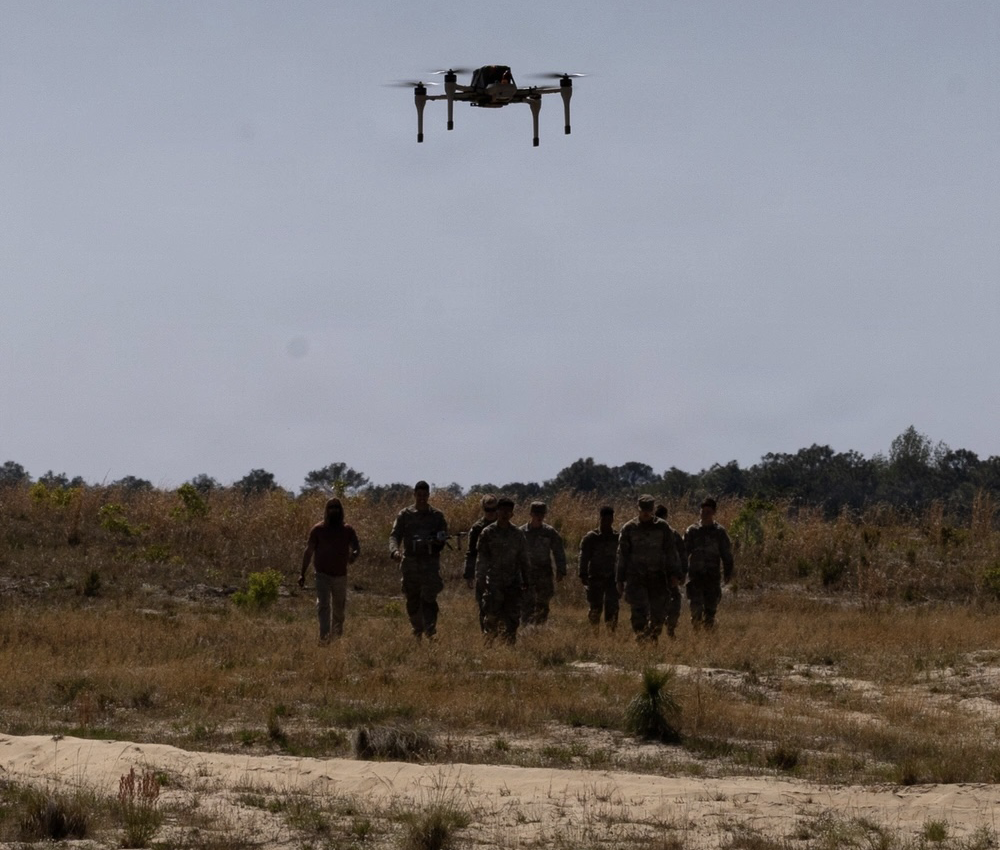
Building on Version 1 of the U.S. military’s so-called Bumblebee counter- drone system, the Joint Inter-Agency Task Force (JIATF) 401 began testing initial prototypes of the second iteration on April 23 at Fort Bragg, North Carolina.
The Bumblebee Version 2 (V2) features an artificial intelligence-based automated target recognition system as part of its hard-kill, anti-drone capability.
Perennial Autonomy, based in Menlo Park, California, is manufacturing the Bumblebee counter-drone capabilities for the JIATF under an initial $5.2 million, February 2026 award.
Company officials were on hand with 25 of their quad-rotor drones at Fort Bragg’s Salerno jump field with military officials for operational assessments of the V1 and V2, along with SIGNAL Magazine and other invited media.
The operational testing and evaluation is part of an impressive sprint to rapidly field counter-unmanned aerial systems (UAS) to warfighters. The United States greatly needs low-cost attritable UAS that can counter adversarial drones at home and abroad—either through disabling, collision or other kinetic effects.
“That is our mandate, to help get that capability, stated Lt. Col. Adam Scher, USA, strategic communications advisor, JIATF 401.
The threat to American troops and bases from unmanned aerial systems is seen as great—as witnessed by deadly drones in Iran and in Ukraine’s war against Russia. As such, the U.S. military has made counter-UAS solutions a priority for the JIATF. Formed only seven months ago, the task force is moving quickly to field these counter-UAS solutions, specifically for smaller drones in Group 1, 2 and 3.
The JIATF is led by Brig. Gen. Matthew Ross, USA, and is headquartered at the Pentagon. As the JIATF is not in an operational unit, it relies on available warfighters from various units for testing. With the Army, this includes partners in the 18th Airborne Corps, its 82nd Airborne Division, its 10th Mountain Division, and the Lt. Gen. James M. Gavin Joint Innovation Outpost (JIOP).
“The 10th Mountain Division has Bumblebee V1s that they are doing training with, all under the purview of the 18th Airborne Corps,” Scher noted.
He clarified that the Bumblebee V2, which is the version that will be fielded, is meant to be part of a larger, layered system of defense.
So far, the leaders are very pleased with the counter-drone capabilities as well as the warfighters’ reaction to and ease of use of the systems.
The Bumblebee solutions come as a package, including the battery pack, autonomy features, controls, ground station and integrating command and control software. The ground stations included antennas.
The V2 has an advanced camera system with an improved gimbal rotation that houses three cameras and the automated target recognition feature that allows soldiers to use AI for part of the operation.
“We are seeing prototypes of the V2, with updated cameras and sensors, updated software for the automated target recognition,” said Lt. Col. Alex Morse, USA, JIATF acquisitions expert.
The April 23 operational assessment included anti-bomber and anti-intelligence, surveillance and reconnaissance (ISR) scenario testing, with multiple counter-drones going after a “rabbit” drone appointed as the adversarial UAS to be intercepted.
Pairs or single soldiers worked the V1s and V2s at distances out to 900 meters, with a battery range of about 20-25 minutes, depending upon the velocity of the Bumblebees. Other soldiers assisted with command and control, and ISR to find and disable the rabbit drone.
“The leap that Alex [Morse] talked about from V1 to V2, as you are seeing from the V1 training, it is piloted, with the soldiers manually flying one drone into another drone,” Scher clarified. “What the V2 will have with the automated target recognition is the ability for the operator to push a button for that final terminal kill, where it will automatically lock on to the enemy drone and then terminally fly itself, without it being based solely on the skill of the pilot to do the interception.”
The testing involved young soldiers from the 82nd, such as E4s, who had very little prior counter-UAS training. And that was by design, Scher said. The task force wants to field counter-UAS solutions that are very user-friendly and do not require a lot of training or setup time.
It is also meant for units to adopt easily.
“This is small unit level training,” said Sgt. Major Kellen Rowley, USA, senior enlisted advisor to Ross, the JIATF’s director. “This is easy. This is something that a company commander can do. They can resource this. They can get the land. They can take their drones and identify soldiers to train. That is part of the beauty of this. It isn't for some general officer to [dictate the use of]. Your company commander can receive this resource, train their soldiers on it and put it to good use.”
Given that it is a new capability, leaders are taking the soldiers’ experience from the Bumblebee operational assessment to help shape future techniques, tactics and procedures (TTPs), reported Col. Tom Monaghan, director of the JIOP.
“They are creating it, developing a shorthand,” Monaghan noted. “We have watched it here in real time. And then we’ll pull their lessons learned and proliferate those. We use the Joint Counter-UAS University. It is that center point. And everything that they learn will get pulled up to start establishing those [TTPs].
The V2 introduced the artificial intelligence-based automatic target recognition capability, which enables operators to reduce their cognitive load and skip parts of manually piloting air-to-air interception of adversarial drones through the V2’s automated hard-kill capability.
“The V2 has a better camera, and it has some software and AI algorithms that are going to allow it to be much more effective in air-to-air combat, with less reliance on the operator and more autonomous AI-driven intercept,” stated Rowley.
Next, the V2 prototype will go through an engineering assessment with Perennial Autonomy’s engineers and experienced Army UAS operators.
“We will be kicking off the engineering sprint on Monday,” Morse said. “They are going to be running the V2 through its paces with the engineers right next to them, collecting all the data, sending it to their back support team.
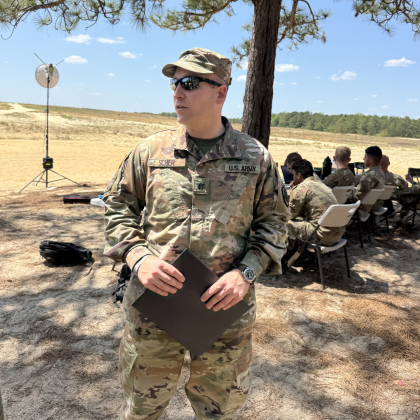
That is our mandate, to help get that capability.
The V1, meanwhile, is already in use in Ukraine.
“Bumblebee V1 has been operated and used in Ukraine, and part of the JIATF mission is the rapid prototype transfer and learning lessons from those battlefields,” Scher noted.
And the Bumblebee V2 is truly a joint agency solution, Scher added. The task force is working with U.S. Customs and Border Protection, Department of Homeland Security, Drug Enforcement Agency, Federal Bureau of Investigation, Department of Justice, Department of Transportation, and the Federal Aviation Administration. It was designed that way from the beginning, from the November 2026 kickoff with the federal partners.
Drones such as the V2 could be used domestically under Title 10, Section 130 (i) provisions, Scher noted, as part of a layered defense of other counter-drone and defense systems.
In addition, the joint aspects of the task force are well underway. Testing with the Air Force was planned for May at Camp Guernsey in Wyoming to aid Air Force Global Strike Command mission sets, followed by work with the Navy this summer.
The leaders of the task force envision having the Bumblebee V2 counter UAS system in weeks or months rather than years—much less than the amount of time it would usually take to identify mission requirements, conduct solicitation and contracting processes, and field solutions to end users.
“It is an iterative product,” Morse stated. “It is not in its end form. But we got it out, under four months from start to the hard opening, which was very fast.”
Scher confirmed that multiyear funding through 2031 for the JIATF was requested as part of the president’s enormous $1.5 trillion fiscal year 2027 budget request.
The goal is to avoid ‘cookie-cutter’ solutions and have a swath of counter-drone capabilities that fit the various needs of different services, units and partners.
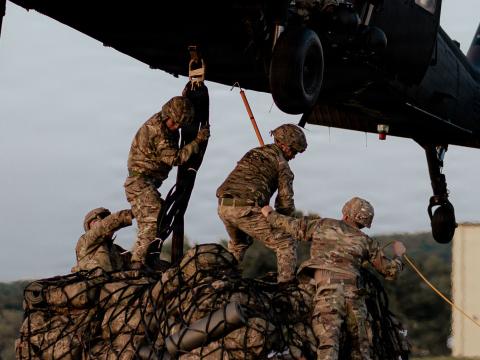
For the 82nd Airborne, the famous parachutists, the leaders can even see soldiers jumping with counter-drone capabilities such as the Bumblebees in the future, thanks in part to a soldier-based solution that advanced from the 18th Airborne’s Dragon’s Lair competition, a prototype technology competition, said Maj. Matthew St. Clair, USA, public affairs officer, 18th Airborne Corps.
“We had two soldiers in the 82nd that developed a mesh system for drones to be put into a box,” St. Clair explained. “The JIOP was able to push it up to the force, so now, everybody around the Army can have this modular drone case that protects their drones when they drop.”
Conducting the operational assessment of the counter-drone solutions was just another day for the technologists of the 82nd Airborne, who are also poised to deploy at any time, said Capt. Leara Schumate with 18th Airborne Corps Public Affairs.
The Bumblebee drones now go on to the Air Force for its consideration of techniques, tactics and procedures in employing counter-UAS capabilities to meet some of its mission sets.
Comments