
What the J6 Wants You To Know
To operate with any coalition partner at any time requires the Federated Mission Network environment, and the United States’ contribution to that network setup when working with allies is the Mission Partner Environment (MPE).
The U.S. military is working on a comprehensive, streamlined approach to the MPE to securely connect networks and communications in an effective manner across the globe, said Jenniffer Minks, the Joint Staff’s J6 and deputy director for Command, Control, Communications, Computers, and Cyber Integration.
Minks spoke, along with other MPE officials, at AFCEA International’s TechNet Cyber conference, held in Baltimore, June 1-4, 2026.
The planned—and impressive improvement for the MPE—is the creation of the coalition information environment (CIE)—a repeatable, foundational network infrastructure for the MPE, which will include network architecture, data-centric foundations, command and control and streamlined network/information technology services.
The CIE will enable the connections and data-sharing of a modern, digital battlefield, including the use of artificial intelligence. And in this day and age, data-sharing is the priority, Minks said.
“Networks are important, but it is all about the data and data center security,” the J6 stated. “And if we get that right, we do not have to worry about how effective artificial intelligence is going to be in a coalition environment.”
But what must happen is stakeholder and industry use of agreed to ontologies and standards.
And for that, the J6 strongly advised industry—and government officials—undertake a complete understanding and use of the policies outlined in Allied Communications Publications 240, or ACP 240, which applies to NATO and Five Eyes Partners—Australia, Canada, New Zealand, United Kingdom and the United States.
ACP 240 reportedly sets forth data-level protections around encryption and access controls, interoperability exchange policies for classified data and access control framework provisions, among other policies.
“One of the most important standards that you can, as industry, take a look at is Allied Communications Publications 240, ACP 240,” Minks emphasized. “If I could get that out to every acquisition authority within the Department of War, or maybe the entire United States, I would do that.”

ACP 240 also provides a standardized metadata framework that shows how to shift from a network-centric approach to data-centric security, she said.
“There you have an SOP, or a book of instructions on how to do it,” Minks explained. “It is all about the data.”
Using these common guidelines creates the necessary baseline for global operations, she continued.
“As the joint staff, what we are trying to do is baseline it, because the most important thing that we need to keep in mind is globally integrated operations, and if you have a baseline of capabilities within the Mission Partner Environment, it can go across all different AORs [areas of responsibility],” Minks clarified. “Coalition information-sharing with all Mission Partner Environments must be aligned with Federated Mission Networking.”
The ACP 240 standards and specifications can apply to various types of operations and activities, from coalition intelligence, reconnaissance and surveillance, to medical, logistics and core services, the J6 advised.
“If we follow those and we work shoulder-to-shoulder with our combatant commands as we build up their MPEs, when we get to an enterprise MPE, we will be able to collapse that into what they already have, because we all follow those same specifications,” Minks said. “That helps us with our partners, so that on day one, we are able to connect.”
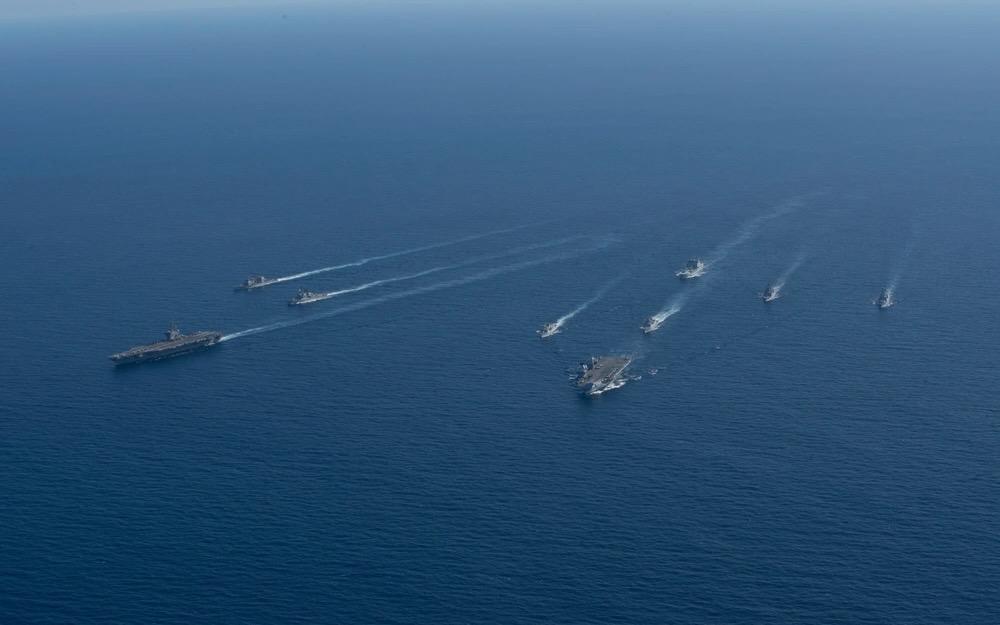
When Ukraine operations started, the J6 said, they employed “specifications from spiral (version) two or three [of the policy], and it’s matured ever since,” she said. “The same thing happened last year as the United Kingdom’s newest aircraft carrier, the HMS Prince of Wales, traversed four of our combatant command AORs.”

If you have not seen that publication, I would familiarize yourself with that if you are trying to come to us from an MPE perspective.
The HMS Prince of Wales was part of a multinational carrier strike group, with different partners “coming and going” from the operations as the international navies and militaries traversed through each of the four AORs.
“They did that by having these standards and specifications,” Minks stressed.
Nick Creswell, who is the new portfolio acquisition executive, director of MPE at Defense Information Systems Agency, also confirmed that part of that future CIE architecture for MPE, and the close work with our allies and partners, requires this standardization use.
“We have shifted the mentality,” Creswell noted. “This is not all about building a set of infrastructure; it is not about building networks like we used to. We have taken an application-first, data-centric approach to the work that we're doing to build that resilient coalition edge with the mentality of our mission partners. And they get a vote in everything that we do.”
He also urged the defense industrial base companies that want to provide MPE tools and services through DISA to really understand the ACP 240 policy.
“We can architect for the future, we can build the environment, but it really takes the community to be able to do that,” he confirmed. “For a lot of the things, we are basing everything that we do on standards. I'll reiterate it here. Allied Communication Publication 240. If you have not seen that publication, I would familiarize yourself with that if you are trying to come to us from an MPE perspective.”
Also important are Federated Mission Network specifications and NATO’s so-called STANAG policies, Creswell stressed.
The Standardization Agreement (STANAG) is a NATO standardization document that specifies the agreement of member countries to implement a standard, applying to technical specifications for equipment and communications technology.
“We fight with our allies and partners,” Creswell said. “The only way that we are able to ensure that the data gets from where it is to where it needs to be is through a lot of the hard work that we just talked about here, especially as we build out that underlying information system.”
TechNet Cyber is organized by AFCEA International. SIGNAL Media is the official media of AFCEA International.

Comments