
Planning for Heavy Rain
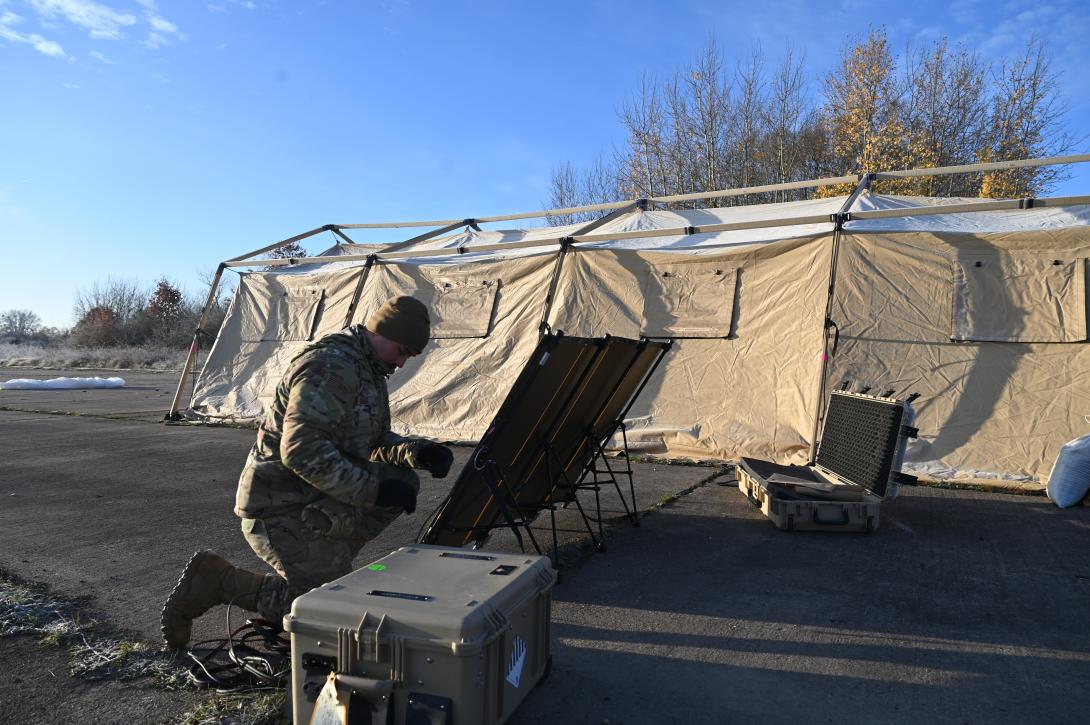
Exercising in a contested environment takes work. For European operators who usually have several communication options and a reliable transport layer, creating a contested world so they can experience and learn what an adversary might bring requires deft planning and well, time, leaders from Ramstein Air Base, Germany, said.
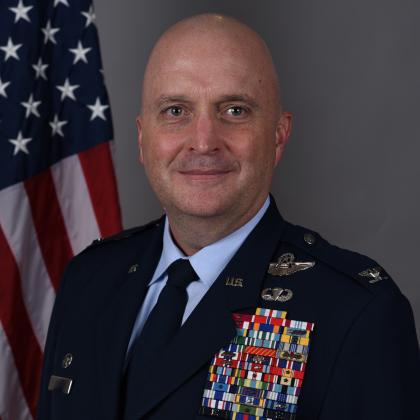
For the Heavy Rain 25 Exercise, held across several locations in Europe between November 11-22, the planning produced a crucial event, said Col. Leland K. “Holie” Cowie, USAF, commander of the 435th Air Ground Operations Wing (AGOW).
“For me, the big takeaway is, this is the only place I think in the Air Force where this is occurring,” the wing commander explained to SIGNAL during a December 2 visit at Ramstein with several leaders.
And impressively, Heavy Rain, is planned, hosted and executed all from a squadron level by the 1st Combat Communications Squadron, Cowie noted.
Air Force leaders saw the need several years ago for an exercise that tested the ability of warfighters to establish and maintain agile communications in contested and degraded environments, including the degradation or loss of network, command and control, ultra high frequency and very high frequency, and other connections.
Leaders’ recognition of the adversarial operations in Ukraine since Russia’s invasion in 2022 only spurred the Air Force further to adjust how airmen and other warfighters prepare for operations in a contested environment. And since the exercise began six years ago, it has only grown in scope and scale, with joint and allied partners participating.
This year, the squadron hosted joint partners, including the U.S. Army 44th Expeditionary Signal Battalion, and allies, with events at Ramstein and Landstuhl, Germany; Grostenquin, France; and Chievres Air Base, Belgium.
The Air Force’s 37th Airlift Squadron, from the 86th Airlift Wing, provided critical air support, according to Capt. Amber Kelly-Herard, from the 435th AGOW public affairs, in a December 10 report about the event.
Heavy Rain 25 also featured the Air Force’s agile combat employment (ACE) operations and mission assurance, on top of the C4 elements of command, control, communications and computing. Additionally, the event included intelligence and special operations units.
“The first iteration started in 2019, and really it is a squadron-up exercise,” noted Col. Scott A. Weed, USAF, commander of the 435th Communications Operations Group. “The realization largely from events happening east of us back then was that we were not going to survive a modern battlefield. Now a lot of that is from the contested communications, electronic warfare standpoint. But there was a realization that just to be ready and harder to kill, we needed to change how we got our airmen ready.”
The lead planners for Heavy Rain 25 began with a concept development phase, said U.S. Air Force Lt. Col. Melanie Strodtman, commander of the 1st Combat Communications Squadron.
“We projected about a year out, assigned the lead planners and then allowed them to develop the concept and identify their supporting team,” Strodtman explained. “A lot of it at that point was trying to provide them with the resourcing that they needed to bring this into fruition. As it got closer, we followed a deliberate planning cycle with the initial, the mid and the final planning events to bring in all of the various participants and make sure that we were capturing the objectives and deliberately establishing the desired learning objectives.”
For Maj. Sean Miller, USAF, director of operations for the 1st Combat Communications Squadron, the higher objectives for Heavy Rain 25 expanded the primary training audience beyond the squadron and the 435th AGOW.
“From my level, it was ensuring that we had the right people and the right level of priority,” he said. “The level of ambition for this iteration, which is the fifth iteration we have executed, was significantly higher than the last Heavy Rain [23] and certainly higher than the first couple. We were prompted to expand the players ... and that brought more people to the table than in the past.”
The wing commander emphasized that it is the elements of the 435th Communications Operations Group—of which the 1st Combat Communications Squadron is a part—that helped to enable the unique event.
“It is partly because Col. Weed’s organization is the only organization, when you look at our capabilities and communications, where they reside all in one organization,” Cowie said.
Given that Heavy Rain 25 featured full-spectrum contestation—including satellite communications, line of sight and cellular communications—the squadron’s planning team spent 8-10 months just obtaining the permissions and access to frequencies.
The planners orchestrated complex effects that did not just go straight to denial or jamming, the leaders said.
“Then, we also had cyber effects that were sprinkled in,” Weed said. “It was a broad and precise electronic warfare and cyber portfolio. And to my knowledge, it is the furthest we have been able to push the effects on.”
The resulting construct set airmen up to really go through primary, alternate, contingency and emergency (PACE) communication alternatives and the associated techniques, tactics and procedures—instead of simple white-card motions, Cowie noted.
“Before, you would say, ‘Well, it might be contested, but it is all white-carded. The adversary might do this and then we might have a workaround,'” the wing commander explained. “What was neat for me about Heavy Rain is that this is the first time we put all those lightning bolts raining down on someone for real. And it forced them all through a PACE plan.”
For me, the big takeaway is, this is the only place I think in the Air Force where this is occurring.
The orchestration was an art from, Weed continued, especially with airmen performing multiple duties.
“Naturally, having less humans to work with when it comes to the actual teams that are going to be on the chess board, taking from an organic base operating support standpoint, that is an entirely different layer of complexity on moving and setting the force, which they did phenomenally,” Weed said.
The event involved convoys with “significant amounts” of cargo that were transiting multiple border crossings.
“There is a lot of paperwork and gates you have to make,” Weed shared. “And when you are going do any of these exercises, there are satellite requests, frequency requests, things that take months.”
In addition, the longest U.S. federal government shutdown of 43 days in October and November also presented a challenge.
“There was a bit of uncertainty with the shutdown in terms of if everything would be able to proceed,” Weed added. “But fortunately, the command saw it as an accepted activity, even if the shutdown persisted. They saw the value and the impact, I think, for the Air Force and Joint Force. It just takes a long time to pull something of that scale together.”
All in all, the leaders said this year’s event successfully reflected Heavy Rain’s growth as a theater exercise with joint and allied presence.
“This past year, we have had [different] elements, not just communications,” Cowie noted. “This includes command and control elements, intelligence, special operations and flying units. We really had a diverse set of missionaries and threads that came together, and each one really got to get after their own training objectives.”
“To me, it was a phenomenal success,” he said.
This article is the first in a series from SIGNAL about the Heavy Rain 25 exercise.
Comments