
The U.S. Army’s Next Generation Command and Control Is ‘Ready,’ Leader Says
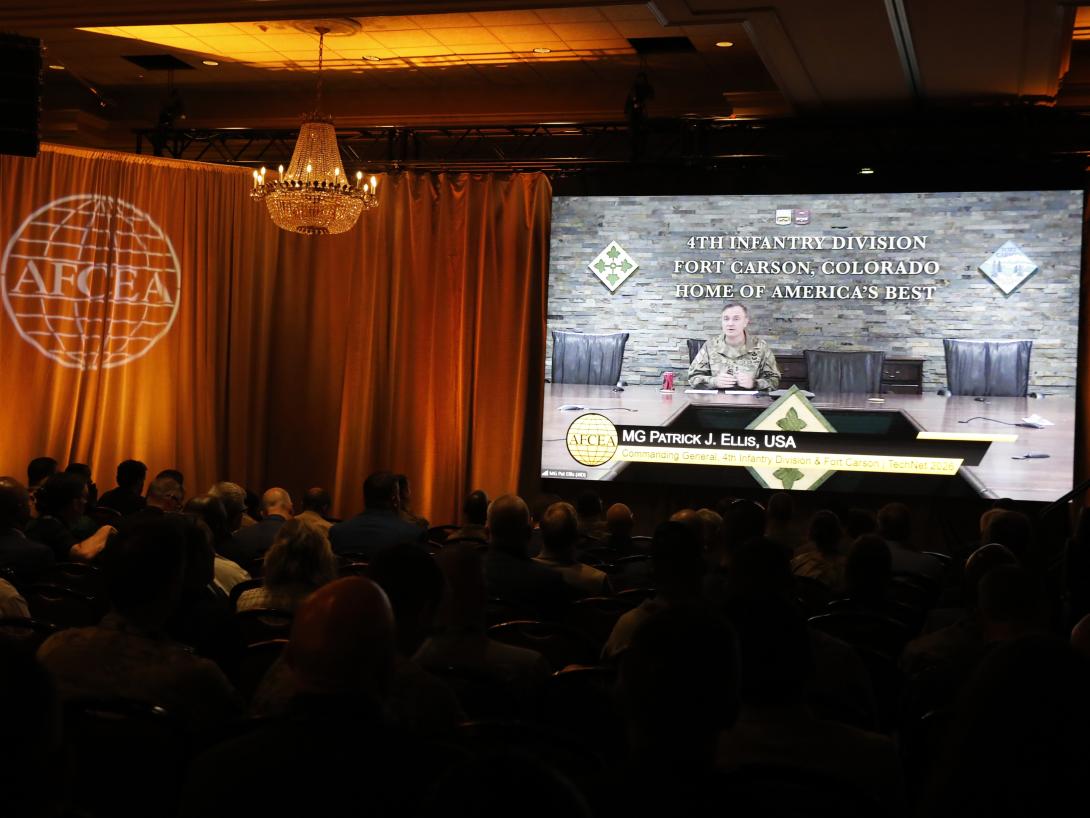
The U.S. Army’s advanced command and control architecture is “ready, but not done,” says Army Maj. Gen. Patrick Ellis, the commanding general of the Fourth Infantry Division and commanding general of Fort Carson.
The service’s Next Generation Command and Control, or NGC2, is a planned digital architecture to move data with high-speed Internet Protocols through various waveforms and harness commercial technology and 5G communications.
The general spoke via a video feed today at AFCEA International’s TechNet Augusta, held in Augusta, Georgia, August 17-20.
“When folks ask, ‘What's the status of NGC2?’ I would say it's ready but not done, or I would say it's functional but not optimized,” Ellis emphasized. “We learned a lot of lessons. There are some things we need to continue to fix and things we need to continue to prepare.”
For the NGC2 capability, the Army is tackling command and control modernization across four different tiers, including the transport, integration and infrastructure layer, data layer and the application layer, Ellis noted.
“It is a four-tiered problem, and the way I would talk about it now, I'll start at the bottom, the transport layer,” he said. “That is how you move the ones and zeros. That is how you communicate. That’s where the radios live. The next layer up, I frequently call the integration layer. I think that's something that the maneuver force understands better, but really it's also described as the infrastructure layer. That's the layer where all of the different feeds, the disparate data, all comes into one location. All that ends up in that infrastructure or integration layer, which then gets into the data layer, which is the third layer.”
The fourth layer, the application layer, is one of the most important aspects for soldiers, Ellis confirmed.
The general took command of the Fourth Infantry Division (4th ID) at Fort Carson in June 2025 and has spent the last 10 months leading the prototyping of NGC2.
Originally an infantry officer from the U.S. Military Academy with multiple deployments, Ellis previously led the cross-functional team at Army Futures Command. This tactical innovation experience is helping to inform the advancements of NGC2, and the general is emphasizing an iterative approach as the key to their success.
The prototyping, soldier-focused process was not without its challenges, he said. Fourth ID had to adjust to having fewer brigades around, given the Army’s deployments to the Southern border and the Middle East.
“A lot of our brigades were gone,” he noted. “I had guys at the Southern border, guys forward at CENTCOM [U.S. Central Command]. We were scattered around. Really, the division headquarters set the architecture, and then we worked on every iteration, pushing that at every event we did.”
This included harnessing an old fires exercise, called Ivy Sting, to advance NGC2 quickly through iterations every other month. The approach was to integrate the architecture into existing training schedules.
“We used to run one [Ivy Sting] a year here in the division,” Ellis explained. “We realized these were going to be great events for us to kind of ramp up to. We did five iterations of that. So essentially, every other month for 10 months, we did a Sting series.”
Beginning with Ivy Sting IV in February, the soldiers ran a series of mission threads to various test warfighting systems and command post activities in live-fire events, according to an April 20 report from Command Sgt. Maj. Waylon Petty, 4th ID and Fort Carson.
The series especially helped with those important applications and use cases for the soldiers supported by the application layer. This included applications for different command and control, tactical communications and decision-making, and other operational activities across both unclassified and classified enclaves.
“The applications were what the soldiers were looking for, and that's where we want most of the soldiers to spend their time, in the application layer, not having to fight the data layer, or certainly not having to fight the transport layer,” Ellis stated.
During the prototyping, the 4th ID also made sure to bring in the private sector during Army events they called “Solution Summits.”
“We’d spend the entire day together, just kind of circling the drain on problems, saying, ‘Hey, look, here's an issue that we are having here at the Fourth Infantry Division inside of NGC2,’” Ellis said. “‘Hey, industry teammates, what do you have that can help? How can you contribute to helping us get ourselves a better [solution] or a fix for these problems?’”
The Solution Summits have been fruitful, the general said, and advised those with command and control or other capabilities to take note and get involved.
“They have been very beneficial,” Ellis stated. “In fact, we have onboarded several vendors as a result of them participating in the Solution Summits to get us where we needed to go.”
The iterative process for the NGC2 capabilities culminated at the military’s latest Project Convergence-Capstone 6 event at Fort Irwin, California, in July. The event, which began years ago as Army-only, is now a huge joint force, multinational event. And it was a great place to test the scale of the NGC2 architecture across the different units.
“It was about 8,900 people,” Ellis offered. “And the way that it was organized is we had our Armor Brigade Combat Team, our Stryker Brigade Combat Team, pieces of our Combat Aviation Brigade, pieces of our Division Sustainment Brigade, a Multinational Brigade, and then actually we had an additional battalion that we pulled in from one of the other formations.”
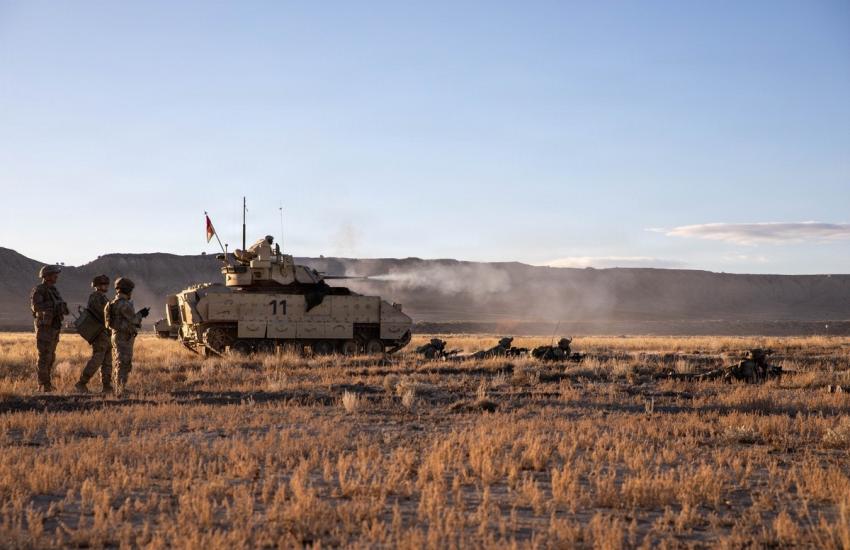
They were able to see immediate gains from the NGC2, both in terms of battlefield awareness, more data and fires processing times, the general said.
“[The NGC2] provided a 60% increase in the volume of fires that [the leader] saw,” Ellis shared, speaking about a command post leader’s experience with the NGC2. “He doesn't exactly know why that was, but I know why. A lot of it had to do with our ability to target and our ability to use the data more effectively. We saw a 60% increase in the volume of fires that he had coming at him. That was 30% by brigade. And I tell you that having the division enabling the fires flow there for us, I think, was an effective way to approach this. Our processing time was down under four minutes per target, which was a pretty aggressive timeline for us.”
Additionally, the 4th ID was able to build more applications to test and use at the Project Convergence events, Ellis continued.
“The application numbers have grown,” he said. “I think we were at eight for PC-C5, and at PC-C6 we were in the 30s or 40s. I would say that's split between IL [Impact Level] 6, the secret version, and IL5, the sensitive but unclassified version.”
Now the 4th ID is preparing to leave for Super Garuda 2026 in Indonesia, to bring NGC2 in a “theater-first” initiative, where soldiers will exercise and integrate the new command and control architecture with joint and coalition tactical systems.
The integration process involves tactical and operational communications, data pathways and ISR, or intelligence, surveillance and reconnaissance feeds, that all support unified, multidomain operations.
To prepare for this integration, 4th ID worked with U.S. Indo-Pacific Command and its J7 Pacific Multi-Domain Training and Experimentation Capability to lay the groundwork for integrating the emerging command and control technologies across some of the most austere training environments in the world, working with U.S., Indonesian, regional allies and partners, according to a report from the command’s public affairs.
“We are getting geared up here to take NGC2 back into the Pacific now,” Ellis said. “We fly out on Sunday with NGC2 aboard a couple of C-17s and some Strykers as we fly into theater to start working on Garuda Shield there in Indonesia.”
Ellis also confirmed that NGC2 will be part of Project Convergence-Capstone 7 next year.
“We were recently informed at the back end of PC-C6 that we are going to carry this through, and we'll run this through PC-C7,” the general stated. “However that looks as we design that out, we are going to continue the same effort.”
“But I think we're in a good place now, and I'm looking forward to seeing where we can go over the next year,” Ellis concluded.
TechNet Augusta is organized by AFCEA International with help from the U.S. Army Cyber Center of Excellence. SIGNAL Media is the official media of AFCEA International.
Comments