
U.S. Needs Much More To Defeat the Drones
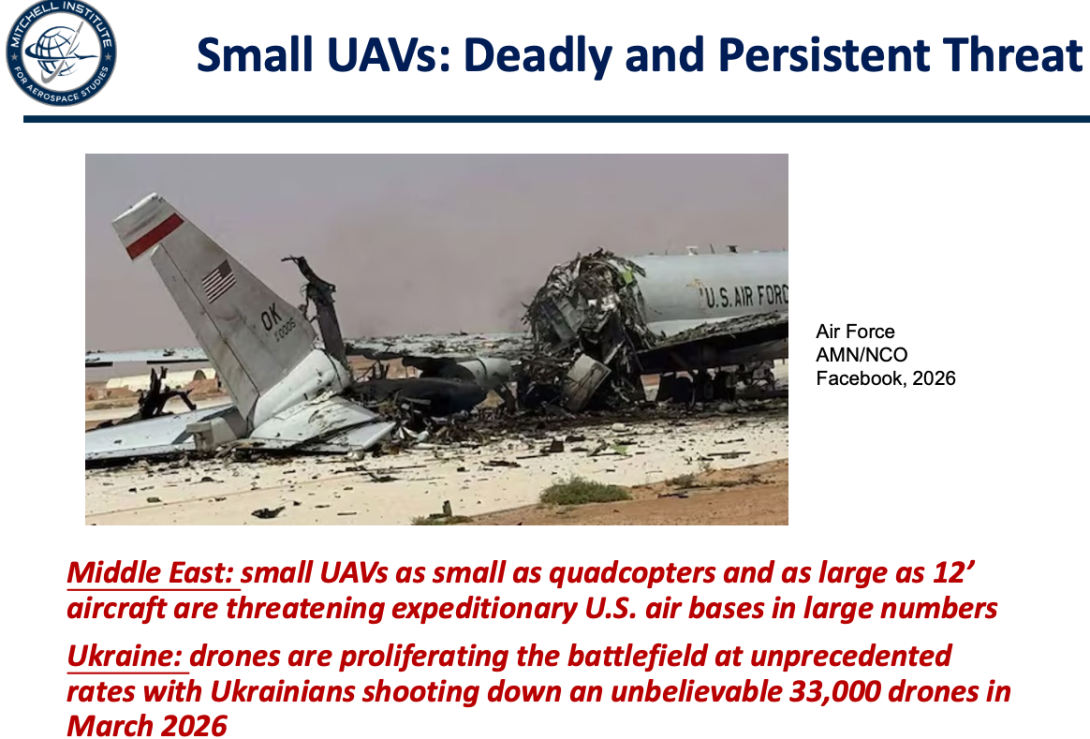
The United States is at great risk against drones in expeditionary operations abroad—as well as at home—said Brig. Gen. Houston Cantwell, USAF (Ret.), senior resident fellow for airpower studies at the Mitchell Institute for Aerospace Studies.
“Small uninhabited aerial vehicles (UAVs) present a rapidly evolving and proliferating air threat to expeditionary air bases and fielded forces,” Cantwell said in the forthcoming study, Defeating the Drones: The Airman's Imperative to Defend from Small, Uninhabited Aerial Vehicles. “Because of their rapid innovation cycles, massive numbers, low-altitude flight path and varied physical characteristics, small UAVs can circumvent traditional air defense systems.”
Cantwell and other Mitchell Institute senior leaders presented their findings to the media at the institute and the Air & Space Forces Association’s headquarters in Arlington, Virginia, on Wednesday.
The leaders advised that a combined approach, which would include sophisticated point defense, offense, the ability to survive and operate while being attacked, and proper management of the radio frequency spectrum, is needed now.
The attacks on U.S. forces over the last six months in the Middle East during Operation Epic Fury have illustrated the lethality of unmanned aerial vehicles, especially small UAVs, the leaders said.
“It is so important that the Air Force really prioritizes some of these efforts, or our projection of military power is in jeopardy,” Cantwell noted. “We have seen that in current operations.”
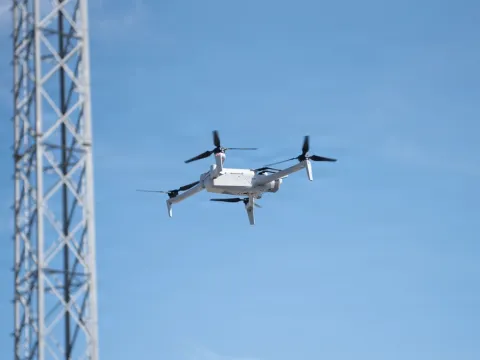
Adversaries are making small UAVs from carbon fiber, Styrofoam, metal, polymers and wood. They are propelling them with gasoline, diesel and battery/electricity and controlling them through cell phone towers, the radio frequency (RF) spectrum or fiber optics. “That makes them difficult to stop with any single effector, and it makes them very difficult to detect with any single radar or sensor,” Cantwell emphasized.

It is so important that the Air Force really prioritizes some of these efforts, or our projection of military power is in jeopardy. We have seen that in current operations.
By flying low, the drones can evade traditional air and ground defenses. Also, the sheer number of drones coming in at one time would flummox traditional systems, at a considerably asymmetric cost.
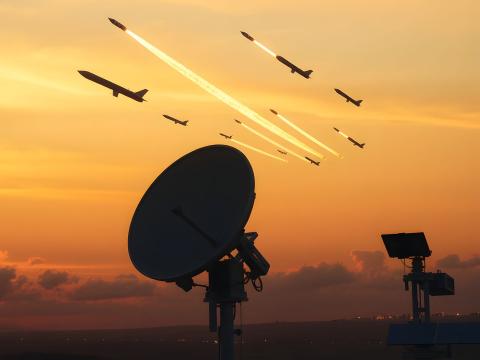
“We are now looking at aircraft that are coming in the 100s to 1,000s,” Cantwell told the reporters. “We just do not have the mass arsenal of weapons to be able to stop all these aircraft. Throw on top of that, that a THAAD [terminal high-altitude area defense] missile is $10 million a piece. A small drone, the quadcopters are $1,000. The ScanEagles [MQ-27] are $50,000. That cost differential is something that has to be taken into account as we look into how we solve this problem with the small drones.”
For the U.S. Air Force, the retired brigadier general said, this means a need to pivot the culture, for airmen operating around the world to understand that they are under constant threat and no longer protected at a base or during operations.
The familiar “take shelter,” response to bombs of the past will not work with this new-age threat, with drones flying for hours, he said.
“[With] the binary nature of air defense for the last 20 years, if a missile was coming inbound, an alarm went off, and everyone stopped what they were doing,” Cantwell said. “You hid in a bomb shelter for 10-20 minutes, and all clear is given, and then everyone resumes work again. With small UAVs, it is a more persistent threat. You may have small UAVs in the area for a handful of hours at a time, and it is no longer possible to take all of your airmen and put them in a bomb shelter for hours to half a day at a time. You would paralyze the production of aircraft and stop everything that we have talked about when it comes to the projection of airpower.”
In addition, traditional stocks of personal protection equipment, or PPE, are not enough to protect warfighters. This may not have been an issue before, as not all airmen were forward deployed or at risk on base, even in a host country.
“Do we have enough Kevlar vests for everybody on the flight line?” asked Col. John Venable, USAF (Ret.), senior resident fellow at the Mitchell Institute and former command pilot. “That's one question, because we did not deploy everybody before. We had many people who didn't have Kevlar vests, who didn't have mobility bags on bases before. Now, if everybody's fighting and everybody needs a Kevlar vest, how many Kevlar vests do we have?”
Additionally, more personnel need to be trained in the ATSO concept, or the ability to survive and operate. It is a concept that has not been discussed for 30 years but is needed now, Cantwell noted.
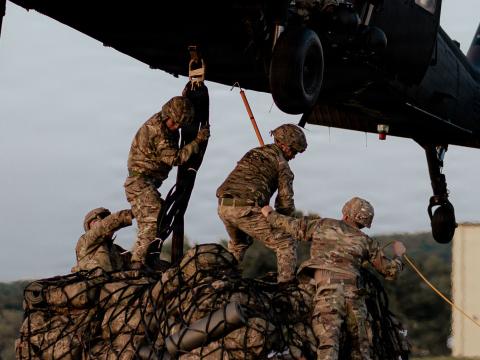
“We need airmen trained to be able to operate in that kind of environment,” he explained. “We do have airmen that understand this challenge. They are generally in the AWACS [airborne early warning and control force] on a crew, so they are weapons directors, or they are air battle managers. They have the great skill sets. We just don't have enough of these airmen to be able to man all of our air bases at one time. We know how to do it. We just need to scale this.”

We had many people who didn't have Kevlar vests, who didn't have mobility bags on bases before. Now, if everybody's fighting and everybody needs a Kevlar vest, how many Kevlar vests do we have?
Overhaul of the military’s base defense operation center structure is “absolutely crucial,” Cantwell noted. This means revamping point defenses, providing additional sensors and integrating command and control.
“As a first step, the U.S. Air Force must fully resource air base point-defense systems into reconceptualized USAF command and control structures, complete with new training for the airmen responsible for performing this critical mission and those expected to perform their regular duties while under small UAV attack,” Cantwell stated in the report.
This includes sophisticated—and industry-available—multispectral sensors.
Although the study focused on expeditionary operations overseas, the threat to bases at home stands. Safety at bases has already been challenged, with two incursions at Langley and Barksdale, the leaders noted.
The leaders acknowledged that the scale of change is “massive,” but necessary, and one that the Air Force needs to fund specifically.
“The question we consistently get is, ‘OK, so this is a new mission, it is unfunded, and what are we going to cut to make it happen?’” said Heather Penney, the Mitchell Institute's director of studies and research. “The Air Force has got to stop saying, 'What are we going to cut?’ They need to start saying, 'We need more funding. We need more resources.’”
Penney said the Air Force has led several U.S. military missions over the past three years and needs more funding to tackle its operations.
“It is time for Congress and the Department of War to provide the resourcing to the Air Force, not only to get healthy, but to begin to expand its mission areas,” she stated.
“If we look at how the United States has projected power, it is on the backs of our airmen, and the key node over the last 30 years has been the air base,” Cantwell said. “If an American soldier has set foot on a foreign land, they have had American airpower overhead, and that is because they were generated from air bases in distant lands. And the thing that we have taken for granted over the last 30 years is that those air bases would be secure and safe. The aircraft would be able to launch freely and able to be recovered at that same base. That is something that we cannot take for granted anymore."

The Air Force has got to stop saying, ‘What are we going to cut?’ They need to start saying, ‘We need more funding. We need more resources.’

Comments