
USCG Looking To Train Crew for Increased Arctic Operations
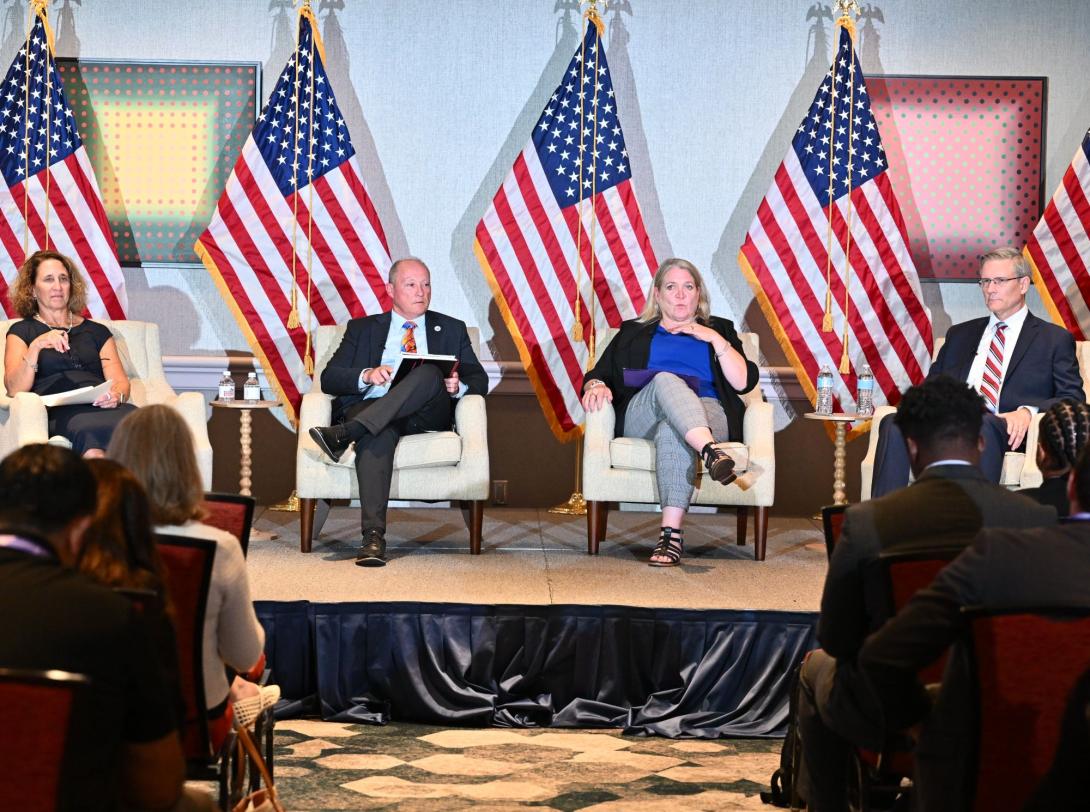
As Arctic activity ramps up, the U.S. Coast Guard (USCG) looks to enhance and increase operations in the region, requiring more resources and trained crew.
“Help us help ourselves help you in getting our crews prepared to operate in that environment,” Shannon Jenkins said during a panel discussion at the 2026 Intelligence & National Security Summit in Bethesda, Maryland.
Jenkins currently serves as the senior Arctic policy advisor for the USCG Polar Coordination Office, or CG-PCO. He was joined on stage by fellow panelists Sue Kalweit, owner of Vector Insights Consulting LLC; Vice Adm. Peter Gautier, USCG, (Ret.), president of Gautier Consulting LLC; and Maj. Gen. Connie Jenkins, USAF (Ret.), former director of logistics and engineering at North American Aerospace and Defense Command and U.S. Northern Command.
There are currently three polar icebreakers deployed: Polar Star, Healy and Storis. Healy, having gone through several major disruptions in recent years, is currently in Seattle undergoing repairs. Over the next decade, Jenkins said, the USCG is expecting 14 new icebreakers.
“That’s a lot of crew that we need to train and be prepared to operate in that austere environment,” he said of the Arctic region, noting that the current three icebreakers do not create enough room for training at the needed scale.
Novel ways of training are required, he stressed.
“We’re working with some of our partner nations, Canada and Finland in particular, doing crew exchanges. Norway is part of that as well,” Jenkins said.
Additional efforts are underway.
The Icebreaker Collaboration Effort U.S. National Workforce Development Plan, commonly referred to as the ICE Pact, published in November 2025, is primarily focused on shipbuilding and is “also about how we’re going to be training our crews being up there.”
“You can’t just take crew off of a ship down in Miami and put them up in the Arctic and expect them to be effective and efficient. It’s challenging,” Jenkins said. “Not just the ice, the wind, the fog . . . it’s so thick, and you cannot operate very effectively up there when you’re in those heightened conditions if . . . you don’t have some type of experience in that realm.”

We’ve got multilateral engagements, bilateral engagements that we have to be able to use, including engagements with the indigenous population, and we’ve got a very austere living environment where you’ve got to bring your own infrastructure.
Increased presence—commercial and military—in the region is making training more crucial than ever, which is where industry can step in, Kalweit added.
“We’ve got to do some training. We’ve got a harsh environment, weather-wise, to operate in. We’ve got multilateral engagements, bilateral engagements that we have to be able to use, including engagements with the indigenous population, and we’ve got a very austere living environment where you’ve got to bring your own infrastructure,” she said.
Kalweit therefore encouraged industry to think about building games and simulations to train forces to successfully operate in the Arctic environment.
The 2026 Intelligence & National Security Summit is co-hosted by AFCEA International and INSA. SIGNAL Media is the official media of AFCEA International.
Comments